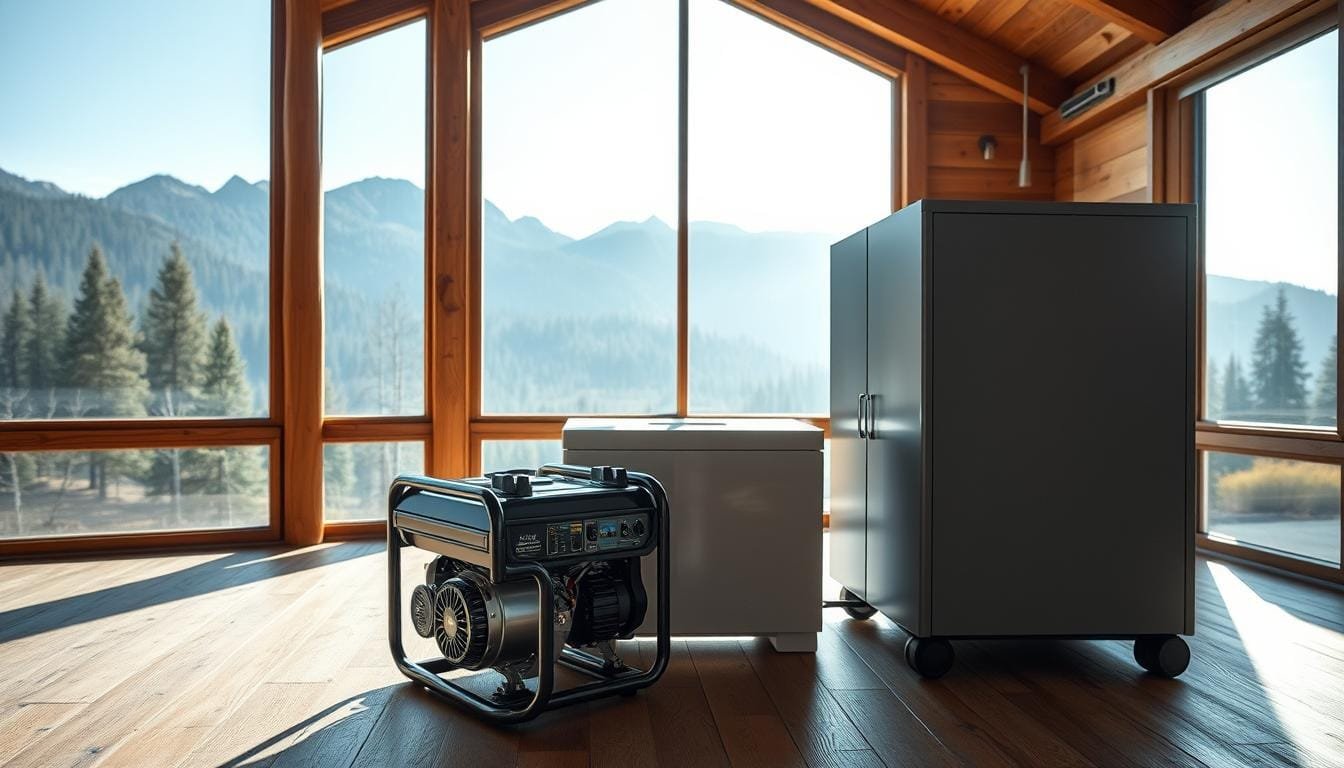

Having reliable power is key for remote property owners. 84% of Americans worry about power outages, says EnergySage. Whether for weekend trips or full-time living, backup power is a must.
Before, many used propane and diesel for power. But now, more are choosing off-grid power solutions. These include modern storage systems that are cleaner and quieter.
Choosing between generators and batteries is more than just for emergencies. You must think about costs, upkeep, and if it saves money all year. This guide will help you understand renewable energy systems for cabins. The best choice depends on your needs, how you use it, and what matters most to you.
Understanding Your Cabin’s Power Requirements
Every cabin has its own energy needs. This decides if you should use a generator or a battery system. Knowing your cabin energy consumption is key before buying equipment.
Getting your electricity needs right is important. You don’t want a system that’s too small or too big. This can save you money.
Calculating Daily Energy Consumption
Start by making a list of all your cabin’s appliances and devices. Note each item’s wattage from labels or manuals. Then guess how long each runs daily.
It’s important to know the difference between watts and watt-hours. Watts show power at a moment, while watt-hours show energy over time. For example, a 100-watt bulb for 5 hours uses 500 watt-hours.
To find kilowatt-hour usage, multiply each appliance’s wattage by its daily hours. Then divide by 1,000. Add these numbers to find your daily total. The average home uses about $150 a month on electricity, which helps set a baseline.
Here’s a simple list of common cabin appliances and their power use:
| Appliance | Wattage | Daily Usage | Daily Energy (kWh) |
|---|---|---|---|
| LED Lighting (5 bulbs) | 50W | 6 hours | 0.3 kWh |
| Refrigerator | 150W | 24 hours (cycling) | 1.8 kWh |
| Water Pump | 750W | 1 hour | 0.75 kWh |
| Space Heater | 1,500W | 4 hours | 6.0 kWh |
| Laptop & Phone Charging | 100W | 5 hours | 0.5 kWh |
Identifying Peak vs. Average Power Demands
Understanding power demand calculation is more than just daily totals. Your system must handle peak loads when many appliances run at once. This is key for proper sizing.
You might use only 1,500 watts daily, but need 5,000 watts at peak times. This is when your well pump, water heater, and coffee maker all turn on. Your system must meet these peak demands, not just average use.
Think about real scenarios in your cabin. Using power tools while the fridge cycles on creates sudden spikes. Starting an electric water heater uses a lot more power than keeping it warm. A 13.5 kWh battery like the Tesla Powerwall can power your cabin for a few hours, but only if your peak demands don’t exceed its capacity.
Make a list of appliances that might run together during busy times. Add up their wattages to find your true peak requirement. This number will help decide between a generator or battery system.
Accounting for Seasonal Variations
Your cabin’s seasonal energy needs change a lot throughout the year. Winter months need more power for heating and extra lighting. Summer brings cooling needs and more visits.
Heating is the biggest seasonal change for most cabins. Electric space heaters use 1,500 watts or more. Wood stoves need fans that run all the time. Summer cooling with fans uses much less energy than winter heating.
How often you use your cabin also affects energy needs. Weekend getaways use less energy than month-long stays in summer. Some cabins need power all year, while others only in good weather. These patterns should guide your system choice and planning.
What Is a Generator and How Does It Work?
A generator turns fuel into electricity in a simple way. It’s like the opposite of an electric motor. Instead of using electricity to move, it uses movement to make electricity. This technology has been used for years in remote cabins and backup systems.
Learning how generators work shows why they’re great for power. They use many systems together to give you electricity when you need it.
Converting Fuel to Electricity
The mechanical energy conversion starts with an engine like a car’s. When fuel burns, it makes the engine spin. This spinning is key to making electricity.
The alternator has wire coils that spin in a magnetic field. This spinning makes a voltage difference. This difference pushes electrons through the circuit, making electricity.
A voltage regulator keeps the electricity steady. Without it, lights might flicker and electronics could break. The cooling and lubrication systems also help the generator work well.
Fuel-powered generators can run for weeks without stopping. They’re great for long power outages or when you need electricity for days.
The whole system works together well. Fuel goes to the engine, combustion makes it spin, and the alternator turns that into electricity. Systems keep the output stable. This cycle has been improved over many years.
Choosing Your Fuel Type
The fuel you choose affects costs and maintenance. Standby generator basics include picking the right fuel for your cabin. Each fuel has its own benefits.
Natural gas is convenient if your cabin has access to it. You won’t run out or need to refill tanks. But, only about 70% of U.S. homes have natural gas, and most cabins don’t.
Propane is the most popular for off-grid cabins. It stores well, burns cleanly, and starts in cold weather. You’ll need to refill tanks, but propane delivery is common in rural areas.
Diesel fuel gives a lot of power per gallon. Diesel generators are durable and efficient. They store well and are less risky than gasoline. But, they cost more and can be louder than propane.
Here’s how these fuels compare for cabins:
| Fuel Type | Availability | Storage Requirements | Maintenance Needs |
|---|---|---|---|
| Natural Gas | Limited to areas with utility access | No storage needed | Low – clean burning fuel |
| Propane | Widely available with delivery service | External tanks (100-500 gallons typical) | Low to moderate |
| Diesel | Available at most fuel stations | On-site tanks with stabilizer additive | Moderate – regular oil changes needed |
Your location helps choose the best fuel. Most cabins without natural gas use propane. If you need a lot of power, diesel might be better, even though it’s more expensive.
Think about winter access too. If snow makes deliveries hard, big propane tanks or diesel storage are good. Some people use both propane and diesel, depending on needs.
Choosing the right fuel balances availability, storage, and power needs. Planning now helps your generator work well when you need it.
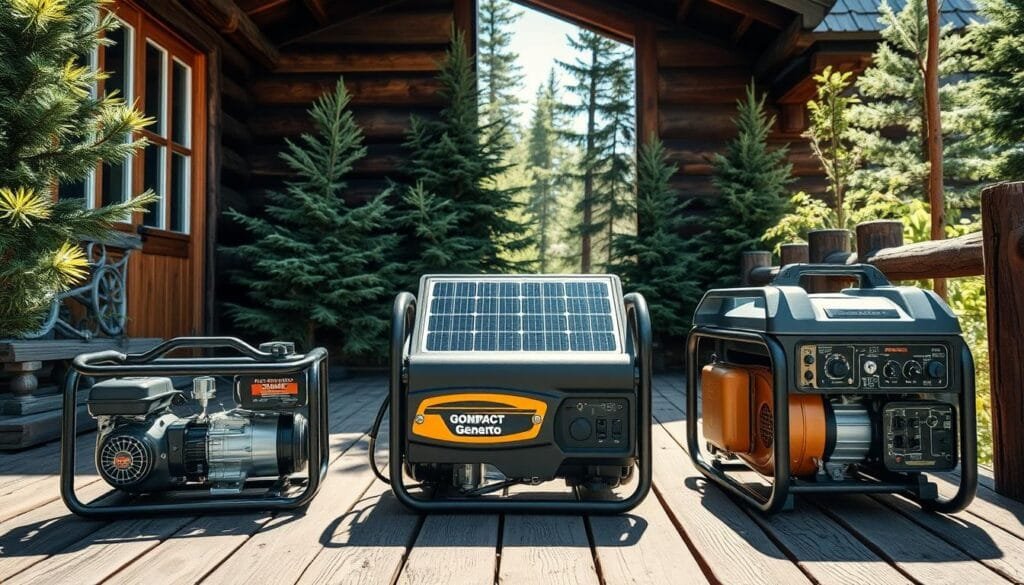
Types of Generators for Cabin Use
The generator market offers many fuel types and configurations for cabin owners. Each style has its own advantages for different needs. Knowing the differences helps you choose the right power solution for your cabin.
Generators make sounds from 50 to 80 decibels. A 50-decibel generator is as quiet as a fridge. An 80-decibel one sounds like a garbage disposal. Standby generators cost about $9,000, including installation. Prices range from $4,000 to $25,000 based on size and fuel type.
Portable Gasoline Generators
Portable gasoline generators are the most affordable and common choice. You can find them at hardware stores, home improvement centers, and online. Basic models start at around $300.
These generators are great for occasional use and emergency backup power. They’re easy to move, simple to use, and parts are easy to find. Most models have 2,000 to 7,500 watts, enough for basic cabin appliances.
But, gasoline generators have some downsides. Gasoline goes bad in three to six months if stored. You need fuel stabilizers or often change the fuel. They use more fuel than diesel and are louder than inverter models. For occasional visits, they’re fine.
Diesel Generators
Diesel generators are durable and fuel-efficient. They can run long and handle big electrical loads. Commercial-grade diesel units can last 20,000 to 30,000 hours with good care.
Diesel generators use about 30% less fuel than gasoline ones. This is a big plus for cabins needing power all season. They’re great for cabins with high power needs or year-round use.
Diesel fuel lasts longer than gasoline, up to 12 months without additives. But, they cost more upfront (usually $2,000 to $15,000) and need more maintenance. Starting them in cold weather can be hard without heating systems. For cabins needing lots of power, diesel generators are a good choice.
Propane Generators
Propane generators are often the best choice for remote cabins. Propane doesn’t spoil like gasoline, so you can store it forever. This makes propane great for cabins that sit unused for months.
Propane is also easy to get, even in rural areas. You can store a lot of it safely on your property. Many cabin owners already use propane for heating and cooking, making a propane generator a natural fit.
Propane vs diesel generators, propane burns cleaner and is quieter. But, it gives less power per gallon. Propane generators cost between $1,500 and $8,000, depending on size. They’re cleaner than gasoline and need less maintenance than diesel.
Inverter Generators
Inverter generators are the premium tier of portable power solutions for cabins. They produce clean electricity safe for electronics like computers and smartphones. They’re also very quiet, making them perfect for a peaceful cabin atmosphere.
Inverter generators are also fuel-efficient. They adjust engine speed to match power demand, not running at constant RPMs. This means they use less fuel and are quieter than traditional models.
They can also connect two identical units to double your power when needed. This flexibility lets you start with a smaller unit and add more power later.
The downside is their higher initial cost, ranging from $800 to $4,000. But, for those who value quiet operation, fuel economy, and protection for expensive electronics, inverter generators are worth it.
| Generator Type | Initial Cost Range | Best For | Noise Level | Fuel Storage |
|---|---|---|---|---|
| Portable Gasoline | $300 – $2,000 | Weekend use, emergencies | 65-80 decibels | 3-6 months |
| Diesel | $2,000 – $15,000 | Heavy loads, frequent use | 70-80 decibels | Up to 12 months |
| Propane | $1,500 – $8,000 | Remote cabins, long storage | 60-75 decibels | Indefinite |
| Inverter | $800 – $4,000 | Quiet operation, electronics | 50-60 decibels | Varies by fuel type |
What Is Battery Storage and How Does It Work?
Battery storage systems are like huge rechargeable batteries. They power your cabin during outages or when you need a lot of energy. Unlike generators, they store energy when it’s available and use it when you need it.
This method is different from using generators. Generators burn fuel to make electricity right away. But, energy storage technology saves power for later. This is great for using renewable energy or cutting down on fossil fuels.
How Battery Systems Store and Release Energy
Modern battery storage uses special chemistry to save electrical energy. Lithium Ferrous Phosphate (LFP) batteries are best for cabins because they’re safe and last long.
These batteries have three main parts: cathode, anode, and electrolyte. They work together to move lithium ions. When charging, ions go one way. When using power, they go the other way.
A computer controls everything with smart algorithms. It decides when to save and use energy. It keeps an eye on power levels and makes sure everything is safe.
This system works automatically. You don’t have to switch modes by hand. The system does it all based on your needs and available energy.
Connecting Batteries with Renewable Power Sources
Battery systems are great with solar panels or wind turbines. They capture renewable energy and store it for later. Many cabin owners use solar battery integration for reliable power in remote places.
Charge controllers manage the flow of energy from solar panels or wind turbines to batteries. They prevent overcharging and make sure energy is stored efficiently. These devices work well in all weather and power conditions.
Inverters turn stored DC electricity into AC power for your appliances. Modern inverters give clean, stable electricity. Your fridge, lights, and electronics work well on battery power.
The system works together seamlessly. When solar panels make extra power, batteries save it. At night or on cloudy days, your cabin uses stored energy. If you have grid access, batteries can store cheap electricity for later.
This setup is perfect for off-grid cabins. You don’t need constant sunshine or wind for power. Energy independence is possible with this balanced power management.
Types of Battery Storage Systems for Cabins
Battery storage systems have many types, each with its own benefits. They fit different cabin needs and budgets. Knowing about each helps you choose wisely, based on your energy use, maintenance habits, and green goals.
The right choice depends on your space, climate, and how often you visit. Let’s look at the main options for cabin batteries. We’ll see what makes each one good for certain situations.
Advanced Lithium-Ion Technology
Lithium-ion batteries have changed off-grid power storage. LFP battery systems (lithium iron phosphate) are the top choice for modern cabins. They perform well and need little upkeep.
LFP batteries are good for the planet. They’re light, versatile, and safe. They don’t have harmful metals like nickel and cobalt found in other lithium-ion batteries. This makes them safer and greener for long-term use.
The Tesla Powerwall has 13.5 kilowatt-hours of storage. It gives enough power for most cabins. Briggs & Stratton’s lithium-iron batteries are safe for homes, giving peace of mind.
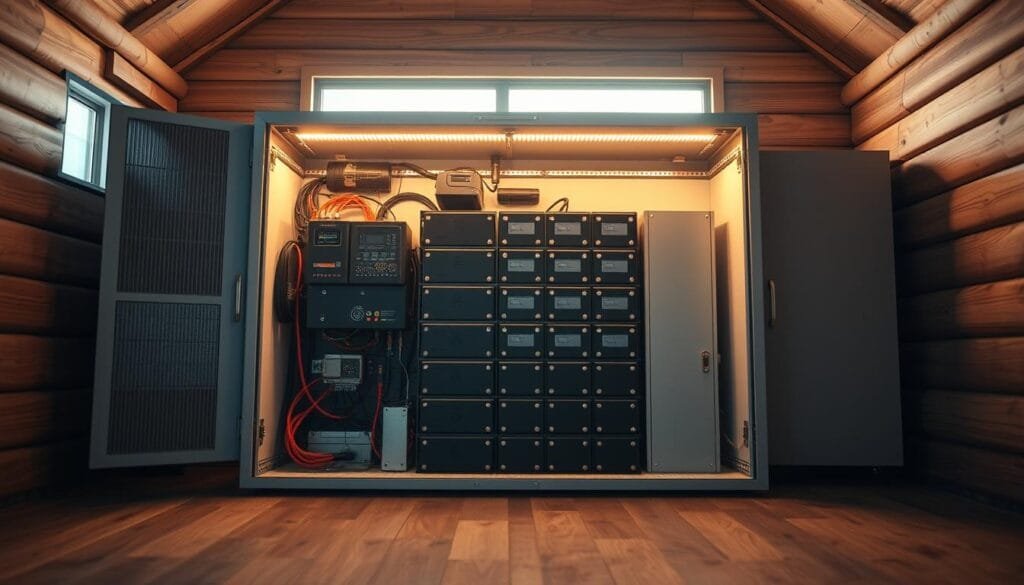
LFP batteries last a long time. They can handle over 10,000 cycles with 80% discharge. This means you can use 80% of the energy many times without harming the battery, unlike traditional batteries.
LFP batteries can go indoors or outdoors. They’re small and can grow with your needs. Modern home battery backup systems work well with solar panels and smart tech.
Traditional Lead-Acid Solutions
Lead-acid batteries are a cost-effective choice for those who like to do maintenance. They come in flooded (wet cell) and sealed AGM (absorbed glass mat) types.
Flooded lead-acid batteries are the cheapest upfront but need regular checks and special charging. AGM batteries don’t need this upkeep but cost more. Both types last 3-7 years, depending on how they’re used and cared for.
Lead-acid batteries can only be used up to 50% of their capacity. To keep them alive, you should only use half of what they can hold. This means you need to install twice as much capacity as lithium batteries.
Lead-acid batteries are heavy. This makes them hard to install and limits where you can put them in your cabin. But, they’re reliable and easy to find, making them good for some uses.
Emerging Saltwater Technology
Saltwater batteries are a new, eco-friendly option. They use saltwater instead of heavy metals, making them safe and recyclable.
The big plus is safety and being green. Saltwater batteries don’t catch fire and are free from harmful materials. They can be fully used without damage, giving you more flexibility than other batteries.
But, they’re not as dense as lithium or lead-acid batteries. You need more space for the same amount of power. They’re also more expensive and harder to find.
Saltwater batteries work well in extreme temperatures. They’re reliable in harsh conditions that might hurt other batteries. This makes them a good choice for cabins in tough climates.
Versatile Portable Power Options
Portable power stations are great for smaller cabins or extra power needs. They have everything you need in one package: battery, inverter, charge controller, and outlets.
They have capacities from 500Wh to 3,000Wh, perfect for small power needs. Brands like Jackery, Goal Zero, and EcoFlow offer models with solar charging, AC outlets, and USB ports.
They’re super convenient. You can move them around, store them, and use them instantly without setup. They’re perfect for seasonal use or as a backup to your main power.
But, they have smaller capacities and cost more per kilowatt-hour. For constant power or big appliances, they’re better as a supplement, not the main source.
| Battery Type | Lifespan (Cycles) | Depth of Discharge | Maintenance Level | Best Application |
|---|---|---|---|---|
| LFP Lithium-Ion | 10,000+ cycles | 80-100% | Minimal | Primary off-grid systems |
| Lead-Acid (Flooded) | 500-1,000 cycles | 50% | Regular maintenance | Budget-conscious installations |
| Lead-Acid (AGM) | 800-1,500 cycles | 50% | Low maintenance | Moderate-use cabins |
| Saltwater | 5,000+ cycles | 100% | Minimal | Eco-focused projects |
| Portable Stations | 2,000-3,000 cycles | 80-90% | None | Supplementary or seasonal use |
Each battery type meets different needs in cabin power. LFP systems are best for permanent off-grid needs. Lead-acid batteries are for those who want to save money and do maintenance.
Saltwater batteries are for those who care about the planet and safety. Portable power stations are great for small needs or temporary power. Your specific needs will help you choose the best battery for your cabin.
Initial Cost Comparison: Generator vs Battery for Cabin
Let’s talk numbers—what you’ll actually spend to get reliable power flowing to your cabin. The backup power investment differs significantly between generators and battery storage systems. Understanding these costs upfront helps you plan your budget realistically. While both options deliver dependable electricity, the price tags tell very different stories.
Your choice affects not just your wallet today, but your financial commitment for years to come. We’ll break down exactly what you’ll pay for equipment, professional installation, and the extras you might not have considered yet.
Generator Purchase and Installation Expenses
Generator costs vary widely based on the type and power output you need. A basic portable gasoline generator producing 7-10 kW typically costs between $800 and $2,000 for the unit alone. These work great for weekend getaways or occasional cabin use.
For permanent whole-cabin backup, you’re looking at a more substantial investment. Installed standby generators range from $7,000 to $15,000 complete, with the average system running around $9,000 including installation expenses.
Here’s what’s included in that professionally installed generator price:
- The generator unit itself (typically 10-22 kW for cabin applications)
- Automatic transfer switch installation
- Concrete pad or mounting platform
- Electrical connections and wiring
- Professional labor and system testing
The installation expenses for standby units make up roughly 30-40% of your total project cost. Diesel generators tend to cost more upfront but offer better fuel efficiency, while propane and natural gas units provide cleaner operation at moderate prices.
Battery System Investment Breakdown
Battery system pricing starts higher than generators, but federal incentives change the equation. A single 13.5 kWh lithium-ion battery costs approximately $9,400 after applying the federal tax credit. That’s just for the battery unit itself.
Most cabin owners combine batteries with renewable energy sources for true off-grid independence. A complete solar-plus-storage system averages around $30,000 after incentives, breaking down like this:
- 11 kW solar panel system: $29,360
- Federal solar tax credit (30%): -$8,808
- 13.5 kWh battery storage: $13,487
- Federal battery tax credit (30%): -$4,046
- Net system cost: $29,993
The 30% federal tax credit remains available through December 31, 2025, significantly reducing your backup power investment. Many states offer additional rebates and incentives that can lower your actual out-of-pocket expense even further.
Battery-only systems without solar panels cost between $10,000 and $20,000 installed, depending on storage capacity. These work well if you have grid access for charging or plan to add renewables later.
Additional Equipment and Infrastructure Costs
Both systems require extra equipment beyond the basic unit, and these installation expenses add up quickly. Generator owners often overlook several necessary components in their initial budget.
For generators, plan to spend additional money on:
- Fuel storage tank: $500-$3,000 (depending on size and material)
- Extended fuel lines and connections: $200-$800
- Weather-protective enclosure: $500-$2,000
- Sound-dampening housing: $800-$2,500 (for noise reduction)
Battery systems need supporting equipment for proper operation. These costs include inverters to convert DC power to AC, charge controllers to protect batteries, and mounting equipment. Budget an extra $2,000-$5,000 for these components if they’re not included in your package.
If you’re creating a renewable energy system, solar panels or wind turbines represent significant additional investments. Solar panel installation averages $15,000-$25,000 before incentives, while small wind turbines cost $10,000-$40,000 depending on capacity and site conditions.
| System Type | Base Equipment Cost | Installation Cost | Additional Equipment | Total Investment Range |
|---|---|---|---|---|
| Portable Generator | $800-$2,000 | $0-$500 | $200-$800 | $1,000-$3,300 |
| Standby Generator | $4,000-$12,000 | $3,000-$8,000 | $1,200-$5,500 | $8,200-$25,500 |
| Battery Only System | $8,000-$15,000 | $2,000-$5,000 | $2,000-$5,000 | $12,000-$25,000 |
| Solar-Plus-Battery | $20,000-$35,000 | $5,000-$10,000 | $1,000-$3,000 | $26,000-$48,000 |
This equipment costs comparison shows generators winning on upfront affordability, but battery systems become more competitive with tax credits and long-term costs.
Remember that prices vary by region, cabin size, and specific power requirements. Getting multiple quotes from licensed installers helps you understand the true costs for your particular situation.
Long-Term Operating Costs and Budgeting
Upfront costs get all the attention, but the real cost is in fuel, maintenance, and parts over time. Many cabin owners find that the initial cost is just a small part of the total. Knowing these operating expenses helps make a better decision, not just based on the first price you see.
Generators and battery systems have different costs over many years. What seems cheap now might cost a lot later. But, a bigger upfront cost can actually save you money in the long run.
Fuel Expenses and Energy Costs
Generator fuel costs are a big ongoing expense. Propane prices vary by location and delivery. A 20 kW generator uses 3 to 4 gallons an hour.
This means $50 to $150 per day for extended use. A weekend trip could cost $200 in fuel alone.
The cost difference is huge over time. For example, moderate generator use of 120 hours a year:
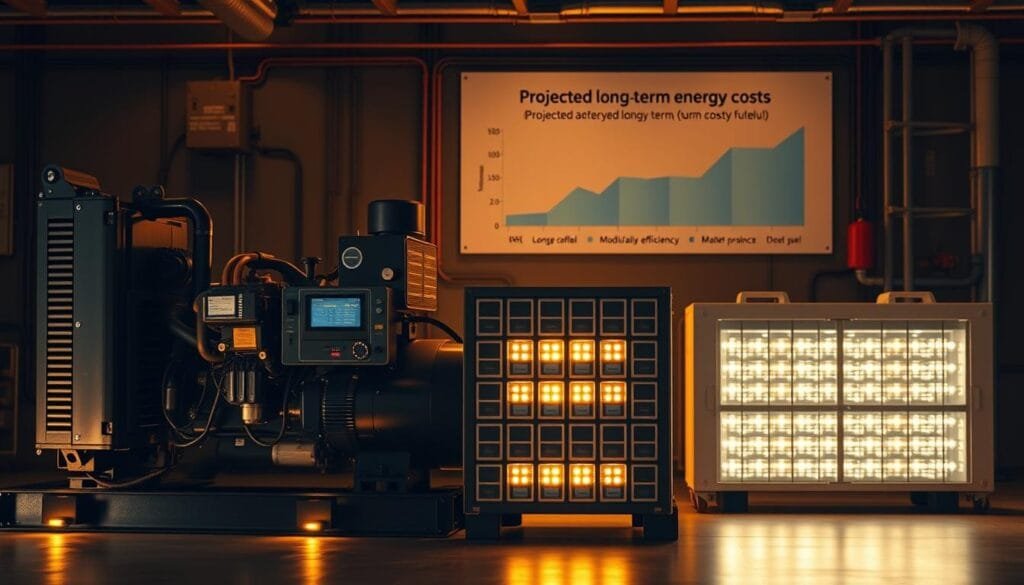
- Annual fuel expenses: $600 to $900 for generator operation
- 20-year fuel total: $7,500 (at conservative estimates)
- Purchased electricity costs: $47,012 over 20 years when grid power supplements generator use
- Battery system energy costs: $0 when charged by solar panels
Battery systems save money in many ways. Charging from the grid can use cheaper rates at night. This way, you get power during expensive hours without high costs.
Solar-charged battery systems mean no energy bills. The sun gives you free power every day, year after year, without price changes or supply worries.
Maintenance and Component Replacement
Generators need regular care to keep working well. Your maintenance costs add up fast with routine services.
A typical generator maintenance schedule includes:
- Oil changes every 50 to 100 operating hours
- Spark plug replacements annually or biannually
- Air filter cleaning and replacement
- Fuel system maintenance and stabilizer treatments
- Professional annual servicing and safety inspections
These tasks cost between $400 and $600 each year. Over 20 years, maintenance expenses are $8,000 to $12,000. Replacing parts adds another $7,000.
Battery systems need little care. Modern lithium-ion batteries need occasional updates and checks. Annual maintenance costs are usually zero dollars for most owners.
The main long-term expense for batteries is replacement. Quality systems last 10 to 15 years before needing a new one. This costs about $9,441 over 20 years.
Return on Investment Timeline
The ROI calculation shows a surprising twist. Generators seem cheap at first, around $7,000. Solar-plus-battery systems cost more upfront, about $30,000.
But the 20-year cost picture is different:
| Expense Category | Generator System | Solar + Battery System |
|---|---|---|
| Initial Investment | $7,000 | $29,993 |
| Maintenance (20 years) | $8,000 | $0 |
| Component Replacement | $7,000 | $9,441 |
| Fuel Costs | $7,500 | $0 |
| Purchased Electricity | $47,012 | $0 |
| Total 20-Year Cost | $78,012 | $39,434 |
Battery systems save nearly $40,000 over 20 years. The break-even point is between year 7 and year 10, based on your use and local rates.
After breaking even, battery systems save money each year compared to generators. For those planning to use their cabin for decades, battery systems are more attractive, despite the higher initial cost.
The savings grow if fuel prices rise or if you use your cabin more than 120 hours a year.
Installation Requirements and Complexity
Setting up power at your cabin is more than just unpacking. It depends on whether you choose a generator or a battery system. Each option affects your time, money, and if you can do it yourself. Knowing the differences helps you plan and avoid surprises.
First, check your site and prepare for your chosen system. Both generators and batteries need the right spot, electrical connections, and safety. But, the complexity varies a lot.
Getting Your Generator Running
Portable generators are easy to set up. You can do it yourself by placing it on a level surface, at least 20 feet from your cabin. It should be downwind to avoid fumes and noise.
Standby generators are more work. You start by picking a site, considering noise, fuel access, and clearance. Make sure it’s far from windows, doors, and flammable stuff.
Then, prepare a concrete pad. It should be 4-6 inches thick, level, and the right size for your generator. Pads are usually 3×4 feet to 4×6 feet, depending on the size.
The fuel system connection varies by generator type. Natural gas units need underground lines. Propane generators require a tank with regulators and safety shutoffs. Diesel systems need tanks that meet fire codes.
Electrical connections are key. You’ll need a transfer switch for safe power switching. This switch connects to your main electrical panel and needs precise wiring. Backup power should not feed back into utility lines.
Professional installation for standby generators costs $2,000-$5,000 in labor. It takes one to two days, depending on the complexity. Most people hire licensed electricians to avoid mistakes.
Setting Up Battery Storage
Battery system setup varies by type. Portable power stations are easy to set up yourself. They charge quickly and connect to your devices in minutes.
Home battery systems need a pro. An electrician will mount the unit, choosing indoor or outdoor based on your model and climate. Proper mounting ensures stability and ventilation.
The installer connects your battery to the electrical panel. This setup allows for whole-house power during outages. Solar panels or wind turbines can be connected during the same visit.
Next, program the battery management system. This software controls charging, discharge, and backup modes. Many systems have smartphone apps for remote monitoring.
Professional battery system installation takes a full day and costs thousands. But, some newer batteries are like oversized portable power stations. They need little more than a transfer switch or smart panel.
Navigating Permits and Regulations
Most places need electrical permits for generators and battery systems. These ensure your installation meets safety standards. Skipping this can lead to fines, insurance issues, or problems when selling.
Building permits might be needed for permanent structures or fuel storage. Generator installations often need permits for pads, fuel tanks, and exhaust systems. Battery systems might need permits for wall units or outdoor enclosures.
Local rules vary a lot, so check before buying equipment. Some areas have rules on generator placement and noise levels. Environmental rules might affect your choices, like diesel fuel storage or emission standards.
The permit process takes 2-4 weeks and costs $50-$500. Add these costs and delays to your timeline. Working with licensed contractors can make things easier, as they know local rules.
Maintenance Demands and Expected Lifespan
Every power solution needs different care over time. Knowing this upfront helps avoid surprises. The care you give affects the cost and how long your system lasts.
When looking at battery backup vs generator, the maintenance needs are clear. Generators need regular checks and parts, while batteries are easy to care for. Both can last decades with the right care, but the effort is different.
Regular Care Tasks for Generators
Generators need regular maintenance based on hours and time. These tasks keep them running well and prevent big problems. Missing these can void warranties and shorten lifespan.
Most makers suggest a maintenance schedule for home generators:
- Oil and filter changes: Every 50-100 hours or yearly, whichever first
- Spark plug replacement: Every 100-200 hours
- Air filter cleaning or replacement: Every 100 hours or when dirty
- Starting battery maintenance: Check terminals and charge quarterly
- Fuel system inspection: Add stabilizer to gasoline systems and check for leaks
- Cooling system checks: Inspect coolant levels and hoses yearly
- Load bank testing: Professional testing every 2-3 years to verify full-capacity operation
Standby generators do automatic weekly tests. Traditional models run for 5-20 minutes, using fuel even when not in use. But, advanced models like PowerProtect do smart weekly tests lasting just 16 seconds, saving fuel and wear.
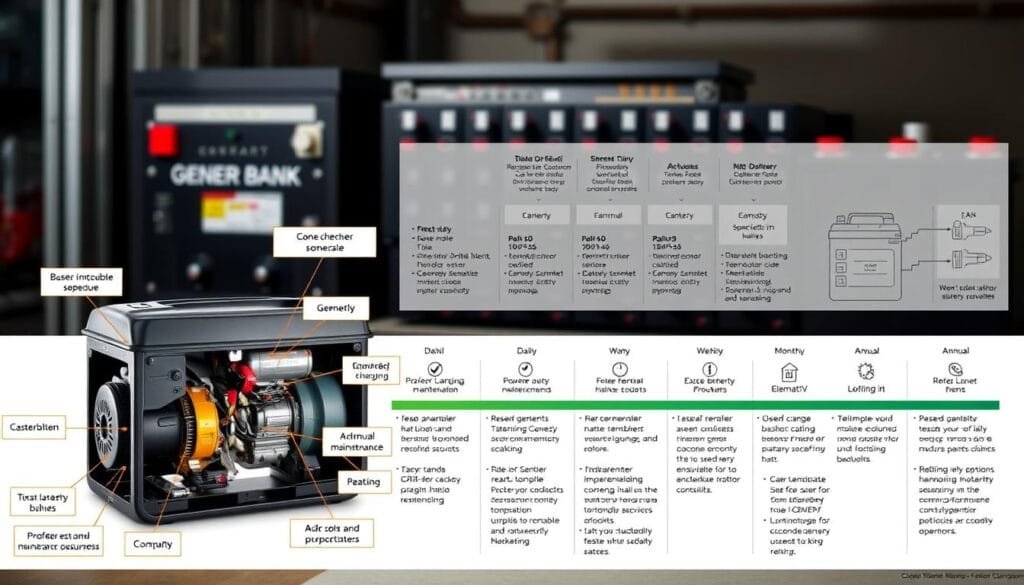
Annual professional service costs $200-$400 for generators. Over 20 years, maintenance costs $8,000-$12,000. You’ll also need to budget for parts like oil, filters, and spark plugs between services.
Battery System Upkeep Requirements
Battery systems need much less care. Modern lithium iron phosphate (LFP) batteries are great for those who want to forget about maintenance.
Battery lifespan depends more on use than maintenance. Your main tasks include:
- Keeping firmware updated when manufacturers release improvements
- Ensuring proper temperature ranges during operation (32-120°F) and storage (-4 to 140°F)
- Conducting occasional visual inspections for physical damage or loose connections
- Keeping the installation area clean, dry, and well-ventilated
No regular servicing is needed for battery systems. You won’t need to schedule annual visits or buy parts. Maintenance costs are zero, making it a big advantage for budgeting.
This low-maintenance approach is perfect for weekend cabin owners or those away for long periods. You won’t worry about maintenance windows or finding service techs in remote areas.
Comparing Service Life and Protection Plans
Equipment longevity varies between generators and batteries. Generators are rated in hours, while batteries in cycles.
Quality generators can last 10,000 to 30,000 hours before needing major work. Running 150 hours a year, they can last 20 years. With good care, some can last 25-35 years.
Modern LFP batteries have impressive cycle life, lasting 3,500 to over 4,000 cycles. Premium options like Briggs & Stratton battery packages can go over 10,000 cycles. This means 15-25+ years of service life for cabin owners.
| Comparison Factor | Generators | Battery Systems |
|---|---|---|
| Expected Lifespan | 10,000-30,000 operating hours (20-35 years at low usage) | 3,500-10,000+ cycles (15-25+ years with daily cycling) |
| Annual Maintenance Cost | $200-$400 plus parts | Essentially $0 |
| Typical Warranty Period | 2-5 years standard coverage | 10 years with capacity guarantees |
| Required Maintenance Skills | Moderate mechanical knowledge or professional service | Minimal technical knowledge needed |
Warranty coverage is key for your investment. Generators have 2-5 year warranties for defects and failures. Extended warranties are available but rarely cover wear items.
Premium battery systems offer better warranty protection. Tesla Powerwall guarantees 70% capacity retention at the end of its 10-year warranty. This means your battery will hold at least 70% of its original capacity after a decade, ensuring long-term performance.
The longer warranties and guarantees give battery owners confidence in their investment. This system durability assurance, along with minimal maintenance, makes the higher upfront cost worth it over the system’s life.
Environmental Impact and Sustainability Factors
The choice of power for your cabin affects more than just the lights. It impacts the environment around your home. For those who love nature, knowing the difference between generators and batteries is key.
Generators and batteries have different effects on the planet. They influence air quality and climate change. Thinking about the long-term effects of your choice is important.
Direct Environmental Consequences
Generators that burn fossil fuels harm the air right at your cabin. They release harmful gases like carbon dioxide and carbon monoxide. These emissions hurt both the air around you and the planet.
Natural gas generators are cleaner but not perfect. They also release harmful gases. These pollutants can harm people and animals living nearby.
Battery systems are different. LFP battery systems produce zero carbon emissions because they don’t burn fuel. They don’t pollute the air when they power your cabin.
Noise pollution is another big issue. Generators are very loud. They disturb the peace and harm wildlife. They can be as loud as 80 decibels.
Battery systems are much quieter. They make very little noise. This makes your cabin quieter and better for the environment.
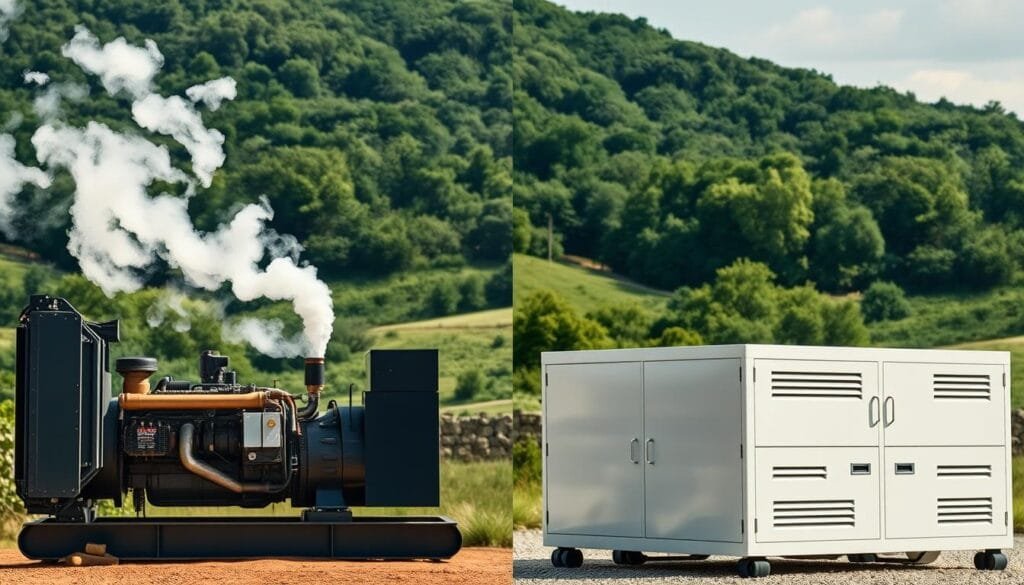
Lifetime Carbon Footprint Comparison
Looking at the whole life of each power solution shows a big difference. Generators emit carbon throughout their life. A 10 kW generator running 100 hours a year emits 1,500-2,000 pounds of CO2.
This doesn’t count the carbon in fuel production and transport. Each gallon of fuel adds to the emissions before it’s even used.
Battery systems have a carbon footprint from making them. But this is spread over 10-15 years. Once installed, batteries produce zero emissions when charged with clean energy.
Over time, batteries are better for the planet. They avoid the constant emissions of generators. Solar-charged batteries have a much lower carbon footprint than fossil fuel generators.
| Environmental Factor | Generator Systems | Battery Storage |
|---|---|---|
| Operational Emissions | 1,500-2,000 lbs CO2 per 100 hours annually | Zero direct emissions |
| Noise Output | 50-80 decibels continuous | Minimal intermittent sound |
| Air Pollutants | CO, NOx, particulates released | None during operation |
| Manufacturing Impact | Moderate embodied carbon | Higher initial, amortized over lifespan |
Clean Energy Integration Possibilities
Battery systems offer a path to clean energy. They help your cabin use renewable energy instead of fossil fuels. Solar panels and batteries are the best choice for eco-friendly backup power.
This combo lets you use sunlight to make energy. You can use it when you need it without emissions. Your cabin becomes a clean energy system that works with nature.
Small wind turbines and micro-hydro systems are other options. They charge batteries and work with the weather. All these renewable energy sources need battery storage to be useful.
Generators can’t work with renewable energy like batteries can. They need fuel and produce emissions. You can’t power a generator with solar or wind.
For those who care about the planet, batteries with renewable energy are the best choice. They reduce carbon emissions and fuel use. This shows respect for the environment that makes cabin life special.
Using renewable energy also makes your cabin more independent. It protects you from fuel price changes and supply issues. Your cabin becomes more self-sufficient and has less impact on the environment.
Reliability and Performance Across Different Conditions
Any cabin power system faces tough tests from Mother Nature. Sub-zero temps, scorching heat, and long power outages are common. Knowing how generators and batteries perform under stress helps you choose wisely. Your cabin’s location and weather patterns are key to picking the right system.
Cabins face unique challenges not seen in suburban homes. Remote areas often see extreme temps, long outages, and hard-to-reach locations for repairs. Your chosen power solution must handle these challenges without constant attention or unexpected failures.
Cold Weather and Extreme Temperature Performance
Generators usually do well in winter. Most start up in cold weather, but use fresh fuel and a block heater for diesel units. Propane vaporization slows in extreme cold, cutting power output by 10-20% below zero.
Battery systems face bigger cold weather challenges. Lithium iron phosphate (LFP) batteries work from -4°F to 140°F. But, their capacity drops 20-30% at freezing temps, and charging slows below 32°F.
Storing batteries is strict. LFP batteries need charging in 32°F to 120°F. Prolonged exposure outside this range damages them and shortens their life.
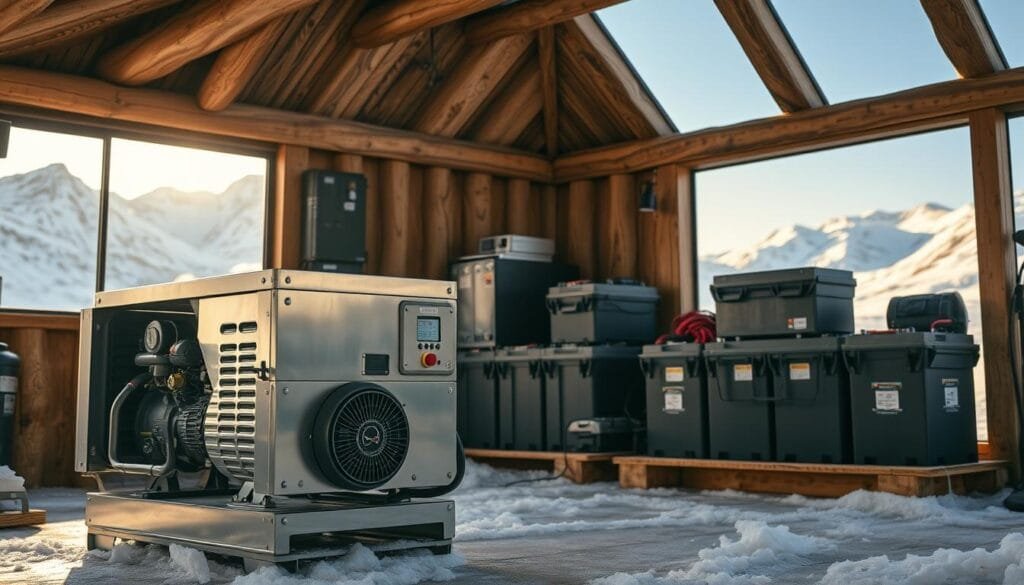
Many battery systems have thermal management to keep the right temperature. But, in harsh climates, insulated enclosures or indoor installation are needed. This adds cost but ensures reliable winter power backup when needed.
Generators are better in very cold climates. They generate heat, helping them run smoothly in winter. Battery systems work better in moderate climates where extreme temperatures are less common.
Extended Use and Continuous Operation Capabilities
Generators excel at running for days or weeks. A quality generator can run up to three weeks with enough fuel. They offer around 3,000 hours of operation between major maintenance, about 125 days of continuous use.
Fuel storage is key for extended generator use. A 500 to 1,000-gallon propane tank can run your cabin indefinitely during outages. This makes generators great for long-term power outages due to storms, wildfires, or infrastructure issues.
Battery systems have a different approach to continuous power supply. They’re limited by storage capacity, not fuel. A typical system like the Tesla Powerwall with 13.5 kWh storage might power essential loads for 6-12 hours, depending on usage.
But, batteries paired with solar panels change the game. With enough solar, your batteries recharge daily, providing sustainable power. The limit is during cloudy winter days when solar drops, and you rely on stored energy.
For long-term use, nothing beats a generator’s continuous power supply as long as fuel lasts. Batteries are great for daily cycling with renewable energy but struggle during multi-day stretches without sun or wind.
Emergency Backup Power Reliability
When power goes out, emergency reliability is key. Both generators and batteries offer backup, but differently in crisis situations.
Generators provide reliable backup with proper maintenance and fuel. The main concern is neglected maintenance or fuel unavailability during emergencies. If you keep up with maintenance and have fuel, your generator will power you through.
Battery systems offer instant, automatic backup without fuel or manual start. They seamlessly take over when grid power fails, providing excellent emergency reliability for short to medium outages.
The challenge with battery backup is its finite capacity. During long outages without enough renewable charging, managing loads is critical. This requires planning and sometimes tough decisions about which appliances to run.
For winter power backup, generators are better in cold climates where battery capacity is reduced and solar production is limited. But, batteries are great for silent, automatic operation, like during nighttime outages or in noise-sensitive areas.
| Performance Factor | Generator Systems | Battery Storage | Best Application |
|---|---|---|---|
| Cold Weather Operation | Excellent reliability down to -20°F with minor power reduction | Reduced capacity below 32°F, requires thermal management below 0°F | Generators for extreme cold climates |
| Heat Tolerance | Operates well up to 110°F with proper ventilation | Accelerated degradation above 120°F, needs cooling systems | Batteries with thermal management in hot climates |
| Continuous Runtime | Up to 3 weeks with fuel supply, 3,000 hours between major service | 6-12 hours on single charge, indefinite with adequate solar recharging | Generators for extended grid outages, batteries with solar for daily cycling |
| Emergency Response | Manual or automatic start within 10-30 seconds, fuel-dependent | Instant automatic backup, capacity-limited without recharging | Batteries for automatic seamless backup, generators for long outages |
Your cabin’s specific conditions decide which system is more reliable. Generators are best for frequent cold snaps and long outages with enough fuel. Batteries are better for daily cycling and short outages in sunny areas.
Many cabin owners choose hybrid systems for the best of both worlds. Batteries handle daily use and short outages silently. A backup generator kicks in for longer periods when batteries run low. This approach ensures emergency reliability in all conditions and seasons.
Noise Levels and Their Impact on Cabin Experience
For those who love quiet, knowing about power system noise is key. The sound of your energy source can keep your cabin peaceful or ruin it. Many choose cabins for their quiet, so picking the right power source is important.
Generators and battery systems differ in more than just sound. They affect your nature experience, neighbor relations, and relaxation. Let’s look at how each system impacts sound.
Understanding Generator Sound Output and Practical Solutions
Generators make sounds from 65 to 80 decibels at 23 feet. That’s like a garbage disposal or busy traffic. Even at 65 decibels, it’s as loud as a vacuum in the next room.
Generator noise depends on size and load. Bigger generators and full loads make more noise.
Inverter generators are quieter, at 50 to 60 decibels. That’s like a normal conversation or a quiet fridge. But, they’re not silent, and you might notice them during quiet times.
There are ways to make generators quieter:
- Put the generator far from living areas and outdoor spaces, but follow local rules.
- Use a sound-insulated generator box with good airflow.
- Put vibration pads under the generator to cut down on noise.
- Keep the exhaust system in good shape to avoid extra noise.
- Choose generators with built-in sound dampening.
Even with these steps, generators are always making some noise. This noise can ruin your cabin’s peace and your outdoor fun.
| Power Source Type | Decibel Range | Comparable Sound | Impact on Cabin Peace |
|---|---|---|---|
| Conventional Generator | 65-80 dB | Vacuum cleaner to garbage disposal | High disruption to natural soundscape |
| Inverter Generator | 50-60 dB | Quiet refrigerator to normal conversation | Moderate disruption, noticeable during quiet times |
| Battery Storage System | 0-30 dB | Whisper to soft humming (occasional) | Minimal to no disruption of peaceful cabin environment |
| Natural Ambient | 20-40 dB | Rustling leaves to birdsong | Desired natural sound experience |
The Advantages of Quiet Battery System Operation
Battery systems are very quiet, thanks to no engines or exhaust. They make almost no sound, except for a faint fan or inverter hum.
This quiet keeps your cabin peaceful. You can enjoy birds singing, wind, or water sounds without mechanical noise.
For writing, meditation, or relaxation, battery systems are perfect. They keep your cabin quiet for reading, stargazing, or meals outside.
They also help with neighbors. Generators can disturb those nearby, causing problems or noise rule violations. Battery systems keep things quiet, which is great for shared spaces or areas with noise rules.
Generators can wake neighbors and disturb wildlife, but battery systems don’t. They let you use power without disturbing anyone.
Scalability and Future Expansion Options
As your cabin becomes a year-round home, your power system needs to grow. Planning for scalability means you won’t have to replace everything when your energy needs increase. Modern power solutions offer flexible ways to expand, but generators and batteries work differently.
Knowing how to expand your power helps you invest wisely. You’ll avoid being stuck with a system that can’t grow with you.
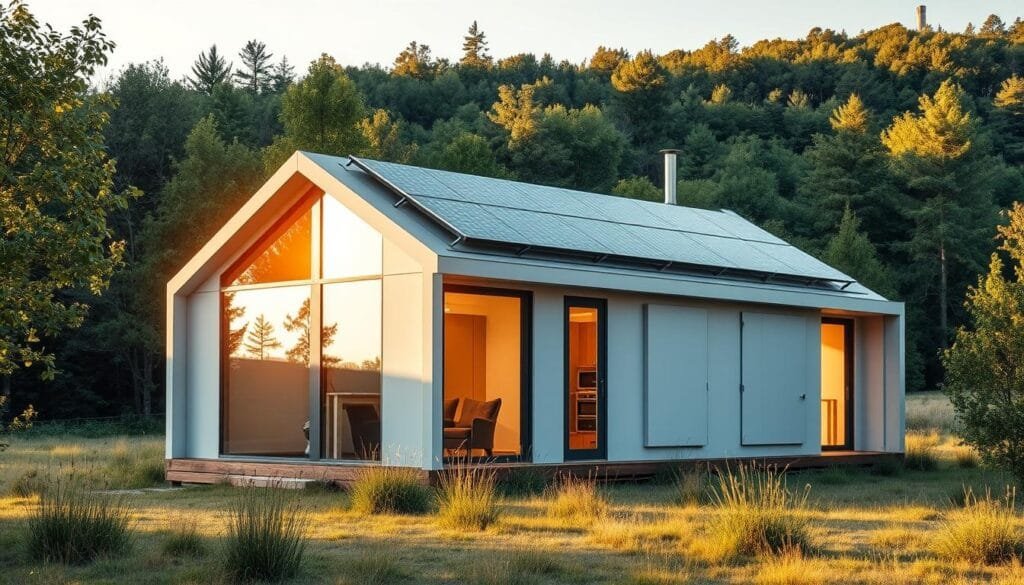
Expanding Your Power Capacity Over Time
Generators and battery systems expand in different ways. This affects your costs and flexibility over time.
Generator capacity limitations are a big problem for growing power needs. You can’t just add parts to a 10 kW generator to make it 15 kW. If your power needs grow, you’ll need a new generator. This means big costs for new equipment, installation, and possibly getting rid of your old generator.
Battery systems, on the other hand, offer modular systems design. This means you can add more units to increase storage and power without replacing everything.
Here’s how battery systems work for expansion:
- Start with one 13.5 kWh battery unit for about $10,000
- Add a second unit later for 27 kWh total storage
- Add a third unit for 40.5 kWh capacity
- All original equipment stays functional in the expanded system
This modularity is very flexible financially. You can start with basic backup for essential circuits. Then, expand to cover the whole cabin as your budget grows or your needs change.
Solar panels work well with this approach. You can add panels to increase charging capability. These upgrades happen step by step, not all at once.
Combining Technologies with Hybrid Systems
You don’t have to pick just one. Hybrid power solutions mix generators and batteries for their best features.
In a hybrid setup, batteries handle most backup duties. They provide quick, silent power for short outages and daily use. The generator kicks in to recharge batteries during long outages, not to power everything directly.
This setup offers many benefits:
- Optimized fuel efficiency: Generators run at the best load levels when charging batteries, not with changing cabin demands
- Reduced noise and emissions: The generator runs for hours, not days, during outages
- Extended generator lifespan: Fewer hours of use means less wear and longer life
- Ultimate reliability: Two independent power systems provide backup redundancy
Modern hybrids can do automatic energy arbitrage. Batteries handle daily loads charged by solar panels. The generator kicks in when batteries run low or loads exceed battery capacity. This smart switching happens automatically through control systems.
For cabin owners looking into these options, a guide to selecting solar hybrid battery backup can help with the technical choices and equipment needed for a complete solution.
The cost of hybrid power solutions is getting better as technology improves. Solar panel prices have fallen a lot in the last decade. Battery prices are also dropping, with lithium-ion becoming more affordable each year.
This price drop makes hybrids more affordable for more cabin owners. What was once expensive is now within reach for moderate budgets. This includes long-term fuel savings and reduced maintenance costs.
System scalability in hybrids offers the best of both worlds. Start with a basic generator for immediate needs. Add solar panels when you can. Include battery storage as prices drop. Each addition boosts system capability without throwing away previous investments.
This approach lets your power system grow with your cabin’s use and your budget. Whether for weekend visits or full-time living, adding modules and hybrids provides a clear path forward. You don’t have to get everything right from the start.
When a Generator Is the Better Choice
Not every cabin owner needs the latest battery technology. Sometimes, traditional generators make more sense. Knowing when to choose generator systems over batteries helps you make practical decisions.
Your cabin’s unique characteristics determine which power solution delivers the best value. Location, usage patterns, and financial constraints all play important roles in this decision. Recognizing generator advantages in certain contexts prevents overspending on technology that doesn’t match your needs.
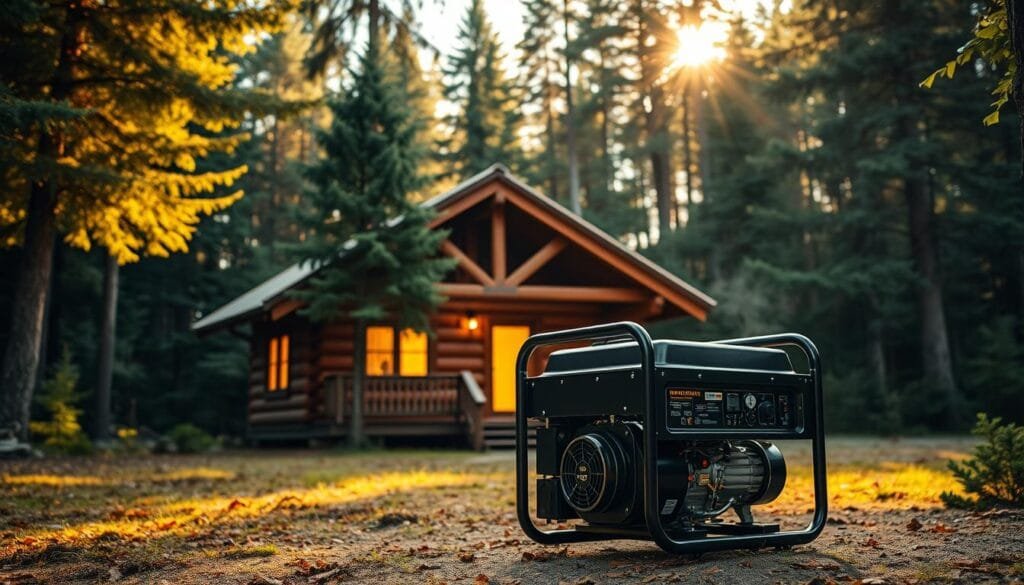
High Continuous Power Demand Scenarios
Cabins with substantial, sustained electricity requirements often benefit most from generators. Properties running high power demands like large well pumps (1-2 horsepower), electric heating systems, or workshop equipment may need 10-20+ kilowatts continuously. These continuous operation needs quickly exceed what battery systems can economically provide.
Consider the cost difference for heavy loads. Achieving equivalent battery capacity for sustained high-power use requires massive battery banks and solar arrays costing $50,000 or more. A quality $10,000-$15,000 generator handles these loads effortlessly as long as fuel remains available.
Full-time cabin residences with modern amenities fall into this category. Properties hosting multiple families simultaneously also generate power demands that favor generators. Workshop cabins with table saws, air compressors, and welding equipment benefit from the reliable, high-output capacity that generators provide without capacity anxiety.
Remote Locations with Limited Solar Access
Geography plays a key role when to choose generator systems over battery storage. Cabins in heavily forested areas with dense tree canopy blocking sunlight struggle to generate adequate solar power. Without reliable renewable charging, batteries lose their primary advantage and become expensive storage with limited capacity.
Properties in far northern latitudes face similar challenges during winter months. Short daylight hours combined with low sun angles reduce solar generation precisely when heating demands peak. Pacific Northwest cabins in persistently overcast rainforest climates also struggle with insufficient solar resources year-round.
In these environments, battery systems require grid or generator charging. This eliminates the sustainability and independence benefits that make batteries attractive elsewhere. A dependable fuel-powered generator becomes the more practical choice when renewable charging proves unreliable or insufficient.
Budget-Conscious Initial Installations
Financial reality matters when selecting cabin power systems. Not everyone can afford the $20,000-$30,000 investment in battery-plus-solar installations, even with available tax credits. Budget backup power solutions start with generators for good reason—they’re significantly more affordable upfront.
Portable generator units begin around $1,000 for basic models. Installed standby systems average $7,000 compared to $10,000-$20,000 for battery storage systems. This substantial cost difference makes generators accessible to more cabin owners who need reliable backup power without breaking their budget.
Seasonal cabins used occasionally present another financial consideration. When power outages occur infrequently and usage remains limited to weekends or vacations, the lower generator investment makes practical sense. You get adequate emergency backup without the higher costs of battery technology you won’t fully utilize.
| Scenario Type | Power Requirement | Generator Cost Range | Battery System Equivalent |
|---|---|---|---|
| Workshop with Power Tools | 15-20 kW continuous | $10,000-$15,000 | $50,000+ (battery + solar) |
| Dense Forest Location | 5-10 kW average | $7,000-$10,000 | $25,000+ (limited solar gain) |
| Seasonal Weekend Cabin | 3-5 kW backup only | $1,000-$3,000 | $10,000-$15,000 |
| Multi-Family Gatherings | 12-18 kW peak demand | $8,000-$12,000 | $35,000-$45,000 |
The table illustrates cost comparisons for different scenarios where generator advantages become clear. Notice how the gap widens as power requirements increase or solar resources decrease. These situations represent where generators deliver better value despite their ongoing fuel costs.
Honest assessment of your situation matters more than following trends. If your cabin faces high power demands, limited solar access, or strict budget constraints, generators may serve you better than batteries. The right choice depends on matching technology to your specific circumstances.
Generators also shine during extended power outages when continuous operation needs exceed battery capacity. As long as you can refuel, generators keep running. Battery systems eventually deplete, requiring days of sunny weather to recharge—weather you may not have during winter storms or prolonged cloudy periods.
Understanding these scenarios helps you avoid overinvesting in battery technology that doesn’t match your cabin’s reality. Sometimes the traditional, fuel-powered approach remains the smartest, most practical solution for reliable backup power.
When Battery Storage Is the Better Choice
Battery systems are more than backup power. They’re perfect for cabins that want to use renewable energy and enjoy quiet living. Generators are good in some situations, but batteries have special benefits for those who value sustainability and quiet.
Some cabin situations are better for battery storage than generators. These include places with access to renewable energy, a love for quiet, and a desire to reduce environmental impact. The initial cost of batteries is worth it for lower operating costs, no emissions, and quiet operation.
Creating Energy Independence with Renewable Sources
Off-grid battery systems with solar panels make your cabin energy independent. If your cabin gets four or more peak sun hours daily, solar panels can make plenty of electricity. They store extra energy for when the sun isn’t out.
Cabins with lots of sunlight are great for renewable power systems. Roofs facing south or areas with little shade get the most sunlight. People living in cabins full-time or for long periods get the most benefit from these systems.
Using batteries and solar panels saves money over time. They cost about $39,434 over 20 years, compared to $78,012 for generators. This money can be used for other cabin improvements. Plus, a 30% federal tax credit until December 31, 2025, makes batteries even more affordable.
You can also add other systems to charge your batteries:
- Wind turbines for power when it’s cloudy or at night
- Micro-hydro systems for properties with flowing water
- Hybrid configurations for all-year reliability
- Grid-tied options to sell back to utilities
Preserving Peace in Nature-Focused Retreats
Battery systems keep your cabin quiet, perfect for places focused on relaxation. They run silently, keeping the natural sounds you love. This makes them great for meditation, nature watching, and family getaways.
Many situations benefit from battery systems’ quiet operation. Cabins near communities avoid noise disputes. Places near nature preserve wildlife and keep the area peaceful. Battery systems are key for those who value quiet and peace.
Think about these activities when choosing a power source:
- Early morning wildlife watching without generator noise
- Evening stargazing sessions in silence
- Outdoor yoga or meditation in quiet
- Recording natural sounds for art or science
- Hosting guests who want a quiet stay
Battery systems also mean no mechanical noise or smells. Outdoor spaces stay pleasant without generator noise.
Aligning Power Choices with Environmental Values
For those who care about the environment, battery storage is more than power. It shows your values and commitment to clean energy. It produces zero emissions and uses renewable sources.
Many cabin owners buy property to live more sustainably. Battery systems fit these goals by avoiding harmful emissions. You won’t have to worry about spills or harming the environment.
Choosing battery systems also helps the environment. It supports clean energy technology and reduces carbon emissions. As technology improves, early adopters show that renewable power works in remote areas.
Consider these environmental benefits:
- Zero carbon footprint with renewable charging
- Elimination of noise pollution that harms wildlife
- Prevention of fuel spills that harm soil and water
- Reduced transportation impacts from no fuel deliveries
- Long-term sustainability without fossil fuels
For those who value the environment, battery systems are worth the extra cost. Knowing your cabin runs on clean power brings satisfaction. It shows who you are and how you interact with nature.
Making the Right Power Decision for Your Cabin
Your cabin power choice isn’t just about picking between generators and batteries. It’s about finding what fits your needs best. The right power solution depends on how you use your cabin, its location, and what’s important to you.
First, think about your daily energy needs and when you use the most power. Look at your location’s sunlight, weather, and how close you are to neighbors. Also, consider if you visit often or live there all year. These details are more important than any general advice.
The cost is also a big factor. If you’re thinking about batteries, act fast. Congress cut off the 30% solar tax credit early, giving you a short time to save. This makes choosing backup power urgent for those looking at renewable options.
Don’t overlook hybrid systems. Mixing a generator with batteries offers both flexibility and reliability. This is great when one option seems too restrictive.
Get advice from experts for a tailored plan. Solar installers, electricians, and generator pros can help. They’ll suggest solutions that fit your budget and lifestyle.
Either choice brings peace of mind during power outages. Your cabin should have reliable electricity that suits your lifestyle and values.