

Starting your dream cabin in the woods means making smart choices about tools. You don’t need to buy everything at the store to begin.
The right timber cutting equipment is key to a smooth build. Three tools are must-haves: chainsaw, circular saw, and jigsaw. Each is perfect for different cutting tasks, from starting to finishing touches.
Many wonder which tools to spend their money on. The answer is simple: choose wisely.
This guide shows how each saw fits into your project. You’ll learn which tasks they’re best for. We’ll help you pick the right tools for your budget, schedule, and project needs.
Understanding Your Cabin Construction Sawing Needs
Building a cabin starts with more than just wood. It’s about knowing which saws you need for each task. Builders who plan well avoid wasting money and frustration.
Planning your tools is key to success. Before buying, map out your project’s needs. This way, you invest in timber frame construction tools that will be useful throughout.
Building a cabin involves many cutting tasks. Each task needs a specific saw, based on the material and precision needed. Knowing this helps you buy the right tools and avoid unnecessary purchases.
Types of Cutting Tasks in Cabin Building
Cabin building has many cutting tasks. Framing cuts are big and rough, but don’t need to be precise. You need powerful saws for these tasks.
Joinery and timber frame construction tools require precise angle cuts. These cuts are critical for structural connections. You can’t use a chainsaw for these.
Custom features in your cabin need curved cuts. These cuts are done with specialized saws. Log preparation is another unique task, often needed for traditional timber frames.
Trim work needs the most precision. The saws for framing won’t cut clean enough for visible trim. This is where the best saws shine.
When planning your log cabin construction, know what tools you’ll need. This helps you prepare the right equipment before you need it.
Matching Saws to Different Construction Phases
Cabin construction has different phases, each with its own needs. Knowing this helps you choose the right saws for each phase. This way, you can plan your tool purchases wisely.
The foundation stage needs basic cuts. You might use a versatile saw for these tasks. This phase doesn’t require many tools.
Framing is the most tool-intensive phase. You’ll make many cuts daily. Power and endurance are more important than precision here.
Roofing work needs cuts at various angles and lengths. Cordless saws are valuable here because of the height. The off-grid building equipment you choose should be reliable and easy to use.
Exterior finishing requires precision. Your cuts will be visible, so quality is key. You’ll work with trim boards and siding that need clean cuts.
| Construction Phase | Primary Cutting Tasks | Essential Saw Types | Precision Level Required |
|---|---|---|---|
| Foundation & Site Prep | Form lumber, stakes, rough cuts | Circular saw, chainsaw | Low – functional cuts |
| Framing & Structure | Dimensional lumber, sheet goods, repetitive cuts | Circular saw, chainsaw, miter saw | Medium – square and straight |
| Roofing | Rafters, decking, angle cuts | Circular saw, miter saw | Medium-High – structural angles |
| Exterior Finishing | Siding, trim boards, decorative elements | Miter saw, circular saw, jigsaw | High – visible surfaces |
| Interior & Trim Work | Crown molding, baseboards, custom fits | Miter saw, jigsaw, hand saws | Very High – finished appearance |
Trim work is all about precision. Every cut matters, and mistakes are costly. This is where quality saws make a big difference.
Planning Your Saw Budget and Purchase Priority
Setting a realistic saw budget is essential. Experts say you can keep costs low by balancing tool purchases with rentals. This requires careful planning.
New saws come with warranties, but used tools can be a great value. Look for professional-grade used saws that outperform new ones. Always check for wear and test before buying.
Plan your purchases based on immediate needs and long-term use. The saws you’ll use most should get the most budget. Rent tools for tasks that are less frequent.
Think about your off-grid building equipment needs for power. Battery-powered saws need charging systems, while gas tools need fuel storage. These costs add up and affect your budget.
Quality is more important than quantity when building your tool collection. One reliable saw is better than three that don’t work well. Budget for dependable tools for your most common tasks, and add specialized saws later.
Start by identifying your first essential saw purchase. This saw should handle many tasks. Add more saws as needed as your project progresses.
Many builders finish cabins with just three core saws and occasional rentals. This focused approach keeps costs down while ensuring you have the right tools. Choose those three saws wisely based on your project’s needs.
Chainsaws: The Workhorse for Log Cabin Construction
Log cabin chainsaws are key for any serious timber project. They handle everything from tree felling to precision notching. If you’re building with logs, this tool will be your most used piece of equipment.
Choosing the right chainsaw is important. You need to think about the power source, bar length, and engine capacity that fit your project. Getting these right makes cutting tasks easier and safer.
Why Chainsaws Are Essential for Timber Work
The chainsaw does many critical tasks in cabin construction. Felling trees on-site gives you free or low-cost materials if your property has suitable timber. This is great for remote sites where moving lumber is expensive or hard.
Once trees are down, you’ll use your chainsaw for bucking logs to length. This means cutting them into sections that fit your building plans. Removing limbs and preparing logs for construction requires precise cuts.
Perhaps the most specialized use is cutting notches for log joinery. Traditional log cabins use interlocking corner notches. These need careful chainsaw work for accuracy and control.
Land clearing is another key task. Removing brush and small trees makes your work area safe and accessible. For more on log home building tools, including measuring and leveling gear, check out additional resources.
Gas-Powered vs. Battery-Powered Chainsaws
Gas-powered chainsaws offer maximum power and unlimited runtime with fuel on hand. They’re best for heavy-duty timber work, like cutting through large logs. These saws usually have engines from 40cc to 60cc or more for professionals.
Gas saws are great for remote locations. You don’t need electrical outlets or worry about battery charge times. Just keep fuel and bar oil ready, and you can work all day.

Battery-powered chainsaws have improved a lot. Modern cordless models offer impressive cutting capacity without the noise, emissions, or upkeep of gas engines. They start instantly and need little maintenance.
For wilderness building, battery saws are good as secondary tools or for lighter tasks. They’re best for cutting smaller logs, trimming branches, or working in places where exhaust is a problem. Their main limit is battery life, which doesn’t last as long as gas models.
Bar Length and Engine Size Considerations
Bar length determines the max diameter of timber you can cut in one pass. A 16 to 18-inch bar is good for most cabin construction tasks. It can cut logs up to 32-36 inches in diameter with cuts from both sides.
For bigger timber projects, a 20-inch or longer bar gives more capacity. But longer bars need more engine power for speed and efficiency. They also weigh more and can tire you out during long work sessions.
Engine size, measured in cubic centimeters (CC), must match your bar length and workload. A 40-50cc engine is good with 16-18 inch bars for moderate work. Stepping up to 55-60cc engines gives the power needed for 20-inch bars and heavy cutting.
Weekend builders should think about their stamina and power needs. A lighter saw with enough power is often better than a heavy one that tires you out. Balance your need for cutting capacity with comfort and safety over long periods.
Top Chainsaw Models for Cabin Builders
Choosing the best chainsaw models depends on your building needs, budget, and tool needs. Here are some top choices that cabin builders rely on for serious timber work.
| Model | Engine/Power | Bar Length | Best Application | Price Range |
|---|---|---|---|---|
| Husqvarna 460 Rancher | 60.3cc gas | 18-24 inches | Versatile mid-range timber work | $500-$600 |
| Stihl MS 271 Farm Boss | 50.2cc gas | 16-20 inches | General cabin construction | $450-$550 |
| Echo CS-590 Timber Wolf | 59.8cc gas | 18-24 inches | Value-conscious professional work | $400-$480 |
| Milwaukee 2727-21HD M18 Fuel | 18V battery | 16 inches | Cordless convenience, M18 platform | $450-$550 |
Husqvarna 460 Rancher
The Husqvarna 460 Rancher offers professional-grade performance for serious builders. Its 60.3cc engine has enough power for large logs, and it’s not too heavy at about 13 pounds (powerhead only).
This model has X-Torq engine technology for less fuel use and emissions without losing power. It also has an inertia-activated chain brake and LowVib anti-vibration system for safety and comfort.
Builders like the 460 Rancher for its versatility. It’s good for felling medium-sized trees, bucking logs, and cutting construction lumber. It can use bars from 18 to 24 inches, giving you flexibility as your project changes.
Stihl MS 271 Farm Boss
The Stihl MS 271 Farm Boss is known for reliability and dealer support. This 50.2cc saw is a great balance of power and ease for general cabin construction.
Stihl’s wide dealer network means great parts availability and service support, which is key for remote work. The MS 271 has reduced-emission engine tech and toolless fuel and oil caps for easy refilling.
This saw works well with 16 to 20-inch bars for logs up to 24 inches in diameter. The Farm Boss name shows it’s designed for dependable performance on various cutting tasks. Many pros keep one as a reliable backup saw, even with bigger models.
Echo CS-590 Timber Wolf
The Echo CS-590 Timber Wolf offers exceptional value for builders who need top performance without high prices. Its 59.8cc engine is as powerful as more expensive saws, making it popular among cost-conscious builders.
Echo backs this model with a five-year consumer warranty and two-year commercial warranty, showing confidence in its durability. The CS-590 has a heavy-duty air filtration system that helps extend engine life in dusty environments.
This saw handles 18 to 24-inch bars well, cutting through big timber with ease. Users praise its reliable start and consistent power. For builders on a budget who want top cutting performance, the Timber Wolf is a great choice.
Milwaukee 2727-21HD M18 Fuel Cordless
The Milwaukee 2727-21HD M18 Fuel brings cordless convenience to serious cutting tasks. If you’re already using Milwaukee’s M18 batteries, this chainsaw fits right into your system.
This model uses a brushless motor for performance like 40cc gas chainsaws. The 16-inch bar can cut logs up to 32 inches in diameter with cuts from both sides. Battery tech means instant starts, zero emissions, and little upkeep.
The 12.0Ah battery gives about 150 cuts through 6×6 treated lumber on one charge. For cabin building, this means enough time for trimming, cutting smaller lumber, and detail cuts where gas saw exhaust is a problem.
While not replacing gas saws for all-day timber felling, the Milwaukee cordless is great as a secondary saw. It’s perfect for quick cuts, indoor work during finishing stages, and situations where starting a gas saw seems like overkill.
Circular Saws for Lumber Cutting and Framing
Circular saws are the top choice for cabin builders. They offer great versatility and value. These handheld tools are essential on construction sites across America.
They’re perfect for cutting dimensional lumber and trimming plywood sheathing. Circular saws do the job quickly and accurately.
Most builders use their circular saw more than any other tool. The 7-1/4-inch blade size is standard. It’s big enough for most tasks but light enough to carry around.
Prices start at $60-$80 for basic models. Professional-grade saws cost between $100 and $300.
The Versatility of Circular Saws in Cabin Construction
Circular saws are great for many tasks in cabin building. They cut through 2x4s, 2x6s, and bigger beams easily. They also rip boards to custom widths.
During framing, they cut studs, joists, and rafters to exact lengths. They handle angle cuts and compound angles for complex timber connections. When it’s time for sheathing, they quickly cut through plywood and OSB panels.
Advanced techniques let you make plunge cuts in sheet materials. Notching posts and beams for timber frame connections is also easy with the right blade and measurements.
Their portability is a big plus for cabin construction. You can take them anywhere on your site without the hassle of heavy equipment. This is important when working on platforms, ladders, or in tight spaces.
Corded vs. Cordless Circular Saws for Building Sites
Choosing between corded and cordless saws depends on your needs. Each type has its own advantages.
Corded circular saws run forever if you have power. They cut consistently, even through thick wood. They’re lighter and cheaper than cordless models.
The main drawback is managing extension cords. Cords can trip you up and limit your space. You also need reliable power, which can be hard to find in remote areas.
Cordless construction saws get rid of cord worries. You can work anywhere without worrying about outlets. Modern batteries are powerful, rivaling corded saws.
Sticking with one battery platform saves money and reduces clutter. If you already have tools from brands like Milwaukee, DeWalt, or Makita, it’s a smart choice.
The biggest issue with cordless saws is battery life. You’ll need at least two batteries to keep working. They’re also pricier and heavier than corded saws.
Worm Drive vs. Sidewinder Design Differences
Circular saws come in two main designs: sidewinder and worm drive. Knowing the difference helps you pick the right one for your project.
Sidewinder circular saws have the motor on the right side. They’re lighter and easier to handle. They’re great for right-handed users making most cuts.
These saws spin fast, making clean cuts in plywood and sheet goods. They’re also lighter, reducing fatigue during long cuts.
Worm drive circular saws have the motor in line with the blade. They’re better for cutting thick lumber and dense materials. They’re popular among professional framers.
Worm drive saws are heavier due to the gearing. They cost more but offer more power. They’re best for heavy-duty framing but might be tiring for all-day finish work.
| Feature | Sidewinder Design | Worm Drive Design |
|---|---|---|
| Motor Position | Perpendicular to blade (right side) | In-line with blade (rear mounted) |
| Blade Location | Right side of motor | Left side of motor |
| Weight Range | 7-9 pounds (lighter) | 12-15 pounds (heavier) |
| Power Delivery | Higher RPM, less torque | Lower RPM, higher torque |
| Best Applications | Sheet goods, general cutting, finish work | Heavy framing, wet lumber, thick materials |
Best Circular Saw Models for Cabin Projects
Finding the right circular saw can be tough. Here are four top picks for different needs and budgets.
DeWalt DWE575SB Lightweight Circular Saw
The DeWalt DWE575SB is a great value for budget-conscious builders. It’s a sidewinder that weighs just 8.8 pounds, making it easy to use for long periods.
It has a 15-amp motor for cutting through lumber and sheet materials. An electric brake stops the blade fast, and a dust blower keeps your cut line clear.
It costs around $130-$150, making it a professional-grade tool without the high price. It’s perfect for beginners who need a lightweight saw.
Makita 5007MGA Magnesium Circular Saw
The Makita 5007MGA is the top sidewinder saw for pros. It’s made of magnesium, making it light but durable.
Its 15-amp motor spins the blade at 5,800 RPM for smooth cuts. The electric brake stops the blade in two seconds. It has large controls for easy adjustments.
It has a built-in LED light for cutting in dim places. It costs around $180-$200, making it a worthwhile investment for serious builders.
Skilsaw SPT77WML-01 Worm Drive Saw
Skilsaw created the worm drive saw, and the SPT77WML-01 is a top choice for framing. It’s made of magnesium, weighing 11.6 pounds.
Its 15-amp Dual-Field motor has 3.23 horsepower for cutting thick lumber. It has an integrated dust port for cleaner work areas.
It’s designed for right-handed users, with the blade on the left and the motor in the back. It costs around $200-$230, making it a professional-grade tool.
Milwaukee 2732-20 M18 Fuel Cordless
The Milwaukee 2732-20 M18 Fuel is the best cordless saw for builders who value mobility. It has a brushless motor that rivals 15-amp corded saws.
It maintains consistent speed, even when cutting dense materials. It has an LED light and an electric brake for safety. It’s perfect for remote locations without power.
It costs around $200-$250, making it a good investment. You’ll need at least two batteries for continuous work. Battery life is the main limitation.
Jigsaws for Detailed Cuts and Curved Work
The jigsaw is a unique tool for carpentry, perfect for detailed cuts that others can’t do. It has a short, thin blade that moves fast to make precise cuts and curves. While chainsaws and circular saws do most of the cutting, jigsaws add precision and creativity.
Quality jigsaws cost between $40 to $200. Contractor-grade ones give smoother cuts and are more accurate. If you won’t use it often, renting might be a better option.
Specific Applications for Jigsaws in Cabin Building
Use your jigsaw when other saws can’t handle the job. It’s great for tasks that need precision and creativity, not just power.
It’s perfect for cutting sink openings in countertops and making decorative trim. You’ll also use it for curved window casings that add charm to your cabin.
Other uses include:
- Notching around pipes and obstacles during plumbing and electrical installations
- Cutting custom cabinet components that maximize limited space in smaller cabins
- Creating archways or curved design elements that distinguish your cabin from cookie-cutter designs
- Making interior cutouts for electrical boxes, vents, and specialty fixtures
- Crafting rounded corners in cabinetry and built-in furniture
Jigsaws aren’t essential for basic framing but are vital for adding custom finishes that make your cabin special.
Important Features for Construction-Grade Jigsaws
Not all jigsaws are created equal. Look for features that make a professional-grade tool stand out from cheaper models.
Tool-free blade changing systems save time when switching blades. This is important because you’ll change blades often when working with different materials.
An adjustable shoe lets you make bevel cuts at various angles. This expands your cutting options for trim work and specialty tasks.
Other key features include:
- Dust blowing mechanisms that keep your cut line visible during operation
- LED work lights for illuminating dark corners and tight spaces
- Comfortable grip design that reduces fatigue during extended cutting sessions
- Sufficient motor power (at least 5-6 amps for corded models) to handle hardwoods and thick materials
Understanding Orbital Action and Speed Control
Orbital action and variable speed control are key to jigsaw performance. Knowing how to use these features helps you get the best results for different materials and tasks.
Orbital action moves the blade in an elliptical motion for faster cuts in softer materials. Most jigsaws have multiple orbital settings for different cutting needs.
Straight cutting mode (zero orbital action) offers maximum control for delicate tasks. Use it for cutting laminate countertops, decorative scrollwork, or materials that chip easily.
Variable speed control lets you adjust the blade speed for different materials and precision needs. Slower speeds are better for harder woods and metal, while faster speeds work well for softer materials. This prevents blade damage and ensures clean cuts.
Best Jigsaw Options for Cabin Builders
These three models are top choices for different budgets and power needs. They offer reliability and features important for construction work.
Bosch JS470E Corded Jigsaw
The Bosch JS470E is a top-quality corded option for builders who need power and precision. It has 7.0 amps of cutting power and reduces vibration for less hand fatigue.
Its tool-free blade change system is quick and reliable. It has four orbital settings plus straight-cut mode for versatility. At around $140, it offers professional performance without a high price.
DeWalt DCS334B Cordless Jigsaw
The DeWalt DCS334B is great for mobility with reliable cordless performance using the 20V MAX battery system. It cuts smoothly through 2x4s and sheet materials without slowing down.
The keyless blade change lever and adjustable shoe make it easy for all skill levels. Its LED light illuminates cut lines in dark places. It’s usually around $130 for the bare tool.
Makita XVJ03Z Brushless Cordless Jigsaw
The Makita XVJ03Z is a premium brushless cordless model with extended runtime and professional features. Its brushless motor runs cooler and lasts longer, providing consistent power throughout the battery charge.
It has three orbital settings plus straight cutting mode for various materials. The tool-less bevel adjustment and large two-finger trigger provide excellent control. At around $170 for the bare tool, it’s an investment for serious builders.
Best Saws for Cabin Construction: Building Your Complete Tool Arsenal
Choosing the right saws for cabin building isn’t about having lots of tools. It’s about having the essential ones at the right time. Walking into a hardware store can be overwhelming with so many options. But, you don’t need everything right away.
Smart builders start with three key saws and add more as needed. This approach keeps costs down while giving you the power to tackle most tasks. Let’s look at which saws you need first and when to add more to your collection.
Essential Three-Saw Combination for Any Cabin Project
Every cabin build starts with a core trio of tools. For log cabin construction, you need a chainsaw, circular saw, and jigsaw. This trio handles everything from cutting down trees to trimming details.
The chainsaw is for processing timber and notching logs. Your circular saw cuts lumber for framing and more. The jigsaw is for curves and details that other saws can’t do.
For stick-frame cabin builders, the key tools are different. You’ll need a circular saw, a miter saw, and a jigsaw. These tools cover framing, roofing, and interior work.
These three saws work well together because they don’t do the same thing. Each tool excels in its own area. This means you won’t need to rent tools or use the wrong one for a job.
Which Saw to Buy First When Starting Out
Your first saw depends on your cabin type and immediate needs. Log cabin builders should start with a quality chainsaw. This is your biggest investment because you can’t process timber without it.
Next, get a circular saw. It’s versatile for cutting lumber for floors and roofs. You’ll use it a lot during construction.
Stick-frame builders should start with a circular saw. It’s versatile for cutting studs and plywood. You can do most of your cutting with just this saw.
Your second purchase should be a miter saw or a rental agreement for one. Miter saws make crosscuts faster and more accurate. They’re worth it for framing work.
The jigsaw should be your third purchase. It’s key for detail work but you won’t need it until later. Waiting to buy it keeps costs down without slowing your work.
Expanding Your Collection Based on Project Complexity
Once you’ve got your core saws, you can add more for specific tasks. A reciprocating saw is great for demolition and cutting through walls. It’s not essential for new builds but great for renovations.
Consider a table saw for custom work and precise cuts. It’s a big investment but offers accuracy that handheld saws can’t match.
Timber frame builders might want a portable sawmill for on-site lumber processing. This is a big investment but can save money on large projects.
Specialty saws like band saws and scroll saws serve specific needs. Add these only when you have a repeated need that your current tools can’t meet.
Balancing Quality and Budget Across Multiple Purchases
Spending wisely on saws means focusing on quality where it matters most. Invest in your daily-use saws like circular saws and chainsaws. They’ll see a lot of use and need to be reliable.
For tools you use less often, like jigsaws, mid-range options are good value. You don’t need the most expensive model if you’re not using it a lot. Quality brands offer reliable mid-tier options that last.
Look at combo kits with multiple tools on the same battery platform. Milwaukee, DeWalt, and Makita offer deals where you get several tools and batteries for less. This is great for cordless tools.
Don’t overlook refurbished or used professional-grade saws. A lightly-used contractor’s tool can be a better deal than a new consumer model. Check warranties and return policies before buying.
| Saw Type | Budget Priority | Quality Level Needed | Purchase Timing |
|---|---|---|---|
| Circular Saw | High Investment | Professional Grade | First Purchase |
| Chainsaw (Log Cabins) | High Investment | Professional Grade | First Purchase |
| Miter Saw | Medium Investment | Contractor Grade | Second Purchase |
| Jigsaw | Medium Investment | Mid-Range Quality | Third Purchase |
| Reciprocating Saw | Low Investment | Mid-Range Quality | As Needed |
Building your tool arsenal takes time and planning. Start with the essentials, master them, and add more as needed. This approach gives better results than buying everything at once.
Remember, the best saws are the ones you use well. A smaller set of quality tools you know how to use is better than a garage full of tools you don’t.
Reciprocating Saws for Demolition and Rough Cuts
Cordless construction saws like the reciprocating saw are key for demolition and tough cuts. They might not be your first pick for a cabin project. But, they become essential when you face specific challenges. Weekend builders often find them a “Hot Tool” worth the investment.
The cost of these saws ranges from $100 to $300, based on brand and features. They offer great value for renovation and rough cutting, tasks that can damage or frustrate other tools.
The Role of Reciprocating Saws in Cabin Building
Reciprocating saws are versatile and handle tough jobs. Their short, thin blades move fast, cutting through materials other saws can’t. This makes them perfect for challenging situations.
They’re great for cutting through nail-embedded lumber. This is super helpful when renovating or removing old materials. What takes hours with other tools takes just minutes with a reciprocating saw.
These saws are also great for tight spaces. They fit where circular saws can’t, making them ideal for trimming or cutting in tight areas.
They’re also useful for site preparation. They can cut branches, trim roots, and remove old structures. With the right blade, they can cut through wood, metal, plastic, and composite materials.
Best Applications for Sawzalls on Construction Sites
The Sawzall brand is known for reciprocating saws. Knowing when to use them is key.
Demolition and renovation work are their main uses. They’re perfect for removing subfloor sections or cutting out damaged rim joists. They also make interior wall demolition faster and more controlled.
They’re great for correcting mistakes. If you’ve placed a framing member wrong, they can remove it without damaging other lumber. This alone can make the tool worth it.
They also offer unexpected value. They can break down pallets, cut metal roofing or siding, and prune trees. The compact cordless recip saws are great for these tasks.
They’re also good for rough cuts. When you need to quickly reduce material sizes before precise cutting, they get the job done.
Top Reciprocating Saw Models
Choosing the right reciprocating saw depends on your budget and needs. Here are three top picks at different price points.
Milwaukee 2720-21 M18 Fuel Super Sawzall
The Milwaukee M18 Fuel Super Sawzall is a professional-grade option. It has a brushless motor that rivals corded saws but is cordless.
It has a variable speed trigger and a 1-1/4 inch stroke length. This makes it perfect for demanding demolition tasks. The battery lasts all day, even with heavy use.
Milwaukee is known for durability. The tool’s metal gear housing and rubber overmold handle can withstand jobsite abuse. It’s worth the investment for its performance and longevity.
Makita XRJ05Z Brushless Reciprocating Saw
The Makita XRJ05Z is a lighter-weight alternative with great ergonomics for overhead work. It weighs just 7.3 pounds with an 18V battery, making it less tiring.
It has a tool-less blade change system for quick swaps. This is handy when switching between wood and metal cutting. The variable speed control and 1-1/8 inch stroke length handle most cabin construction tasks.
The electric brake stops the blade quickly after releasing the trigger. This prevents accidents and reduces blade wear. The shoe adjusts without tools for different cutting depths and angles.
DeWalt DCS382B Cordless Reciprocating Saw
The DeWalt DCS382B is a solid mid-range choice. It offers good value and works with the popular DeWalt 20V MAX battery system. If you already have DeWalt tools, this saw fits right in.
It has a variable speed trigger and a 1-1/8 inch stroke length. This combination delivers cutting performance similar to more expensive models for most cabin construction tasks.
The pivoting shoe increases stability and extends blade life. The four-position blade clamp allows for flush cutting and versatility. An LED work light illuminates the cutting area, useful in dim spaces or early/late hours.
The tool weighs 8.8 pounds with battery, placing it in the middle range for reciprocating saws.
| Model | Speed Range (SPM) | Stroke Length | Weight | Best For |
|---|---|---|---|---|
| Milwaukee 2720-21 | 0-3,000 | 1-1/4 inch | 8.5 lbs | Professional demanding use |
| Makita XRJ05Z | 0-2,800 | 1-1/8 inch | 7.3 lbs | Overhead work and extended use |
| DeWalt DCS382B | 0-3,000 | 1-1/8 inch | 8.8 lbs | Value and battery compatibility |
Choose based on your existing battery platform. Staying within one brand’s ecosystem saves money on batteries and chargers. Milwaukee offers the best long-term performance, while DeWalt is great for occasional use.
Reciprocating saws might not be your first choice. But, they’re essential for tackling tough jobs like demolition and cutting through nail-embedded lumber. They’re a must-have for cabin construction projects.
Miter Saws for Precision Angle Cuts and Trim Work
The miter saw makes tricky angle cuts easy and repeatable. It’s great for improving your cabin’s finish. This tool is perfect for tasks like installing window casings, building deck railings, or cutting crown molding.
Unlike handheld saws, a miter saw keeps your material steady. This ensures consistent cuts. The circular blade drops down with great accuracy. This makes it perfect for cutting many trim pieces to the same length or creating precise miter joints for door frames.
Why Miter Saws Matter for Cabin Finishing and Timber Frames
Your cabin project needs precision at every stage. The miter saw delivers it consistently. It’s essential for cutting studs and blocking to exact lengths, ensuring walls are square and true.
When installing windows and doors, this saw makes flawless miter joints for casings. These joints meet at perfect 45-degree angles without gaps. This is vital for a professional finish.
Deck construction becomes easier with a miter saw. You can quickly cut deck boards to consistent lengths. It also prepares railing components with identical angles.
The repetitive nature of deck building means time savings. This is compared to measuring and cutting each piece individually with other saws.
For those working with timber frame construction tools, the miter saw is essential. It prepares joints and connections with precision. Timber framing requires precise angles for mortise and tenon joints.
Crown molding installation is one of carpentry’s biggest challenges. It requires compound angles that cut in two directions simultaneously. A compound miter saw shines in this task.
The tool’s portability means you can set it up wherever needed. Many builders have a dedicated miter saw station in their workshop. Others take it on-site, reducing trips back and forth.
Compound vs. Sliding Compound Miter Saws
Understanding the different miter saw types helps you choose the right one. The basic miter saw pivots left and right for angled cuts but doesn’t tilt. This design works well for simple crosscuts and basic trim work.
Compound miter saws add a tilting blade for bevel cuts. This dual-angle capability is key for cutting crown molding or creating complex timber frame construction tools joinery. The blade tilts to one side (single bevel) or both sides (double bevel).
Sliding compound miter saws have rails for the blade to glide forward and backward. This increases cutting capacity, letting you cut boards up to 12-16 inches wide. The added versatility comes at a higher price and requires more space.
A quality non-sliding compound miter saw with a 12-inch blade costs under $250. Sliding models with double bevel capability start around $400 and can exceed $600 for professional-grade options. Your choice depends on the material widths you’ll cut most frequently.
Professional Miter Saw Recommendations
The following three models represent excellent choices across different price ranges and capabilities. Each offers proven reliability for cabin construction, with features that match specific building needs. These recommendations come from professional carpenters and timber frame construction tools experts who depend on their equipment daily.
DeWalt DWS780 Double Bevel Sliding Compound Miter Saw
The DeWalt DWS780 is the premium choice for professional builders. It tilts both directions for double bevel cuts, eliminating the need to flip your material. The sliding mechanism extends cutting capacity to 16 inches for crosscuts and 12 inches vertically for base molding.
The integrated XPS cross-cut positioning system projects an LED light onto your workpiece. This shows exactly where the blade will cut without shadows from traditional laser guides. This feature is invaluable for precision work where a sixteenth of an inch matters.
At around $600, this saw represents a significant investment. Its durability and precision make it worthwhile for serious cabin builders planning extensive trim work or multiple projects. The adjustable stainless steel miter detent plate provides 10 positive stops for common angles, and the cam-lock miter handle delivers quick, accurate angle changes.
Metabo HPT C10FCGS Compound Miter Saw
The Metabo HPT C10FCGS delivers impressive performance at a budget-friendly price under $200. This 10-inch compound miter saw handles most cabin finishing tasks with ease. It cuts trim boards up to 5-1/2 inches tall against the fence.
The 15-amp motor spins the blade at 5,000 RPM, providing clean cuts through hardwoods and composite materials. Thumb-actuated positive stops lock in at common angles including 0, 15, 22.5, 31.6, and 45 degrees on both left and right sides. The horizontal handle design improves cutting accuracy compared to traditional D-handle saws.
This saw weighs just 24.2 pounds, making it easy to transport between workshop and job site. The compact footprint fits on smaller workbenches, and the vertical handle doesn’t require as much clearance behind the saw. For builders focused on trim work and general carpentry, this model offers excellent value.
Bosch GCM12SD Glide Miter Saw
The Bosch GCM12SD takes an innovative approach with its patented Axial-Glide system. This design replaces traditional sliding rails, delivering the same 14-inch crosscut capacity but requires less space behind the tool. You can position this saw flush against a wall, maximizing workspace in cramped job sites or small workshops.
The dual bevel system tilts smoothly in both directions, with angle ranges from 0 to 47 degrees left and right. Large, easy-to-read bevel and miter scales ensure accurate angle settings. The square lock quick-release fence provides precise 90-degree cuts. The expanded cutting capacity handles wide crown molding and large dimensional lumber with confidence.
Priced around $500, this saw sits between the budget-friendly Metabo HPT and the premium DeWalt options. The unique glide system provides smooth, maintenance-free operation that eliminates the wear issues sometimes found in rail-based designs. Professional builders appreciate the precision and compact design, making it ideal for timber frame construction tools that demand exact angles.
| Miter Saw Model | Blade Size & Type | Key Features | Best Applications | Price Range |
|---|---|---|---|---|
| DeWalt DWS780 | 12-inch sliding compound double bevel | XPS LED positioning, 16-inch crosscut capacity, stainless steel detent plate | Professional builders, extensive trim work, timber framing | $550-$650 |
| Metabo HPT C10FCGS | 10-inch compound single bevel | 15-amp motor, 5,000 RPM, horizontal handle, lightweight design | General carpentry, basic trim work, budget-conscious builders | $150-$200 |
| Bosch GCM12SD | 12-inch glide compound dual bevel | Axial-Glide system, 14-inch capacity, space-saving design, square lock fence | Workshops with limited space, crown molding, precision angles | $450-$550 |
Each of these miter saws will serve you well throughout your cabin construction journey. The DeWalt offers maximum capabilities for those who demand professional-grade performance. The Metabo HPT provides solid functionality at an entry-level price that won’t strain your budget. The Bosch splits the difference with innovative engineering that solves space constraints without sacrificing cutting capacity.
Consider your specific needs carefully before purchasing. If you’re building a single cabin with standard trim work, the Metabo HPT likely provides everything necessary. Builders planning multiple projects or extensive custom timber work should seriously consider investing in the DeWalt or Bosch models for their enhanced capabilities and long-term reliability.
Table Saws for Ripping Lumber and Sheet Materials
Table saws are a big debate in cabin building. They are very good at certain tasks but not always needed. Many cabins are built without one.
Deciding if you need a table saw depends on your project. They cost between $300 and over $1,000. This is a big decision.
When You Need a Table Saw for Cabin Construction
Table saws are great for precise cuts and lots of lumber. They make your work faster and more accurate.
Use a table saw for these tasks:
- Ripping lumber to custom widths for framing members, floor joists, or wall studs that aren’t available in standard dimensions
- Breaking down sheet materials like plywood or OSB into manageable components for subfloors, wall sheathing, or roof decking
- Creating custom millwork including door jambs, window casings, and trim pieces that require consistent dimensions
- Building furniture and cabinetry as part of your cabin’s interior finish work
- Cutting dados and rabbets for specialized joinery in timber frame connections
- Making repeated cuts where the fence system ensures identical dimensions across dozens of pieces
But, you can also use a circular saw with a straightedge guide for some cuts. Buying pre-cut lumber can also save you from needing a table saw on simpler projects.
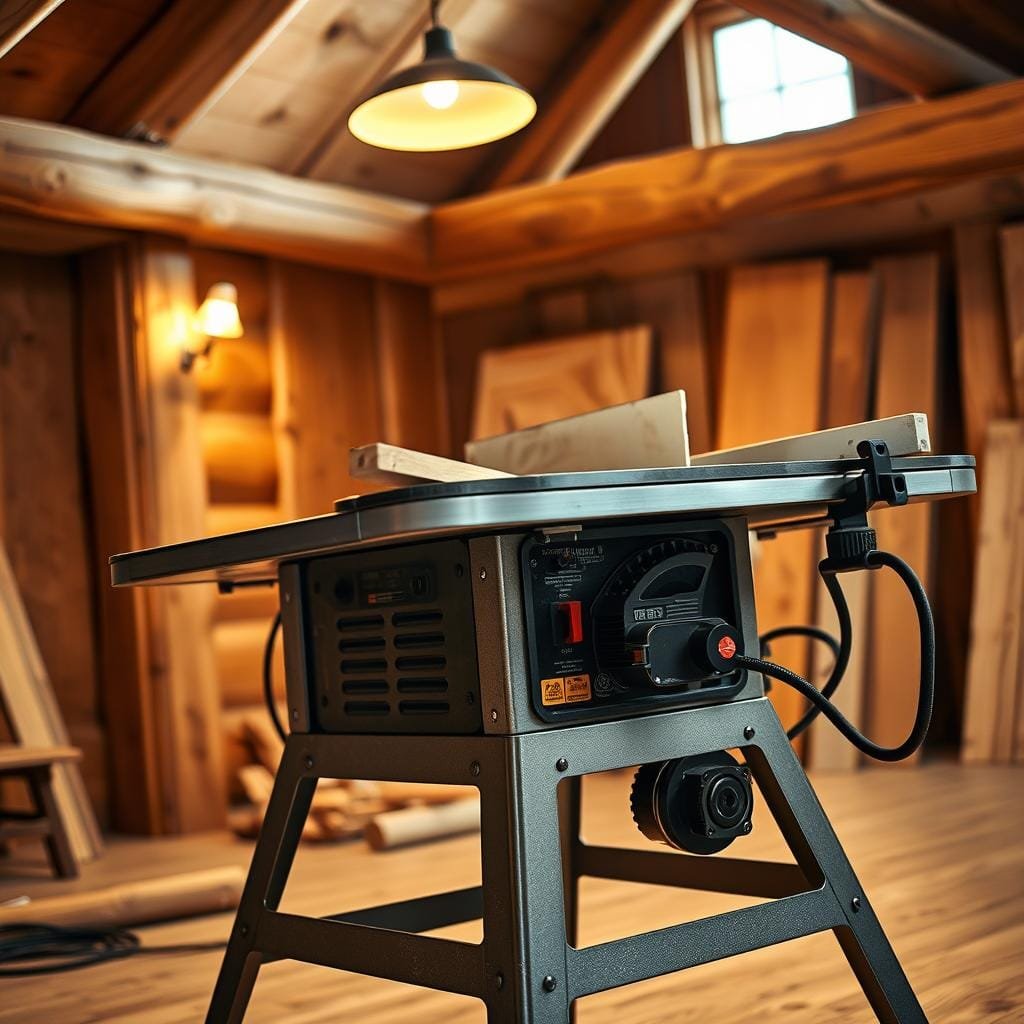
Portable Job Site Saws vs. Stationary Models
Choosing between portable and stationary table saws depends on your building location and workspace. Each type has its own benefits for cabin construction.
Portable job site saws are easy to move around. They weigh 50-70 pounds and are great for remote sites. They fit in small workshops or outdoors when the weather is good.
Most portable models have 10-inch blades and enough power for cabin building tasks.
Stationary cabinet saws offer better accuracy, power, and dust collection. They are heavy (200-400 pounds) and need a dedicated space. They make smoother cuts and handle hardwoods better than portables.
But, they’re not good for wilderness sites without existing structures. They’re best for a workshop and extensive woodworking.
| Feature | Portable Job Site Saws | Stationary Cabinet Saws |
|---|---|---|
| Mobility | Excellent – folds for transport | Poor – requires permanent location |
| Price Range | $300-$700 | $800-$3,000+ |
| Accuracy | Good for construction work | Excellent for fine woodworking |
| Power | 15-amp motors (adequate) | 3-5 HP motors (superior) |
| Best For | On-site cabin building projects | Dedicated workshop operations |
Recommended Table Saws for Builders
Portable job site models are best for cabin building. They offer great performance and practicality. These are the top choices for professional builders.
DeWalt DWE7491RS Job Site Table Saw
The DeWalt DWE7491RS is a top pick for contractors. It’s a 10-inch portable table saw with a 15-amp motor. It handles hardwoods and pressure-treated lumber well.
Its rack and pinion fence system is very accurate. It can cut full sheets of plywood in half lengthwise. The saw weighs 88 pounds and has a 32.5-inch rip capacity.
The rolling stand is easy to set up and includes wheels for moving. It connects to shop vacuums for dust collection. At around $500, it’s a great value for serious builders.
Bosch 4100-10 Worksite Table Saw
The Bosch 4100-10 has a gravity-rise wheeled stand that sets up quickly. This stand is a big plus for frequent setup and teardown. It’s a great choice for builders who need to move the saw often.
The 15-amp motor has enough power for ripping lumber and cutting sheet materials. The SquareLock fence system is easy to use and keeps cuts accurate. It has a 25-inch rip capacity.
Bosch includes safety features like a transparent blade guard. It also has on-board storage for tools. Priced like the DeWalt, it’s a good choice for builders who value quick setup and thoughtful design.
Both saws are great for cabin builders. Your choice depends on whether you need more rip capacity (DeWalt) or faster setup (Bosch). Either way, they make processing lumber and sheet goods much easier.
Hand Saws and Traditional Cutting Tools
Using a sharp hand saw adds a special touch to cabin building. It’s quieter than power tools and offers control for fine details. These professional carpentry saws are great for when power goes out, in quiet areas, and for precise work.
Hand saws cost between $10 and $100. They don’t need batteries or electricity to work. Many builders keep them handy, even with modern power tools.
The Place of Hand Saws in Modern Cabin Building
Manual tools are perfect for certain jobs where power tools don’t fit. They’re quiet, so they’re good for working near neighbors. They’re also essential in places without steady electricity.
Hand saws are great for detailed work that power tools can’t handle. They’re perfect for small trim jobs and making custom fits. You can stop and adjust easily, feeling the blade’s action.
Teaching woodworking with hand tools is safer and more effective. It’s slower, so you can learn better and make fewer mistakes. Many woodworkers enjoy the quiet, meditative work after using loud power tools.
Manual saws are reliable backups when power tools fail. They prevent delays and keep projects moving. Having quality hand saws on site is always a good idea.
Essential Hand Saw Types for Backup and Detail Work
There are many hand saw types for cabin building. Each is good for different tasks during construction and finishing.
A quality crosscut hand saw is for general work. Look for ones with 8 to 12 teeth per inch for smooth cuts. They’re great for trim and cutting lumber when power saws aren’t right.
Rip saws cut with the grain. They’re less needed but useful for splitting boards without power. If you mill your own lumber, a rip saw is valuable.
Coping saws are best for curves and tight cuts. They have thin blades for detailed trim work. They’re essential for crown molding and other decorative woodwork.
Hacksaws are for cutting metal. They’re needed for plumbing, electrical work, and installing hardware. Every builder needs them for metal cuts.
Pull saws are for flush cuts and detail work. They cut without damaging the surrounding area. Their flexible blade ensures perfect flush cuts.
| Hand Saw Type | Primary Applications | Tooth Configuration | Price Range |
|---|---|---|---|
| Crosscut Hand Saw | General cutting across grain, trim work, backup cutting | 8-12 TPI for smooth finish | $25-$80 |
| Rip Saw | Cutting with grain, splitting boards lengthwise | 4-6 TPI for aggressive cutting | $30-$90 |
| Coping Saw | Curves, interior cuts, detailed trim installation | Fine blade, 15-20 TPI | $15-$40 |
| Japanese Pull Saw | Fine carpentry, precise joinery, finish work | Variable, very fine teeth | $30-$120 |
| Hacksaw | Metal cutting, plumbing, electrical work | 18-32 TPI for metal | $12-$35 |
Japanese Pull Saws for Fine Carpentry Work
Japanese pull saws are popular among woodworkers. They cut on the pull stroke, unlike Western saws. This changes the cutting experience.
Thinner blades make narrower cuts, wasting less material. The pulling motion keeps the blade tight, preventing buckling. This results in clean cuts with little tear-out.
Many find pulling easier and more natural than pushing. It uses your body’s leverage better, reducing fatigue. This is important for long hand-sawing sessions.
Japanese pull saws are great for hardwoods and finish materials. They’re perfect for interior trim, custom furniture, and visible joinery. The best ones need little sanding.
There are many blade types for different tasks. Ryoba saws have teeth on both sides for versatility. Dozuki saws are for straight cuts, and Kataba saws are single-edged but versatile.
Quality Japanese pull saws cost from $30 to $120+. Replacement blades are $10 to $40. This makes them a good investment for years of use.
Hand saws won’t replace power tools for big jobs. But they’re great for detailed work and as backups. Having them on site expands your options and protects against power tool failures.
Portable Sawmills for On-Site Lumber Production
Modern portable sawmills let you turn trees into lumber right at your cabin site. If you have suitable trees nearby, these tools can change how you build. You can make custom lumber sizes not found in stores.
But, milling your own lumber is hard work. It takes a lot of time and effort. Yet, for the right builder, the rewards are worth it.
Benefits of Milling Your Own Lumber for Cabin Projects
Processing your own timber offers unique benefits. You can save a lot of money, which is big when building in remote areas. With the right trees nearby, you have your own lumber yard.
Cost reduction is a big plus for cabin builders. You skip the extra costs of commercial lumber. A big tree can give you enough lumber for a lot of your cabin.
Custom sizes are another big plus. Standard lumber yards don’t have what you need for timber frame construction. Portable sawmills let you cut exactly what you need.
Quality control is in your hands. You pick the trees, check the lumber as it’s cut, and spot any defects right away. This means you’re building with materials you trust.
Here are more benefits:
- Live-edge lumber creation for unique features like mantels or shelving
- Immediate material availability without waiting for deliveries
- Environmental sustainability through careful harvesting and less transportation
- Property improvement by removing trees for land clearing or forest management
- Personal satisfaction from using lumber you processed yourself
But, there are challenges too. Milling lumber is hard work, takes time, and requires new skills. Green lumber needs to dry before use in many cases. You’ll need space for milling and storing lumber during drying.
Types of Portable Sawmills for Different Needs
There are many types of portable sawmills for different needs and budgets. Knowing the types helps you choose the right one for your project. Each type has its own benefits based on your needs and budget.
Chainsaw mills are a good starting point. They turn your chainsaw into a milling tool without a big investment. They’re lightweight, easy to move, and affordable. They’re great for occasional use or adding custom pieces to your project.
Chainsaw mills are good for making beams and thick slabs. They’re not as fast as dedicated mills, but they’re great for small projects. Setup is quick, and the whole system fits in your truck bed.
Bandsaw mills are the most efficient. They cut through logs faster with less waste. This means more usable lumber from each log.
Bandsaw mills range from small, one-person models to larger ones that need two people. They’re best for those who need a lot of lumber or plan to mill often. They cost more than chainsaw mills, but you get more capacity and better quality lumber.
Circular saw mills are a middle ground. They use a circular blade that swings through the log. They’re faster than chainsaw mills but simpler than bandsaw mills. They’re good for builders who want better production than chainsaw mills but don’t need the complexity of bandsaw systems.
| Mill Type | Best For | Production Speed | Investment Level |
|---|---|---|---|
| Chainsaw Mill | Occasional use, custom beams, limited quantities | Slow (1-2 boards per hour) | $200-$500 |
| Bandsaw Mill | Regular production, efficiency, large projects | Fast (5-15 boards per hour) | $3,000-$15,000+ |
| Circular Saw Mill | Mid-level production, simple maintenance | Moderate (3-6 boards per hour) | $1,500-$5,000 |
Portable Sawmill Options Worth Considering
Three specific models are worth considering. They offer different price points and capabilities. Your choice depends on your needs, budget, and how much lumber you need for your project.
Norwood PortaMill Chain Saw Mill
The Norwood PortaMill turns your chainsaw into a milling tool. It’s affordable and easy to use. It’s perfect for custom beams or small projects.
Setup is quick, and it can handle logs up to 36 inches in diameter. It’s great for creating beams and slabs. The system costs around $350-$450, making it a budget-friendly option.
TimberKing 1220 Portable Sawmill
The TimberKing 1220 offers professional-grade performance. It cuts logs up to 20 inches in diameter and 10 feet long. It’s ideal for serious lumber production.
The 1220 has a 20-horsepower engine and cuts fast. You can produce 150-200 board feet per hour. It’s portable but needs a trailer for moving.
It offers precise thickness control and minimal waste. Expect to spend $8,000-$10,000 for the setup. This mill can supply lumber for entire cabin projects.
Alaskan Chainsaw Mill by Granberg
The Granberg Alaskan Mill is a classic choice. It’s simple and reliable. It attaches to chainsaws with bars from 20 to 60 inches.
Its design is straightforward, and it’s durable. You’ll use a guide board for the first cut and then ride on the previous cut for subsequent passes. It’s easy to learn and has a gentle learning curve.
Pricing ranges from $200 for smaller models to $400 for larger ones. Many builders start with this mill and upgrade later as their needs grow.
All three options require patience and effort. Milling lumber is not quick or easy. But, the satisfaction of building with lumber you processed yourself is unmatched.
Power Tool Considerations for Off-Grid and Wilderness Building
Choosing the right tools for building a cabin in remote areas is key. You’ll face challenges like finding power, which affects your work schedule and tool choices. Unlike city projects, wilderness sites need a solid power plan from the start.
Today’s power tools are much better for wilderness work. Batteries last longer, and solar chargers are affordable and portable. You’ll likely use a mix of power sources based on your location, budget, and project timeline.
Committing to a Single Battery System
Choosing one battery system for all your tools is a smart move. It saves money and space when moving equipment. Interchangeable batteries mean no need for multiple chargers.
Buying tools without batteries can save 30-40% after your initial battery purchase. This way, you can swap batteries between tools when needed. It’s better than having batteries for each tool, which is useful in areas without easy charging.
Milwaukee M18 has the widest tool selection on one battery platform. Their tools are professional-grade but cost more. M18 batteries last long, and High Output versions are as powerful as corded tools.
DeWalt 20V Max is widely available in rural areas, which is helpful for getting parts or tools during a project. Their tools are a good balance of quality and price. DeWalt’s Flexvolt batteries work with both 20V and 60V tools, making them versatile.
Makita 18V LXT batteries last longer than others and have a wide range of tools. Many pros find Makita the most reliable. Their cordless chainsaw and table saw work well off-grid.
Other good battery platforms include:
- Bosch 18V – great engineering and ergonomics, but fewer tools
- Ryobi One+ – affordable with many tools, good for weekend projects
- Ridgid 18V – offers a lifetime service agreement for long-term value
- Craftsman V20 – a middle option with growing tool selection
Combustion Power for Isolated Sites
Gas tools are essential for wilderness construction, despite battery advancements. They offer unlimited power as long as you have fuel. This makes them perfect for really remote sites.
Chainsaws are the most obvious gas tool for log cabins. While battery chainsaws are getting better, gas models are better for heavy work. A good gas chainsaw can run all day with quick refueling.
Gas generators are great for running tools and charging batteries. They let you use the best tool for each job without battery limits. A 3000-watt generator can power a miter saw or table saw while charging batteries.
Gas tools are noisy and pollute, but they’re often needed for long projects. They require fuel storage and maintenance, unlike battery tools. Despite these downsides, gas power is often necessary for wilderness building.
Harnessing Solar Energy for Tool Charging
Solar charging is now a good option for remote tool charging. Modern solar panels and lithium batteries can power tools for days. It’s important to understand how much solar you need.
First, calculate your daily power needs based on tool usage. A 5.0Ah 18V battery stores 90 watt-hours. For three batteries a day, you need 270 watt-hours. Add 20% for charging loss, and you need 325 watt-hours daily.
A 100-watt solar panel can produce 400-500 watt-hours in sunlight. But, weather is the biggest solar challenge. Cloudy days can reduce output to 25-40%, forcing you to adjust your plans.
For off-grid building, you’ll need:
- Portable solar panels – 200-400 watts for fast charging
- Charge controller – MPPT for better sunlight use
- Battery bank – lithium for storing energy at night
- AC inverter – for charging tools with DC power
Popular systems include Jackery Explorer 1000 or Goal Zero Yeti 1500X with 200-watt panels. These can charge many batteries daily in good weather. Budget $1,200-2,000 for a system that supports active construction.
Choosing the Right Generator
Choosing a generator depends on your tool needs. Inverter generators are better for electronics and battery charging, while conventional ones offer more power at a lower cost. Pick based on your tools and needs.
Inverter generators give stable power for tools and chargers. They’re quieter and adjust speed with load, saving fuel. Models like Honda EU3000iS or Yamaha EF3000iSEB offer 3000 watts for most tools.
Here are some tool power needs:
| Tool Type | Running Watts | Starting Watts |
|---|---|---|
| 7-1/4″ Circular Saw | 1400-1800W | 2200-2800W |
| 10″ Miter Saw | 1500-2000W | 2400-3200W |
| Portable Table Saw | 1800-2400W | 3000-4000W |
| Battery Charger Station | 200-400W | 250-500W |
Conventional generators are cheaper but noisier and less reliable. Champion 3500-watt or Westinghouse 4500-watt are budget-friendly for tough tools. They’re good for job site lights, battery charging, and occasional corded tools.
Fuel planning is key for long projects. Quality inverter generators use 0.3-0.5 gallons per hour. A 5-gallon tank gives 10-15 hours. Plan your generator hours, multiply by project length, and add 25% for extra needs.
Blade Selection and Maintenance for Optimal Performance
Even the most expensive saw performs poorly with a dull blade. Blade knowledge is as important as the tool itself. Choosing the right blade and keeping it sharp is key to your cabin construction project.
Many cabin builders spend thousands on quality saws but forget about the blades. This oversight leads to poor results, dangerous kickbacks, and tool wear. But, proper blade selection and maintenance are simple once you know the basics.
Chainsaw Chain Types and Sharpening Techniques
Chainsaw chains come in different types for various cutting conditions. Full chisel chains cut aggressively through softwood and hardwood. They’re perfect for milling fresh timber on your cabin site.
Semi-chisel chains have rounded edges that stay sharp longer in dirty conditions. These chains cut slower but need less sharpening. Low-profile chains are best for smaller saws and prioritize safety over speed.
Skip-tooth chains have fewer cutters for less drag when cutting large logs. They’re great for milling operations and cutting logs over 20 inches in diameter.
Recognizing when chains need sharpening prevents dangerous situations and poor cutting. Dull chains produce fine sawdust, require excessive pressure, and cut crookedly. Sharp chains cut easily and create large chips.
Sharpening chainsaw chains requires the right round file size. Most cabin building chains use 5/32-inch, 3/16-inch, or 7/32-inch files. Keep the filing angle at 25-35 degrees and file each cutter with the same number of strokes. Don’t forget to file down the depth gauges every 3-5 sharpenings.
Many builders sharpen chains themselves or use electric sharpeners. Professional sharpening services cost $10-15 per chain and ensure consistent results.
Circular Saw Blades for Lumber, Plywood, and Specialty Cuts
Circular saw blade selection affects cutting quality and speed. Tooth count determines the balance between cutting speed and surface smoothness. Choosing the right tooth count saves time and improves results.
24-tooth framing blades cut quickly through dimensional lumber. These aggressive blades are ideal for rough framing work. Use them when speed is more important than appearance.
40-60 tooth combination blades handle general-purpose cutting tasks well. They rip lumber reasonably and crosscut with decent smoothness for most cabin construction applications.
60+ tooth plywood blades cut sheet goods without splintering or tearout. These blades are perfect for visible surfaces like interior paneling or cabinet work.
| Blade Type | Tooth Count | Best Applications | Cut Quality |
|---|---|---|---|
| Framing Blade | 24 teeth | Dimensional lumber, rough structural cuts | Fast, rough finish |
| Combination Blade | 40-60 teeth | General purpose, mixed materials | Moderate speed and smoothness |
| Plywood Blade | 60-80 teeth | Sheet goods, finished surfaces | Slow, very smooth finish |
| Specialty Blades | Varies | Metal, masonry, fiber cement | Material-specific performance |
Specialty circular saw blades handle materials beyond standard lumber. Metal-cutting blades have small teeth for cutting steel roofing or pipes. Masonry blades use abrasive particles for cutting concrete blocks or stone. Fiber cement blades resist the abrasive nature of products like Hardie board siding.
Carbide-tipped blades cost more but last longer than steel blades. These premium blades can be sharpened multiple times, making them more economical over the life of your cabin project.
Jigsaw Blade Varieties and Material Applications
Jigsaw blades come in many varieties, but understanding TPI (teeth per inch) ratings simplifies selection. Lower TPI numbers cut faster but leave rougher edges. Higher TPI numbers cut slower but deliver smoother finishes.
Blade material affects what you can cut effectively. High-carbon steel blades work well for softwood and hardwood but dull quickly. Bi-metal blades are flexible and hard, suitable for wood and metal cutting. Carbide-grit blades use abrasive particles to cut tile, fiberglass, and other challenging materials.
Blade length matters when cutting thick materials. Standard 3-inch blades handle material up to 2 inches thick. Longer 4-inch or 6-inch blades reach through thicker stock but flex more during cutting, which can reduce accuracy.
Specialized jigsaw blades serve specific purposes during cabin construction. Scrollwork blades have fine teeth for tight radius curves in decorative trim. Aggressive wood-cutting blades have widely spaced teeth that clear sawdust quickly when cutting thick lumber. Knife-edge blades cut soft materials like leather, rubber, or foam insulation without tearing.
Most jigsaw blades use universal T-shank fittings that work with any modern jigsaw. Older U-shank blades offer no advantages and limit your blade selection options.
When to Replace vs. Sharpen Saw Blades
Knowing when to sharpen versus replace blades saves money without compromising cutting quality or safety. Carbide-tipped circular saw blades justify professional sharpening. Quality blades cost $30-80 and can be sharpened 5-10 times for $10-15 per sharpening. This makes a $50 blade an investment that lasts for years.
Chainsaw chains sharpen easily and affordably, either by yourself or through professional services. A single chain lasts through dozens of sharpenings until the cutters wear down to minimum height specifications. Replacing chains costs $15-40 depending on size, while sharpening costs just a few dollars in file expenses or $10-15 professionally.
Jigsaw and reciprocating saw blades are designed as disposable items. These thin blades cost $1-5 each and can’t be effectively resharpened. Replace them when cutting becomes noticeably slower or requires excessive pressure.
Certain damage requires immediate blade replacement regardless of sharpness. Missing or broken teeth create dangerous situations and ruin cutting accuracy. Warped blades wobble during cutting and produce dangerous kickback. Excessive heat discoloration (blue or purple tinting) indicates the blade has been overheated and lost its temper, making it unsafe to use.
Regular blade inspection prevents problems before they affect your work quality or safety. Check circular saw blades for missing carbide tips before each use. Examine chainsaw chains for damaged drive links or broken tie straps. Replace any blade showing signs of damage immediately to avoid injury or ruining expensive lumber.
Proper blade maintenance extends tool life dramatically. Clean resin buildup from circular saw blades using oven cleaner or specialized blade cleaning solutions. Store blades in protective cases to prevent damage. Keep spare blades on hand so you can immediately swap out dull blades without compromising cutting performance.
Safety Practices and Essential Protective Gear for Saw Operation
Working with construction saws requires respect for their power. It also demands a commitment to safety measures that keep you safe. Professional carpentry saws can cause serious injuries if used carelessly or without proper protection. Safety equipment is not optional; it’s the most important tool investment for your project.
No cabin building weekend should ever include an emergency room visit. Power tools like circular saws, chainsaws, and miter saws generate tremendous cutting force. This can cause life-changing injuries in seconds. Learning safe and proper operation techniques before using any power tool protects both your project timeline and your physical well-being.
Personal Protective Equipment for Professional Carpentry
The right protective gear creates multiple barriers between you and injuries. Eye protection ranks as the single most critical safety item because sawdust, wood chips, and debris fly toward your face with every cut. Choose ANSI-rated safety glasses or goggles that fit snugly against your face and provide side protection.
Smart builders keep multiple pairs of safety glasses distributed around their work site. Place them wherever you store power tools so they’re always within arm’s reach. Any safety accessory that’s more comfortable and convenient will be worn more consistently.
Hearing protection prevents permanent damage from the loud noise generated by professional carpentry saws. Earmuffs offer the most reliable protection because they’re quick to put on and difficult to insert incorrectly. Foam earplugs work well when properly inserted, but many people don’t achieve a proper seal.
Work gloves protect your hands when handling rough lumber and materials between cutting operations. Remove gloves before operating power tools because loose material near moving blades creates entanglement hazards. This applies to any loose-fitting clothing that could get caught in rotating components.
Complete your basic PPE with these additional items:
- Steel-toed boots protect feet from dropped lumber, tools, and materials
- Dust masks or respirators filter harmful particles when cutting treated lumber or working in enclosed spaces
- Chainsaw chaps with cut-resistant layers stop chains before they reach your legs
- Chainsaw helmet systems combine face shields, hearing protection, and head protection
- Cut-resistant gloves designed for chainsaw operation
Common Saw-Related Hazards and Prevention Strategies
Understanding specific dangers helps you develop prevention habits that become automatic over time. Kickback represents the most common serious hazard with circular saws and miter saws. This violent reaction occurs when the blade binds in the material and throws the saw backward toward the operator.
Prevent circular saw kickback by supporting workpieces properly so they don’t pinch the blade during cutting. Never force the saw through material or twist the blade to change direction mid-cut. Allow the blade to reach full speed before starting each cut.
Chainsaw kickback happens when the upper portion of the bar tip contacts material, causing the saw to rotate upward toward your face. Maintain a firm grip with both hands and thumbs wrapped completely around the handles. Avoid cutting with the kickback zone at the bar tip whenever possible.
| Hazard Type | Common Causes | Prevention Strategy | Tools Most Affected |
|---|---|---|---|
| Kickback | Blade binding, tip contact, improper setup | Proper workpiece support, correct blade speed, firm grip | Circular saws, chainsaws, miter saws |
| Finger Contact | Improper hand position, removed guards, rushing | Maintain safe distances, use guards, work deliberately | All power saws |
| Projectile Debris | Broken blades, ejected material, loose pieces | Inspect blades before use, secure workpieces, wear eye protection | Circular saws, miter saws, table saws |
| Electrical Shock | Damaged cords, wet conditions, improper grounding | Use GFCI protection, inspect cords, keep dry | All corded tools |
| Fatigue Accidents | Working tired, skipping breaks, rushing to finish | Take regular breaks, stop when tired, plan realistic schedules | All tools |
Finger contact with blades causes devastating injuries that proper hand position prevents entirely. Always keep your hands outside the blade’s cutting path and use clamps or guides instead of holding small pieces near the blade. Never reach under or around a blade guard.
Projectile hazards come from broken blade teeth, ejected knots in lumber, or loose workpieces catching the blade. Inspect blades before each use session for cracks or damaged teeth. Secure all workpieces firmly before cutting, and position yourself to the side of circular saw cuts.
Electrical hazards affect all corded professional carpentry saws on construction sites. Use GFCI-protected outlets or portable GFCI adapters for all power tools. Inspect extension cords regularly for damage and replace them immediately if you find exposed wires or worn insulation.
Proper Saw Handling Techniques for Each Tool Type
Each saw type requires specific operational techniques that maximize both safety and cutting effectiveness. Circular saw operation begins with proper setup and support. Always allow the blade to reach full operating speed before contacting the workpiece. Rushing this step increases kickback risk and produces rough cuts.
Support the saw’s base plate firmly against the workpiece throughout the entire cut. Never set a circular saw down until the blade stops spinning completely. The exposed blade continues cutting anything it contacts during coast-down.
Chainsaw safety demands precise starting procedures and grip techniques. Follow the manufacturer’s starting instructions exactly, whether using ground starts or supported starts. Never attempt to start a chainsaw while holding it in the air with one hand.
Maintain a firm grip with both hands during all cutting operations. Wrap your thumbs completely around the handles instead of resting them alongside. This grip prevents loss of control during kickback events.
Miter saw operation requires these specific practices:
- Clamp or firmly hold workpieces against the fence before cutting
- Verify blade guards move freely and return to position after each cut
- Keep both hands clear of the blade path—never cross your arms over the saw
- Allow the blade to stop completely before raising the saw head
- Never reach behind the blade to remove cutoff pieces while it’s moving
Jigsaw control prevents blade breakage and material damage. Hold the saw firmly against the workpiece to prevent bouncing that breaks blades and creates rough cuts. Let the saw’s weight and blade action do the cutting work instead of forcing downward pressure.
Maintenance Routines That Keep Saws Safe and Effective
Regular maintenance directly impacts operational safety by keeping tools functioning as designed. Sharp blades require less force to cut, which gives you better control and reduces fatigue that leads to accidents. Dull blades force you to push harder, increasing the chance of slips and loss of control.
Inspect power cords before each use session, examining the entire length for cuts, exposed wires, or damaged insulation. Replace damaged cords immediately instead of wrapping them with tape. Electrical failures on professional carpentry saws can cause both shock hazards and tool malfunctions during cutting.
Blade guards and safety mechanisms require regular cleaning to function reliably. Sawdust accumulation prevents guards from returning to position or operating smoothly. Clean these mechanisms after each work session using compressed air or a brush.
Check blade tightness before starting any cutting session. Loose circular saw blades can detach during operation and cause serious injuries. Chainsaw chains require proper tension—too loose and they can derail, too tight and they increase wear and heat buildup.
Proper tool storage protects both the equipment and people around it. Store saws with blades covered or guards in position. Keep them in locked areas if children or untrained individuals access the work site. Remove batteries from cordless tools during storage to prevent accidental activation.
Safety practices aren’t restrictions that slow down your cabin construction progress. They’re fundamental skills that enable you to work confidently and complete your project without interruption. Developing consistent protective habits and maintenance routines transforms saw operation from a source of anxiety into controlled, productive work that brings your cabin vision to reality.
Equipping Yourself for Successful Cabin Construction
You now know which tools are best for your building journey. You don’t have to pick just one between a circular saw, chainsaw, or jigsaw. Each tool is great for different tasks, making your project safer and more efficient.
Begin with the tools you’ll use most often. A chainsaw is perfect for cutting timber, while a circular saw is great for framing. Use a jigsaw for detailed work. This way, you won’t spend too much money and will have a good toolkit.
Renting tools for special tasks is smart. You can rent table saws, miter saws, and portable sawmills when needed. This lets you focus on buying the essentials you’ll use every day.
Quality tools last for decades if you take care of them. Sharpen chains, replace blades when necessary, and store your tools right. These saws will help with cabin upkeep and future projects for years to come.
Many beautiful cabins exist today because builders started with basic tools and learned as they went. Knowing about the best saws for cabin construction puts you ahead of many builders.
The tools are just a means to your ultimate goal: building a cabin that offers shelter, comfort, and memories for years. You’re all set to turn your plans into reality, one cut at a time.


