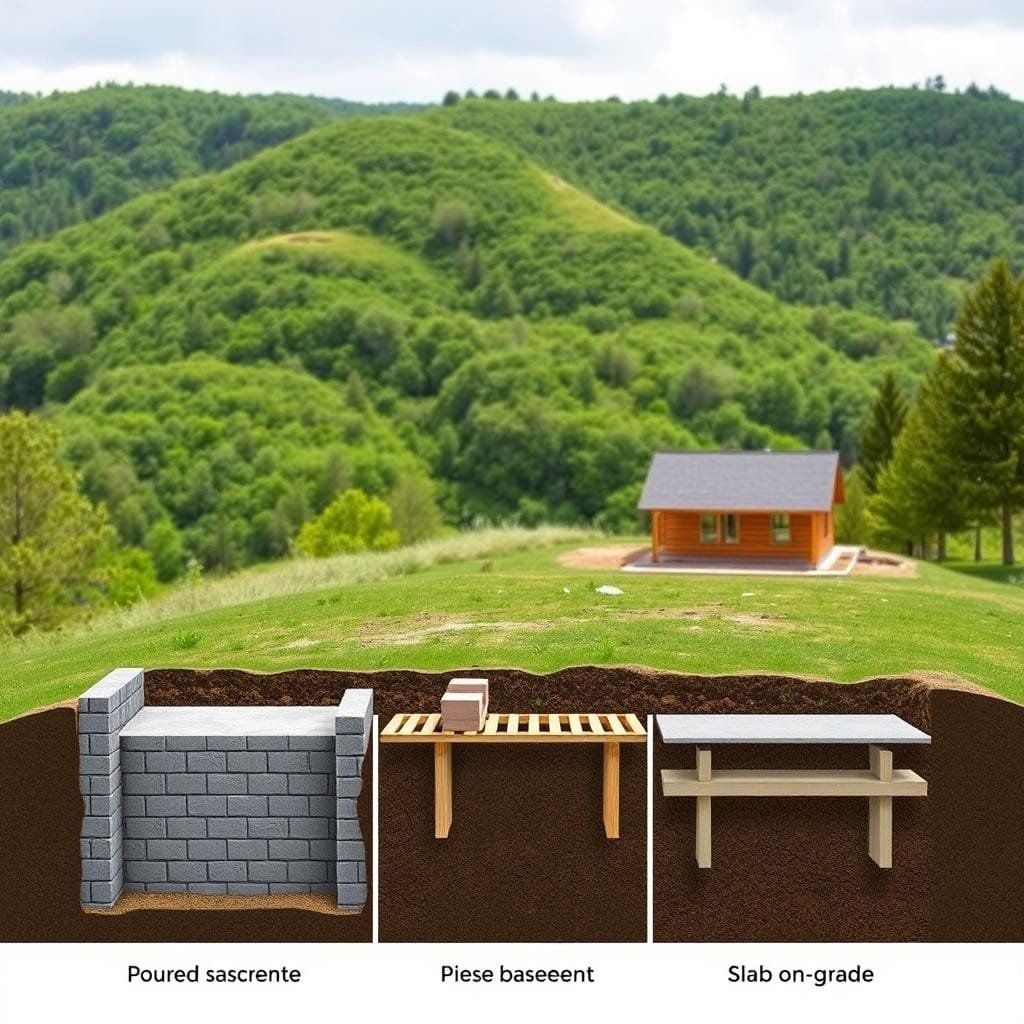

Imagine your dream cabin perched on a hill, with views of the valley below. Building on sloped land is exciting, but it comes with its own set of challenges. Unlike flat lots, sloped land requires special care.
Many fear the complexity of hillside building. Stories of failed projects and cost overruns can be scary. But, with the right planning and support, your mountain home can be both beautiful and strong.
Choosing the right foundation is key for your site. Building on uneven terrain means focusing on water flow, soil strength, and the slope’s angle.
This guide will show you foundation types that work on slopes. You’ll learn about pier systems and retaining walls. We’ll explain why each is good for your site, budget, and dream. You’ll feel ready to start your project.
Understanding the Unique Challenges of Building on Sloped Terrain
Building on a slope means physics is your toughest partner. Cabin construction on uneven terrain is different from building on flat ground. Forces that are small on flat ground become big challenges on slopes.
Hillside sites offer amazing views and beauty. But they need special knowledge, careful planning, and often more money. Knowing these challenges helps you make smart choices and avoid costly mistakes.
Dealing with Gravity and Soil Pressure
Gravity pulls things down on a slope, but it also pushes sideways. Your foundation must fight against this sideways force. Builders on flat ground rarely face these forces, but they’re big concerns on hills.
Soil on slopes acts differently than flat ground soil. The earth is already stressed by gravity, affecting how it settles. Your foundation must handle this movement and pressure.
Structural support for cabins on inclines must tackle several key points:
- Downslope soil pressure that grows with the slope’s steepness
- Uneven load distribution as weight shifts through sloped footings
- Differential settlement where parts of the foundation settle at different rates
- Potential soil creep that slowly moves earth downward
The steeper the slope, the bigger these forces are. A 10% grade is manageable, but a 30% or steeper slope needs serious engineering. Calculating load distribution is like solving a math puzzle.
Managing Water Flow and Preventing Erosion
Water management is key on slopes. Experienced builders say proper drainage is the top priority on hillsides. Without it, even the best foundation can fail.
Water flows downhill, gathering speed and force. Without drainage, it can undermine foundations, wash away soil, and create erosion channels. These channels get worse with each storm.
Builders have seen cabins with cracked foundations and tilted walls. These problems come from poor drainage. One rainy season can ruin years of work if water isn’t directed away.
But, slopes can help if you design drainage systems that use the natural slope. This directs water away from your cabin and other structures. Planning for drainage from the start is essential.
Effective water management includes:
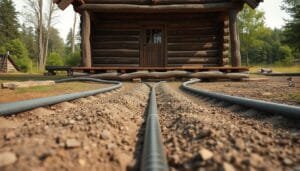
- Installing French drains uphill from the foundation to catch groundwater
- Creating swales and berms to channel runoff around the building site
- Ensuring proper grading to direct water away from foundations
- Adding erosion control measures like retaining walls, vegetation, and drainage rock
Areas with lots of rain need extra attention to these details. What works in dry climates may not be enough in wet ones.
Overcoming Access and Equipment Challenges
Getting materials and machinery to a hillside site is a puzzle. Flat-land builders never face these challenges. Concrete trucks and excavators need clear paths, and your steep grade foundation options may be limited by what equipment can reach your site.
Consider the practical realities: concrete trucks are heavy and need stable roads. Excavators and cranes need level areas. Material deliveries get more expensive when drivers can’t easily reach your site.
Time is also a factor. Excavator rentals are daily, and tough access can turn a one-day job into three. Remote sites may mean pumping concrete longer distances, adding cost and complexity.
Smart planning can overcome these challenges:
- Building or improving access roads before starting foundation work
- Creating staging areas for safe material storage and organization
- Scheduling equipment rentals to maximize productivity
- Considering alternative construction methods that need less heavy equipment access
These challenges affect which foundation type is best for your project. A design that looks good on paper might be impractical if equipment can’t reach your site or if material delivery costs are too high.
Key Factors to Consider Before Choosing Your Foundation
Every sloped building site has its own challenges. The best foundation for cabin on slope depends on several factors. These factors vary from one property to another.
Choosing the right foundation means looking at your land, local rules, and budget. Each factor affects the foundation types that are safe and practical for your hillside cabin.
Measuring Slope Steepness and Grade Levels
First, you need to understand your slope angle. Slope is measured as “rise over run.” This tells you how steep your land is.
To find the grade percentage, divide the rise by the run and multiply by 100. For example, a 10% grade means your land rises 10 feet for every 100 feet horizontally.
Different slope percentages affect your foundation choices. Gentle slopes under 10% might work with a slab foundation. Slopes between 10-20% often need pier and beam or post systems.
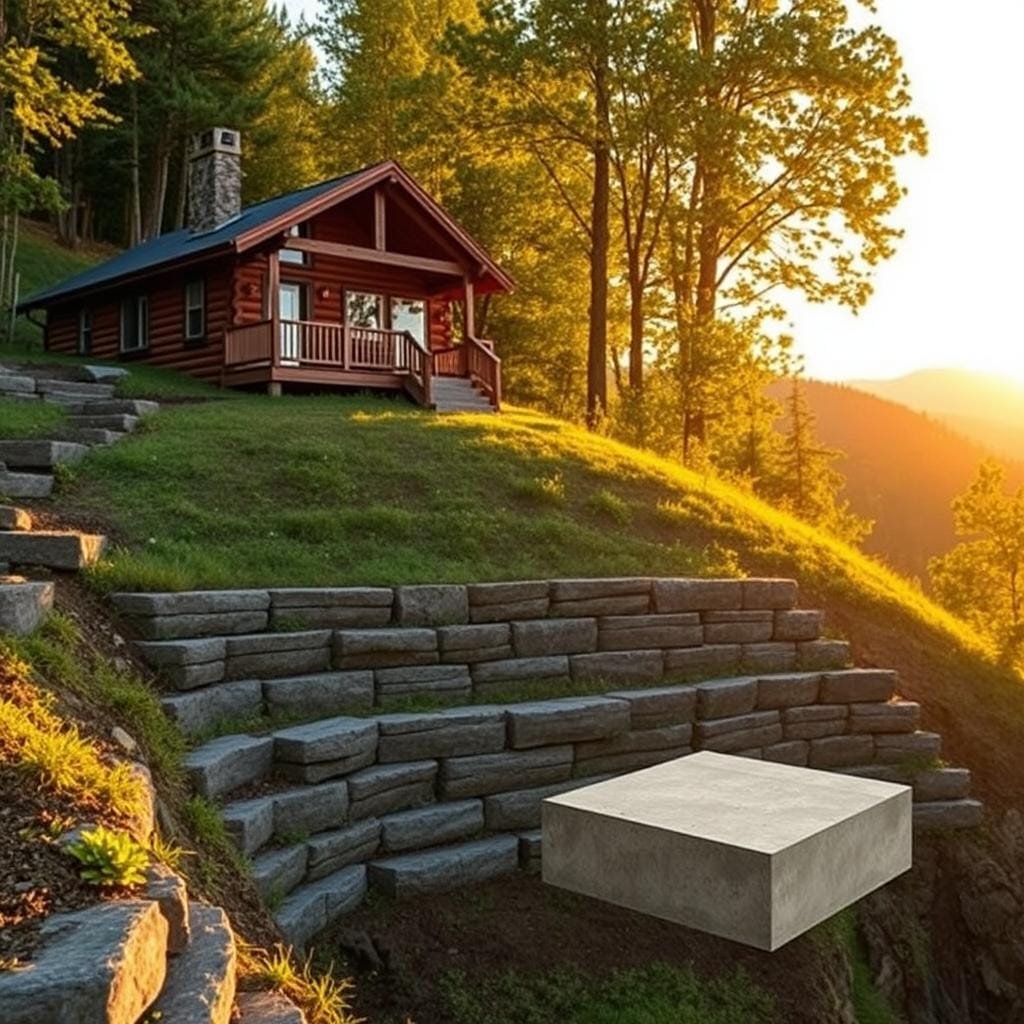
Steep slopes from 20-40% limit your choices. You might need specialized pier systems or cantilever designs. Slopes over 40% are very challenging and often require the most expensive solutions.
You can measure your slope with simple tools like a level and measuring tape. But, hiring a surveyor gives you accurate measurements and a topographic map for planning.
Understanding Your Soil Composition and Load-Bearing Capacity
Soil type is key to foundation stability. What’s under your cabin site determines if certain steep grade foundation options are right for you.
Professional soil testing shows the bearing capacity and stability of your site. This testing is critical for safety and code compliance on hillside sites.
Bedrock is the most stable base and supports heavy loads well. If your slope has shallow bedrock, pier foundations can anchor into it for great stability.
Clay soils expand when wet and contract when dry. This can crack foundations. Clay sites often need deeper foundations or special drainage.
Sandy soils drain well but may not support heavy structures. Sandy sites can shift and erode, needing engineered pier systems.
Unstable fill or organic soils are the most problematic. These materials compress under weight and don’t support well. Sites with fill may need excavation to native soil or bedrock before foundation work.
Navigating Hillside Construction Regulations
Local building codes for sloped terrain are stricter than for flat sites. Your area may have specific rules for hillside development. These rules affect which foundation types for hillside building you can use.
Many mountain and hillside communities require structural engineer approval for slope construction. The engineer must review your plans and provide sealed drawings that confirm your foundation design meets safety standards.
Geotechnical reports are often needed for building permits on slopes. These reports document soil conditions and recommend foundation approaches. Without this documentation, permits won’t be approved.
Some areas have rules on setbacks from slope edges, restrictions on cut-and-fill, or environmental protections. Checking with your local building department early prevents costly surprises.
Watershed protection rules may affect drainage design and erosion control measures. These requirements add complexity and cost but protect your property and surrounding areas from water damage.
Balancing Investment and Construction Timeline
Budget and timeline constraints influence your foundation choice. Foundation costs vary based on design complexity, site access, and local labor rates.
Concrete foundations are the most expensive and take the longest. They require specialized equipment and experienced crews. Weather delays are common due to temperature and moisture conditions.
Pier and beam systems are faster and more affordable. Pre-manufactured pier components can be delivered easily. Smaller crews can complete pier installations quicker than concrete foundations.
Site accessibility affects your budget and schedule. If heavy equipment can’t reach your slope, costs increase. Remote locations may need smaller machinery or helicopter delivery of materials.
Weather and seasonal considerations impact construction timelines more on slopes than flat sites. Rain can halt work and cause erosion. Snow and frozen ground stop work in many mountain regions. Planning your foundation work during optimal weather is key.
| Slope Grade | Suitable Foundation Types | Relative Cost | Construction Timeframe |
|---|---|---|---|
| 0-10% (Gentle) | Slab-on-grade, Walkout basement, Pier and beam | $$ – $$$ | 2-4 weeks |
| 10-20% (Moderate) | Pier and beam, Post and beam, Stepped footings | $$$ – $$$$ | 3-6 weeks |
| 20-40% (Steep) | Concrete piers, Steel post systems, Cantilever designs | $$$$ – $$$$$ | 6-10 weeks |
| 40%+ (Extreme) | Engineered pier systems, Specialized cantilever structures | $$$$$ – $$$$$$ | 10-16 weeks |
Hidden costs can surprise first-time hillside builders. Slope stabilization, retaining walls, and erosion control add to your budget. Plan for a 15-20% contingency fund for unexpected site conditions.
Your timeline should account for permit approval delays. These can take months in areas with strict hillside regulations. Starting the permit process early keeps your project on schedule and prevents delays.
Pier and Beam Foundation on Hillside: A Popular Choice
For decades, builders have chosen pier and beam systems for cabins on uneven ground. This method is flexible and popular for sloped properties. It’s affordable and adaptable, making it a great choice for many cabin projects.
A pier and beam foundation on hillside terrain uses vertical support columns and horizontal beams. It naturally compensates for grade changes, making your cabin sit level on steep land. This solution has proven effective in many projects.
The Mechanics Behind Slope Adaptation
Understanding this foundation system’s mechanics shows its versatility. Vertical piers or posts are installed at strategic points, extending from stable ground to a consistent height. These piers vary in length to create a level plane for your cabin.
The structural support for cabins on inclines comes from the interaction of these components. Horizontal beams connect the tops of the piers, forming a grid that distributes weight evenly. Floor joists then span across these beams, creating the platform for your cabin floor.
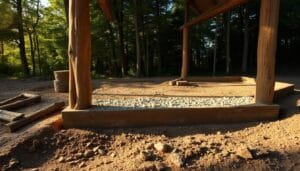
There are two main approaches to pier construction. The first uses concrete pads at ground level, topped with cinder blocks or pressure-treated wood posts. The second method sets vertical posts directly into the ground within concrete footings, providing excellent stability.
Why Builders Love This Foundation System
The advantages of choosing a pier and beam foundation on hillside properties are significant. These benefits often make the difference between a feasible project and one that exceeds budget or timeline constraints.
Cost efficiency is a top reason builders choose this system. It costs 30-50% less than full concrete foundations. The reduced material requirements and faster installation lead to savings.
Here are the key advantages you’ll enjoy:
- Minimal excavation required: You won’t need extensive earth-moving equipment or extensive site preparation, which reduces both cost and environmental impact.
- Fast installation timeline: Many pier and beam foundations can be completed in just a few days, unlike traditional foundations that take weeks.
- Unlimited design flexibility: Piers can be positioned in virtually any configuration, accommodating irregular slopes and unique cabin designs.
- Natural ventilation benefits: Air circulation beneath your cabin prevents moisture accumulation and reduces the risk of mold or rot.
- Valuable crawl space: The area beneath your cabin provides convenient access to plumbing, electrical systems, and even storage opportunities.
- Spectacular elevated views: The raised position of your cabin often creates stunning vantage points that wouldn’t be possible with ground-level construction.
- Reduced environmental disturbance: Less excavation means preserving more natural vegetation and minimizing erosion risks.
The ventilation aspect deserves special mention. Unlike slab foundations that trap moisture against building materials, the open air circulation beneath a pier and beam system keeps everything dry and healthy.
Understanding the Limitations
Every foundation system has trade-offs, and pier and beam construction is no exception. Being aware of its drawbacks helps you make an informed decision and plan appropriately.
Structural stability doesn’t match that of solid concrete foundations. While adequate for most cabin applications, the system may experience slight movement over time, mainly during extreme weather events or seismic activity.
Consider these challenges:
- Frost heave vulnerability: In regions with deep ground freezing, piers can shift as soil expands and contracts through freeze-thaw cycles.
- Pest and animal access: The open crawl space beneath your cabin may attract rodents, insects, or larger animals seeking shelter.
- Floor movement concerns: Some homeowners notice slight bouncing or flexing in floors, specially in rooms with long beam spans.
- Ongoing maintenance needs: Wooden components require periodic inspection and treatment to prevent deterioration.
- Code compliance issues: Some jurisdictions have strict requirements that may limit or prohibit pier and beam construction in certain areas.
Cold climate builders need to pay particular attention to frost depth requirements. Piers must extend below the frost line to prevent shifting, which can significantly increase installation depth and cost in northern regions.
Ideal Situations for This Foundation
Knowing when to choose pier and beam construction ensures project success. This foundation type excels in specific scenarios where its strengths align perfectly with site conditions and project goals.
The system works best for moderate to steep slopes where traditional foundations would require excessive excavation. Grades ranging from 10% to 40% are ideal candidates, though steeper applications are possible with proper engineering.
Climate considerations play an important role. Mild to moderate climates without extreme temperature swings or deep frost penetration are perfect for pier and beam systems. Southern and coastal regions often see excellent long-term performance.
Budget-conscious builders find this foundation type appealing. When project funds are limited but quality is a priority, pier and beam construction offers the best value proposition.
Remote locations with limited equipment access benefit greatly from this approach. The ability to install foundations without massive excavators or concrete trucks makes mountain and wilderness builds more feasible. Hand tools and portable equipment can accomplish much of the work.
Lastly, consider this foundation when environmental preservation matters to your project. Properties with protected vegetation, sensitive ecosystems, or erosion concerns benefit from the minimal ground disturbance that pier and beam installation requires.
Concrete Piers for Sloped Sites: Strong and Stable
Looking for a foundation that can handle steep terrain? Concrete piers are your best bet. They anchor deep into the ground, creating a stable platform. This is key for your cabin’s stability, no matter the slope.
Concrete piers are flexible and customizable. You can adjust their height to fit your slope perfectly. This approach saves on excavation costs and keeps your cabin connected to nature.
Different Pier System Options
Poured concrete piers are the most customizable for hillside construction. Contractors dig holes, add steel bars, and fill them with concrete. This method ensures your pier fits your cabin’s needs and soil conditions.
Precast concrete piers are ready-made and quick to install. They’re best for sites with predictable soil conditions. This makes them a fast and reliable choice.
Concrete-filled sonotubes offer a cost-effective option. They use cardboard tubes as forms for wet concrete. The tubes protect the concrete from moisture and can be stripped for a clean finish.
Bell-bottom piers have wider bases for better stability in soft soils. Their mushroom shape helps them stand firm on slopes with clay or loose soil.
Grade beam systems connect piers with concrete beams at ground level. This creates a unified structure that shares loads. It’s great for larger cabins where weight management is key.
| Pier System Type | Installation Time | Cost Range | Best Slope Application |
|---|---|---|---|
| Poured Concrete | 5-7 days | $150-$300 per pier | Steep slopes with varying soil conditions |
| Precast Concrete | 2-3 days | $100-$200 per pier | Moderate slopes with stable soil |
| Sonotube Systems | 4-5 days | $120-$250 per pier | All slope types, budget-conscious projects |
| Bell-Bottom Piers | 6-8 days | $200-$400 per pier | Soft soil conditions on any slope angle |
| Grade Beam Systems | 8-12 days | $250-$500 per pier | Large structures on steep terrain |
Building Pier Foundations on Hills
The process starts with site assessment and pier marking. Engineers plan pier locations based on your cabin’s weight and design. This planning avoids costly changes later.
Excavation digs holes to the frost line, which is 3 to 4 feet deep in cold climates. The holes need to reach solid ground for stability.
Downhill piers are taller than uphill ones. This creates a level surface for your cabin. Contractors plan for these height differences to prepare materials and schedule work.
Gravel fills the holes to prevent water buildup. It also provides a stable base for the piers.
Forms or sonotubes are placed in the holes, with steel bars inside for strength. The rebar helps the concrete resist cracking. Most piers use at least four vertical rebar pieces.
Concrete pouring requires careful mixing and placement. The mixture must fill all spaces around the rebar without air pockets. Vibrating the forms helps eliminate bubbles.
Curing time depends on temperature and humidity. It usually takes 7 to 14 days. Rushing this process can weaken the foundation.
The final step is connecting piers with beams. Metal brackets or bolts secure the beams to the pier tops. These connections must transfer loads properly and allow for adjustments during cabin assembly.
Durability and Upkeep Expectations
Properly installed concrete pier systems last 50 years or longer with little maintenance. They resist moisture, insects, and decay better than wood. This means lower costs over time, despite higher initial costs.
Concrete piers resist frost heave better than shallow foundations. Their deep anchor points stay stable year-round. This prevents damage from seasonal lifting and settling.
Regular inspections are key to catch issues early. Most experts recommend checks every 2 to 3 years, with more frequent inspections after severe weather. Catching problems early can save on expensive repairs.
Over time, you may need to adjust the foundation for settling. Shims or hydraulic jacks can fix minor issues without major reconstruction. This flexibility is a big advantage of pier systems.
The space under your cabin needs attention to prevent erosion and pest issues. Wire mesh skirting helps protect this area while allowing ventilation. Keeping debris and vegetation away helps maintain airflow and prevents moisture buildup.
Post and Beam Foundation for Sloped Lot Construction
Building cabins on hills can be tough. Post and beam foundations offer a smart solution that’s easy on the wallet. This system uses vertical posts and horizontal beams to support your cabin’s floor. It’s great for uneven land because it doesn’t need deep digging or concrete.
Unlike concrete, post and beam foundations work well on slopes. Each post can be cut to fit the land’s slope. This makes it perfect for remote sites where getting heavy equipment is hard or expensive.
This method uses less material and tools than concrete. It’s cheaper and faster, letting you move to framing sooner. This saves time and money compared to traditional methods.
Design Principles and Structural Components
Post and beam construction works well on slopes because of how it transfers loads. The load starts at the roof, goes down through walls, then to the floor. It moves across beams to posts and into the ground.
It’s important to space posts correctly for strength. Posts are usually 6 to 8 feet apart on center. The beams use lumber like 4x4s or 4x6s, depending on the distance and load.
Beams must be level for a solid foundation. Even with different post heights, the beam tops need to line up. Builders use lasers and transit equipment to get it right, within a quarter-inch.
Posts and beams connect with metal brackets or screws. These connections must handle vertical and lateral forces. For big cabins, engineers make sure these connections can handle the stress.
Material Options: Wood vs. Steel Posts
Choosing between wood and steel posts affects your foundation’s cost and durability. Each material has its own benefits for different budgets and building needs. Think about upfront costs and long-term upkeep when deciding.
Wood posts are popular for pier and beam foundation on hillside projects. They’re affordable and easy to work with. But, wood needs regular checks for rot and pests, more so for posts near the ground.
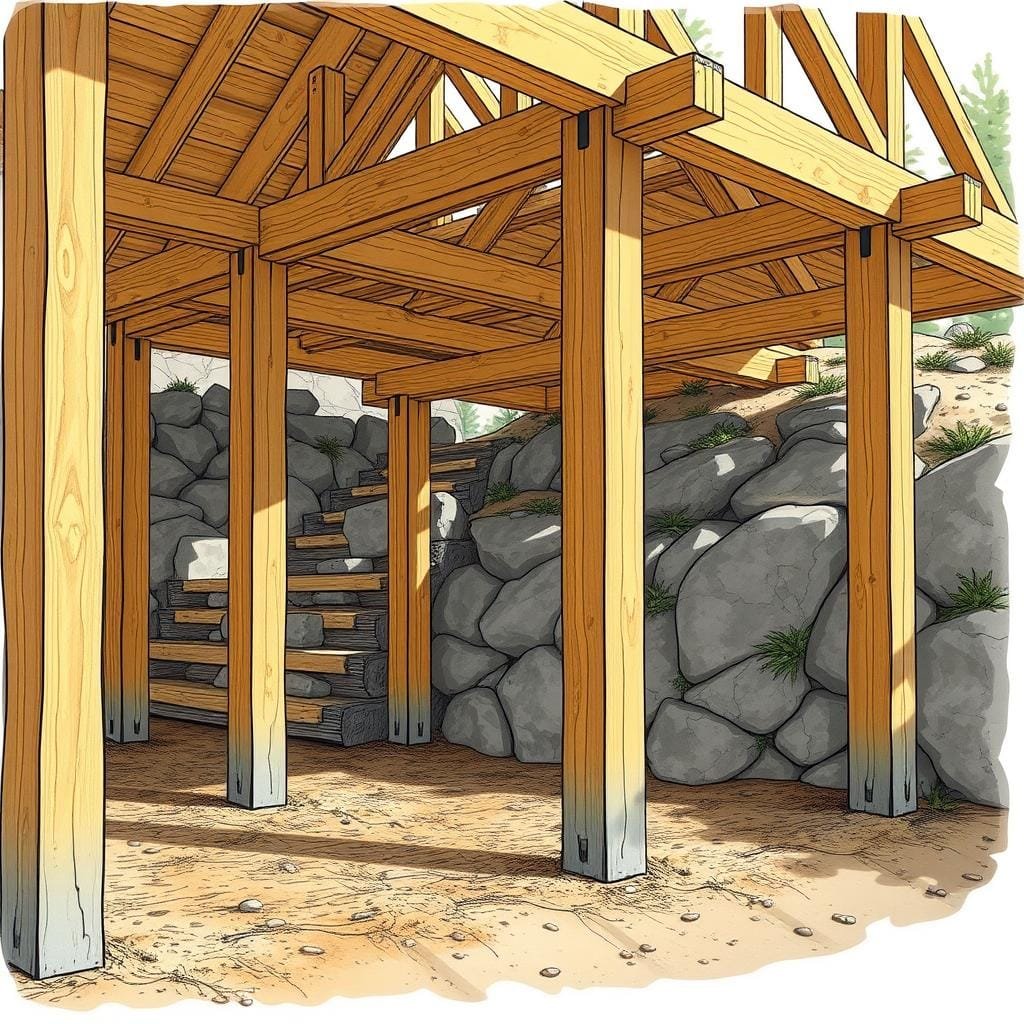
Steel posts are stronger and last longer without rot or pest issues. They allow for longer beam spans, needing fewer posts. But, they cost more and require welding or special connectors. Many use a mix of steel posts and wood beams to balance cost and performance.
| Feature | Pressure-Treated Wood Posts | Steel Posts |
|---|---|---|
| Material Cost | $15-$35 per post depending on size | $50-$120 per post depending on gauge |
| Durability Rating | 15-25 years with proper treatment | 50+ years with corrosion protection |
| Installation Ease | Standard carpentry tools, no special skills | Requires welding or special connectors |
| Maintenance Needs | Annual inspection, treatment every 3-5 years | Minimal, check for corrosion at ground level |
| Load Capacity | Good for standard cabin loads | Excellent, supports heavier structures |
When Post and Beam Makes the Most Sense
Post and beam foundations are best for certain situations. Knowing when to use them helps match your project with the right foundation.
Moderate slopes are ideal for post and beam. Slopes of 3 to 8 feet are manageable. Steeper slopes might need extra engineering.
Remote sites benefit from post and beam. It doesn’t need concrete trucks or heavy equipment. A small team can do most of the work, making it perfect for hard-to-reach areas.
Building on a budget? Post and beam foundations are 30-40% cheaper than concrete. They save money without sacrificing strength for smaller cabins.
Consider post and beam for your sloped lot when:
- Your slope angle falls between 5% and 20% grade
- Soil conditions are stable with good drainage
- You’re building a cabin under 2,000 square feet
- Access for concrete trucks is limited or impossible
- You want flexibility for future additions or modifications
- Environmental impact minimization is a priority
- Your timeline requires faster foundation completion
Need a quick build? Post and beam is faster than concrete. It’s ready for framing right after installation. This saves weeks, which is great in areas with short building seasons.
For sites where digging is a concern, post and beam is a good choice. It needs only small holes for footings, preserving natural drainage and reducing erosion.
Walkout Basement Foundations on Gentle Slopes
Gentle slopes are perfect for building walkout basements. These foundations add extra living space. They work great for cabin construction on uneven terrain with small changes in grade.
A walkout basement has poured concrete walls or blocks on the uphill side. The downhill side gets natural light and direct access. This design supports your cabin and adds space for bedrooms, family rooms, or rentals.
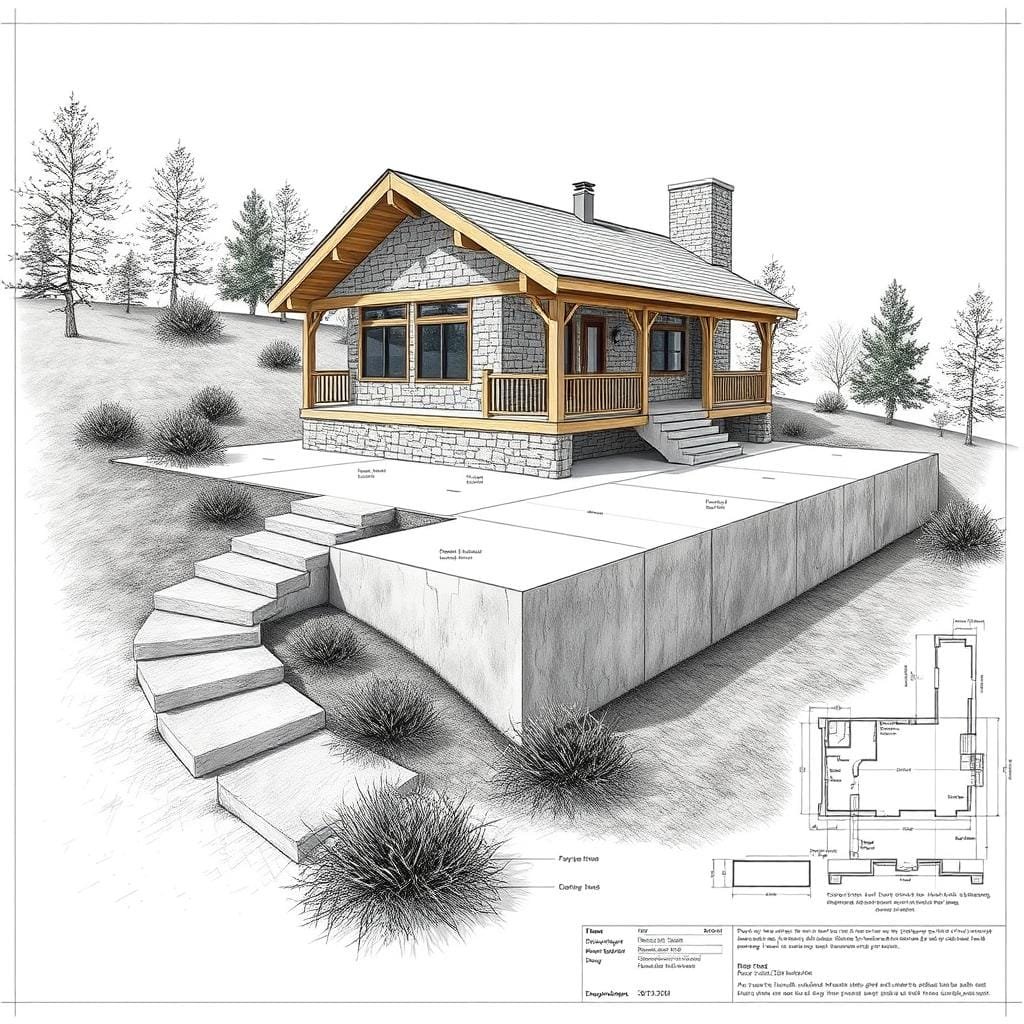
Using Natural Grade to Your Advantage
Walkout basements are best for slopes between 10 and 25 percent. At this grade, the slope matches standard basement ceiling heights. The basement opens to ground level on one side and remains below grade on the other.
Position your cabin to face downhill for a two-story feel. This design requires less digging than a flat site. It makes the most of the slope.
Think about sun exposure and views when planning. Many place living areas on the walkout level for natural light and views. This makes it the best foundation for cabin on slope with moderate inclines.
Structural Support Meets Living Space
Walkout basements are two floors in one. The same walls that support your cabin also make up the basement. You get two floors of living space for a bit more than one floor plus a basic foundation.
Finishing a walkout basement follows standard construction rules. But, consider a few things:
- Egress requirements: Bedrooms need proper emergency escape windows meeting local code dimensions
- Ceiling height minimums: Most jurisdictions require at least 7 feet for habitable spaces
- Moisture control: Interior finishing materials should accommodate below-grade conditions on buried walls
- HVAC systems: Plan for adequate heating and cooling to maintain comfort in below-grade spaces
The extra space boosts property value and functionality. A finished walkout basement can be guest quarters, home offices, recreational spaces, or rentals. This makes the initial investment worth it for many builders.
Critical Waterproofing and Drainage Systems
Water management is key for any basement foundation on a slope. Water flows downhill, so moisture will hit your foundation walls. A good waterproofing plan protects your investment and prevents damage.
Your waterproofing system should have several layers. Exterior waterproof membranes on foundation walls block moisture. Drainage boards over these membranes direct water downward.
Perimeter drain tiles at the footer level collect groundwater. They direct it away from the structure. On sloped sites, this system keeps water from hitting uphill walls. Make sure these drains have the right slope and capacity for storm events.
Other important parts include:
- Sump pump systems with battery backup for power outage protection
- Proper grading around the foundation directing surface water away from walls
- Gutter and downspout systems channeling roof water to safe discharge areas
- Swales or French drains to intercept uphill water flow before it reaches the foundation
Water management needs more focus on slopes than flat sites. You’re dealing with groundwater and surface runoff. A thorough approach costs more upfront but saves on repairs later. Invest in professional waterproofing instead of seeing it as an extra.
Cantilever Foundation Systems for Steep Hillsides
Cantilever foundations open up building possibilities on very steep hillsides. They are among the most advanced steep grade foundation options for cabins. Unlike regular foundations, cantilever systems extend your building area beyond usual support points.
This design makes your living space seem to float over the landscape. It’s great for slopes over 30% or rocky areas where digging is too expensive.
Cantilever foundations mix engineering skill with creative design. They reduce environmental impact while maximizing views and space.
How Cantilever Systems Create Structural Support
Cantilever designs use leverage, like a diving board, to support buildings on slopes. The system starts with a strong foundation on the uphill side. This anchor point holds the main loads, ensuring stability.
From this base, beams extend down the slope, carrying the building’s weight. Engineers calculate how much each beam can handle based on its material and depth.
The beams manage moment forces to resist rotation. This is due to compression and tension forces at the anchor point. Engineers figure out how much load each beam can safely carry.
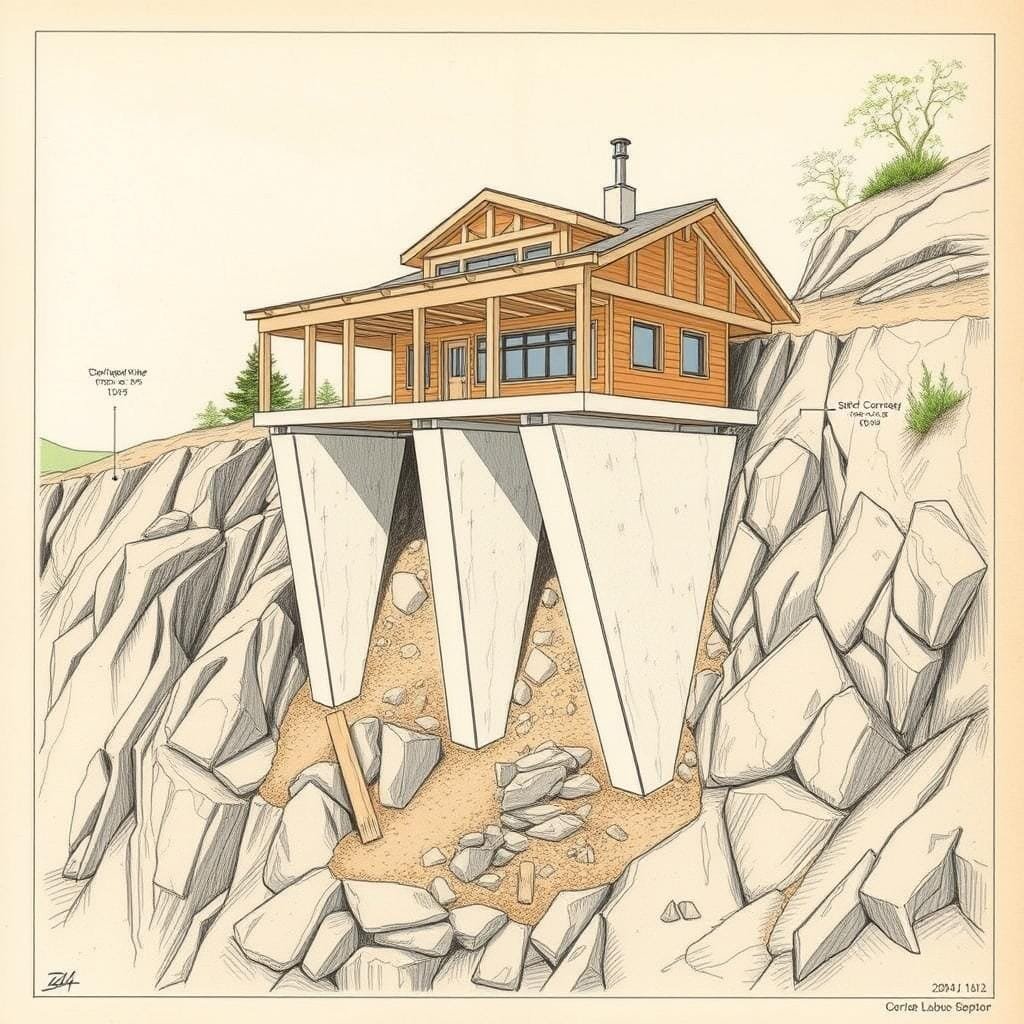
Many cantilever systems include support posts or piers along the slope. These help distribute loads efficiently. This design reduces the need for excavation and creates a stable platform on tough terrain.
Ideal Applications for Cantilever Foundation Systems
Cantilever foundations are best for very steep slopes. They work when traditional foundations are too hard to use. Knowing when to use them helps decide if they’re right for your cabin.
Very steep slopes are the main use for cantilever systems. They avoid the need for lots of excavation and retaining walls. This approach works with the terrain, not against it.
Cantilever construction is great for sites with amazing views. It lets you place living spaces to enjoy panoramic views. This alone can make the extra engineering cost worth it.
They’re also good for places where you don’t want to disturb the environment. Cantilever foundations need less digging, which helps keep the area natural. This is good for both the environment and your cabin’s views.
Rocky terrain is another place where cantilever foundations shine. Instead of digging through rock, you anchor into it and build outward. This makes it cheaper than other methods.
Modern designs often use cantilever elements for a bold look. If you want a modern cabin, this foundation type can help you achieve it. Traditional cabins can’t match the dramatic look of cantilever designs.
| Site Condition | Cantilever Advantage | Cost Impact | Best Use Case |
|---|---|---|---|
| Slopes over 30% | Minimal excavation required | Moderate to high | Extremely steep terrain |
| Rocky substrate | Solid anchor points available | Lower than blasting | Bedrock sites |
| Premium views | Extended building platform | High initial investment | Vista-focused designs |
| Environmental sensitivity | Reduced ground disturbance | Moderate | Protected landscapes |
Engineering Standards and Safety Considerations
Cantilever foundations need professional engineering. They’re not a DIY project. The calculations involve complex load analysis that only licensed experts can handle.
Your engineer will figure out dead loads and live loads. They’ll also consider wind and seismic forces. These calculations determine the beam sizes and anchor depths needed for safety.
Building codes require safety factors of 2 to 3 times the expected loads. This means your foundation can handle more weight than it will ever see. These safety margins account for unexpected stresses and ensure long-term reliability.
The materials for cantilever foundations must meet strict standards. You’ll need heavy-duty steel beams or engineered lumber. Connection points require industrial-grade hardware with documented load capacities. Every detail follows engineering specs, not just builder preference.
Building quality is key for structural support for cabins on inclines using cantilever designs. The contractor must have experience with this type. Poor installation can risk the system’s integrity and safety.
Inspections for cantilever foundations are more frequent than for regular systems. Inspectors check that construction matches engineering plans. These checks protect your investment and ensure safety standards are met.
The initial cost of cantilever foundations is higher due to engineering fees and specialized materials. But, they can be the most cost-effective choice for very challenging terrain. They turn unbuildable sites into amazing cabin locations.
Slab-on-Grade Foundations: Limited But Viable Options
Slab foundations are a less common choice for uneven terrain. They consist of poured concrete on a gravel or sand base for drainage. Most slabs include steel rebar for reinforcement, a vapor barrier, and insulation for energy efficiency.
Slabs are strong and durable, protecting against pests and moisture. They are also cost-effective, making them popular on flat land. Prefabricated homes often choose slabs for their affordability.
But, slabs have downsides. They make homes sit lower, which some find unappealing. Heating systems and utilities must be on the main floor, limiting design options.
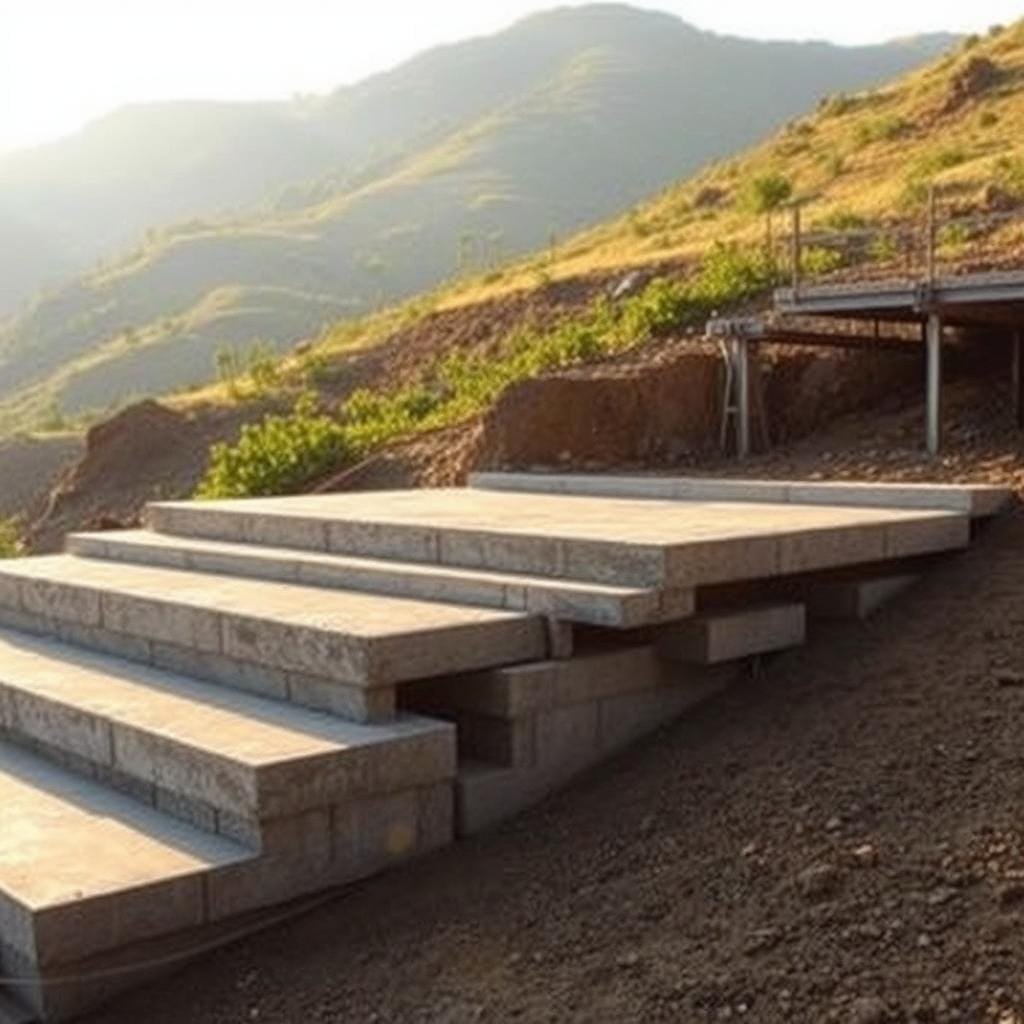
Using Stepped Slab Designs on Mild Slopes
Stepped slabs work on gentle slopes, under 10% grade. They involve multiple levels connected by short walls or steps. Each level is poured on level ground.
Step heights vary, from 18 to 36 inches, based on slope and design. Connecting sections requires careful engineering to avoid cracks.
Stepped slabs can create interesting multi-level floor plans that follow the land. They’re great for smaller elevation changes and add character to your cabin.
Experts recommend stepped slabs for slopes between 5% and 10%. Beyond 10%, the project becomes more complex and expensive.
Cut-and-Fill Techniques for Site Preparation
Cut-and-fill operations can level a slope for a slab foundation. It involves cutting into the uphill side and filling the downhill side with the excavated material.
Executing cut-and-fill requires careful attention to several factors:
- Compaction standards: Fill material must be compacted to at least 95% density in layers no thicker than 12 inches
- Settling time: Adequate time must pass for the filled area to settle before pouring concrete
- Retaining structures: Walls are necessary to hold fill material in place on the downhill side
- Drainage systems: Comprehensives water management prevents undermining of fill material
Costs for cut-and-fill operations can be high. You’re paying for equipment, hauling, retaining walls, and engineering. These costs often outweigh the savings from a slab foundation.
Environmental impact is also a concern. Large-scale grading disrupts natural drainage, removes vegetation, and can cause erosion. Some areas have strict regulations on such operations.
Limitations for Steeper Terrain
Slab foundations are impractical on slopes over 10-15%. The amount of cut-and-fill needed raises significant stability concerns. Large volumes of fill can settle unevenly, threatening the foundation.
Retaining walls become more expensive on steeper slopes. Taller walls need stronger engineering, deeper footings, and materials. The cost of retaining walls often exceeds other foundation types.
Drainage becomes more complex on steep slopes. Water flows downhill with force, requiring sophisticated systems. These systems need ongoing maintenance.
Alternative foundations, like pier and beam systems, are often better for steep slopes. They work with the land, saving money and ensuring better performance.
Forcing a slab foundation on steep terrain can lead to problems. You might face cracking, water intrusion, or structural failure. The initial savings are not worth the long-term risks.
On slopes over 15%, most recommend against slab foundations. The challenges, costs, and maintenance make other options more practical. Knowing these limitations early helps choose the best foundation for your hillside cabin.
Best Foundation for Cabin on Slope: Comparing Your Top Options
Let’s compare foundation types to find the best fit for your slope. Choosing the right foundation is more than just picking one. You must consider your property’s features, local weather, and budget.
Every property has its own challenges and opportunities. Your contractor should assess your land, weather, slope, and building codes. With the right technology, any foundation can meet your needs with professional help.
How Slope Angle Affects Foundation Selection
The slope angle of your lot is key in choosing a foundation. Different slopes need different foundations. Knowing this helps narrow down your choices.
For slopes of 0-5%, you have many options. Slab foundations or crawl spaces are good and cost-effective. These slopes don’t pose big structural challenges.
Slopes of 5-15% offer more choices. Stepped slabs, walkout basements, or pier systems work well here. Your choice depends on your needs and budget.
For slopes of 15-30%, you need specialized foundations. Pier and beam systems are best in this range. They offer good value and support.
For slopes over 30%, you need advanced systems. Tall pier or cantilever designs are best. These systems require expert engineering but work on steep slopes.
| Slope Percentage | Recommended Foundation Types | Structural Complexity | Typical Cost Range |
|---|---|---|---|
| 0-5% | Slab-on-grade, Crawl space | Low | $6,000-$12,000 |
| 5-15% | Stepped slab, Walkout basement, Pier systems | Moderate | $12,000-$30,000 |
| 15-30% | Pier and beam, Post and beam | Moderate-High | $15,000-$35,000 |
| Over 30% | Tall piers, Cantilever systems | High | $35,000-$75,000+ |
Budget Reality Check for Different Systems
Knowing foundation costs upfront is important. Each type has its own price range. Site-specific factors can change the final cost.
Pier and beam systems for small cabins cost $8,000 to $15,000. They’re good for moderate slopes and offer value. Concrete pier systems cost more, usually $12,000-$25,000, but are more durable.
Walkout basements cost more, $25,000 to $50,000 or more. They’re like building two-story construction with the lower level as both living space and foundation. Cantilever systems require custom engineering and can cost over $50,000.
Hidden costs can add up quickly. Difficult site access and poor soil conditions require extra engineering and materials. These can double your costs.
Extreme slopes cost more due to more materials and labor. Retaining walls can add $5,000-$20,000. Extended project timelines, engineering fees, and permit costs should be included in your budget.
Regional Weather and Climate Impact
Where you build is as important as what you build on. Climate conditions affect foundation choices.
Cold climates require frost-depth footings. These must extend 3-6 feet below grade. Shallow pier systems are impractical in northern states. Your foundation must reach below the frost line to prevent damage.
Wet climates need better drainage systems. High rainfall may make basements impractical without waterproofing. Elevated pier systems handle moisture better by staying above ground.
Earthquake zones require special connections between foundation elements. Some foundations adapt better to seismic requirements than others. Local building codes specify earthquake resistance needs.
Expansive clay soils swell and shrink, damaging foundations. Pier systems that reach solid bearing soil are best in these conditions.
Wind exposure on hillside sites is also important. Mountain locations have stronger winds that create additional loads. Your foundation must anchor the cabin securely against these forces.
Slope Stabilization for Mountain Homes
Your cabin’s foundation depends on the hillside it sits on. Slope stabilization is key for its long-term success. Even strong foundations can fail if the terrain shifts or water isn’t managed right.
Water control is the most important factor in keeping the hillside stable. Without proper drainage, even small rains can harm your cabin. Each mountain lot is unique, so your stabilization plan should start early.
Preventing Soil Loss and Surface Damage
Erosion control measures are vital when starting on a sloped site. Soil is exposed and vulnerable from the start. Using erosion blankets or mats early on protects the soil while plants grow.
Swales and berms help direct water away from danger zones. They guide runoff to safe spots, preventing damage. Swales are great for slopes where gentle water flow is needed.
Riprap installations protect steep areas and places with lots of water. These large stones stop water from carving paths. Temporary barriers catch soil during construction, protecting the environment.
Long-term stormwater systems protect against erosion. They slow and redirect water, keeping your cabin and landscape safe. Builders who skip drainage systems often face damage soon.
Natural Stabilization Through Strategic Planting
Vegetation adds beauty and protects slopes around mountain cabins. Native plants with deep roots strengthen soil more than mechanical solutions. These roots hold soil together, making it stronger over time.
Different slopes need different plants. Gentle slopes do well with groundcovers. Steeper hillsides need plants with deep roots to hold soil.
Terraced planting beds solve many problems at once. They reduce slope angles, capture water, and add beauty. Each terrace acts like a mini wall, holding soil in place.
Ground covers protect quickly after construction. But, keeping plants watered during dry times is key. Irrigation during droughts keeps your landscaping and slopes stable.
Choosing the right plants prevents the need for more intense solutions later. Native species need less care but work better than non-native plants.
Advanced Technical Solutions for Challenging Sites
Some mountain areas need advanced solutions for stability. Geotechnical engineering interventions tackle serious issues that simple methods can’t solve. These are needed for very steep slopes, uncertain soil, or sites with past failures.
Soil nailing adds support to unstable slopes. Steel bars or cables inserted at angles tie surface layers to deeper, stable soil. This is great for cut slopes without natural support.
Shotcrete protects rocky slopes from falling rocks. This concrete layer stops rock from breaking off. It’s often the best choice for rocky sites.
Geogrid reinforcement strengthens fill areas. These mesh materials spread loads and prevent fill from spreading. Geogrid can turn poor sites into buildable areas.
Subsurface drainage tackles hidden water problems. French drains and other systems manage groundwater. For very steep slopes or known stability issues, get a geotechnical expert.
Soil amendments can improve stability. Adding binders or changing soil composition makes it stronger. Monitoring for movement helps catch problems early.
Retaining Wall Integration with Cabin Foundation
Building on slopes often needs retaining walls that support your foundation. These walls work together to handle soil pressure and water. Knowing how to link them ensures your cabin stays stable.
When walls and foundations work together, they resist hillside forces better. This prevents settling and structural weaknesses. It’s key to design them as one unit.
Critical Situations Requiring Retaining Walls
Retaining walls are needed when the site demands more soil support than the foundation can handle. Certain situations make them essential.
Creating a level area on steep slopes requires holding back a lot of soil. For terracing or large elevation changes, walls provide the needed support.
Knowing how to build retaining walls ensures they support cabins on slopes. Hillsides with roads also need these structures for stability.
Local codes often require engineered walls for slopes over 30 degrees. This is because natural soil can’t handle steep angles without support.
Important distinction: Decorative walls are different from structural ones. Aesthetics and minimal soil loads define landscape walls. Structural walls need engineering and permits.
Available Retaining Wall System Options
There are many retaining wall systems, each with its own benefits. They vary by site, budget, and look.
- Poured concrete walls: The strongest option for large slopes. They last 50+ years with little upkeep.
- Concrete block systems: Easy to install for walls under four feet. DIY builders can use them.
- Timber retaining walls: Economical for small heights. They last 15-25 years, depending on treatment.
- Stone walls: Great for looks but need skilled masons. Best for walls under five feet.
- Gabion walls: Rock-filled cages offer drainage and unique looks. Good for areas with freeze-thaw cycles.
Costs vary by wall height and site access. Timber can cost $15-25 per square foot. Concrete can be $50-100 per square foot for tall walls.
Essential Drainage Behind Retaining Structures
Drainage behind walls is critical to prevent failure. Water pressure can exceed the wall’s strength, causing damage.
Every wall needs a drainage system. This includes crushed gravel and perforated pipes to channel water away.
Perforated drainage pipes collect water at the base. They should slope toward outlets. Weep holes or permeable materials help water escape.
Surface water control is also important. Use grading, gutters, and swales to direct water away from walls. This prevents water from building up behind walls.
Filter fabric keeps the drainage system clear. It stops fine particles from clogging the system over time.
Coordinating Walls with Foundation Elements
Planning the construction sequence and connection between walls and foundations is key. They often share footings or create the foundation platform.
Walkout basements often include retaining walls as part of the foundation. These walls need reinforcement and waterproofing for both roles.
For pier, post, or slab foundations, walls must be built first. They establish the grade and provide a stable platform for the foundation.
| Foundation Type | Wall Integration Method | Key Coordination Points |
|---|---|---|
| Walkout Basement | Walls are foundation | Waterproofing, drainage continuity, structural reinforcement |
| Pier and Beam | Walls create pad | Wall height establishing level platform, pier placement behind walls |
| Slab-on-Grade | Walls define terraces | Stepped slab coordination, drainage routing under slabs |
| Post and Beam | Independent systems | Separate footings, compatible drainage paths, visual integration |
Shared footings can save costs and ensure structural continuity. This is beneficial for timber-frame cabins on post foundations.
Drainage planning must consider both wall and foundation systems. They should connect to discharge water away from the structure.
Professional coordination between wall builders and foundation contractors is essential. A single contractor can ensure a smooth integration.
Engineering drawings should show both walls and foundations together. This includes shared footings and drainage connections. It prevents construction conflicts.
Permits, Engineering, and Professional Requirements
Building a cabin on sloped terrain is more than just picking a foundation. It needs proper documents, expert analysis, and approval. We know it’s tough to do this alone. The key is professional assessments, testing, and permits for a successful project.
Working with building consultants helps you understand the build process. They guide you through options and make decisions for your site. Recommended builders ensure standards are met, handling terrain challenges.
Before starting, a detailed site plan is essential. It covers the cabin, outdoor spaces, and grounds. This approach avoids surprises and keeps your project on track.
When You Need Engineering Expertise
Most places need stamped plans for hillside builds, over 15-20% slopes. A structural engineer ensures your cabin lasts decades. Their work affects the structural support for cabins on inclines.
Custom foundations need engineering for load capacity and safety. Engineers check how your foundation handles the cabin’s weight and slope forces. Pier and beam systems require engineering for spacing and sizing.
Cantilever designs need engineering for complex loads. Retaining walls over 4 feet must also be engineered for safety.
Structural engineers offer critical services for your cabin project. They analyze soil and calculate loads for your site. They design foundations that fit your terrain and cabin.
They specify materials and connections for stability. Most importantly, they provide stamped drawings for permits. These documents show your project meets safety standards. Costs range from $1,500 to $5,000 or more, based on complexity.
Understanding Ground Conditions Through Testing
Geotechnical engineers do soil borings to understand what’s beneath your site. This first step is essential. Soil testing shows soil composition, bearing capacity, and depth to bedrock.
These reports also show groundwater levels and issues like expansive clays. Each factor affects the best foundation types for hillside building. Costs are between $1,000 and $3,000, but it prevents construction mistakes.
Understanding soil reports helps you make informed decisions. Reports include bearing capacity numbers and identify problematic soil layers. Most hillside permits require soil testing for approval.
| Professional Service | Typical Cost Range | Timeline | Key Deliverables |
|---|---|---|---|
| Structural Engineering | $1,500 – $5,000+ | 2-4 weeks | Stamped foundation plans, load calculations, material specifications |
| Geotechnical Testing | $1,000 – $3,000 | 1-2 weeks | Soil composition analysis, bearing capacity data, site recommendations |
| Building Permit Review | $500 – $2,000 | 4-8 weeks | Approved construction permits, inspection schedule, compliance documentation |
| Building Consultant | $150 – $300/hour | Ongoing | Site evaluation, option analysis, builder coordination, project guidance |
Navigating the Permit Process
Hillside construction gets more scrutiny than flat-land builds. Building departments check for erosion and structural hazards. Your application needs detailed documentation for slope concerns.
Your package will include site plans showing grades. These drawings show how your cabin fits the terrain. Engineering calculations and drawings prove your foundation design is safe.
Additional requirements include erosion control plans and stormwater management strategies. Some areas need environmental impact assessments. HOA rules must be followed in planned communities.
Permit review times for slopes are longer than standard permits. Plan for 4-8 weeks or more, depending on complexity. Experienced local contractors can speed up the process.
Building consultants help with the permit application and identify issues. Their knowledge of local codes reduces the chance of rejections. This is very helpful for first-time builders.
Once permits are issued, regular inspections follow. Your foundation will need multiple inspections. Good relationships with inspectors keep your project moving.
Cost Considerations for Cabin Construction on Uneven Terrain
Building on sloped land is more expensive than on flat ground. It includes many factors not found in flat-site construction. Smart planning is key to avoid budget problems. Knowing these costs helps in choosing the right cabin design and foundation.
Never cut corners on foundational elements to save money. Quality construction on slopes requires investment in proper foundations, drainage systems, and access roads. Saving on these can lead to costly problems later.
Choosing a foundation based on budget is important. But, it should also consider long-term performance and safety. The most affordable option that meets structural requirements is often the most cost-effective over time. When planning cabin construction on uneven terrain, consider all costs for realistic financial expectations.
Foundation Cost Factors by Type
Different foundation systems have different prices. Basic pier and beam foundations on moderate slopes cost $12 to $20 per square foot. These systems work well when pier depths are reasonable and site access is efficient.
Concrete pier systems cost more, about $18 to $30 per square foot. Walkout basement foundations are a big investment at $30 to $50+ per square foot because they include finished living space below grade.
Specialized systems for challenging terrain cost more. Cantilever foundations or tall pier configurations on steep slopes can cost $50 to $100+ per square foot. These options provide great stability but need a bigger budget.
- Pier depth and quantity: Deeper piers and more support points increase material and labor costs substantially
- Beam sizing requirements: Larger dimensional lumber or engineered beams carry higher material costs
- Connection complexity: Custom brackets, anchors, and seismic ties add both material and labor expenses
- Equipment accessibility: Limited access requiring smaller equipment or hand work multiplies labor hours
- Engineering specifications: Detailed structural engineering and inspections add professional service fees
These cost ranges are just guidelines. Regional labor rates, material availability, and site-specific conditions can change costs a lot. Getting detailed quotes from experienced contractors is key for accurate budgeting.
| Foundation Type | Cost Per Square Foot | Best For Slope Type | Key Cost Drivers |
|---|---|---|---|
| Basic Pier and Beam | $12-$20 | Mild to moderate slopes | Pier depth, beam spans |
| Concrete Pier System | $18-$30 | Moderate slopes | Concrete volume, equipment access |
| Walkout Basement | $30-$50+ | Gentle to moderate slopes | Excavation depth, waterproofing |
| Cantilever/Tall Pier | $50-$100+ | Steep slopes | Engineering complexity, custom fabrication |
Site Preparation and Excavation Expenses
Pre-foundation work on sloped sites can be as expensive as the foundation itself. Clearing and grubbing vegetation costs $1,000 to $5,000+ depending on site size and density. Heavy forest cover with large trees increases clearing expenses.
Building an access road or driveway is a big expense many builders underestimate. Hillside driveways can cost $5,000 to $20,000+ based on length, grade, and required cuts or fills. Steep approaches may need switchbacks, retaining walls, or specialized grading, increasing costs.
Excavation and grading expenses range from $3,000 to $15,000+ depending on earth moving required. Cut-and-fill operations to create level building pads involve substantial equipment time. Sites requiring minimal grading save thousands compared to locations needing extensive terracing.
Retaining wall construction adds $25 to $75+ per square foot of wall face area. Taller walls and those requiring engineered designs command premium prices. Multiple retaining walls for terraced sites quickly escalate total project costs into five-figure territory.
Drainage system installation typically costs $2,000 to $8,000+ for a complete solution. This includes:
- French drains around the building perimeter
- Catch basins and drainage pipes for surface water management
- Swales or berms to redirect runoff
- Sump pumps for below-grade spaces
Erosion control measures add another $1,000 to $3,000+ for silt fencing, sediment traps, and temporary stabilization during construction. On difficult sites with limited access, site preparation expenses can actually surpass foundation costs. Remote locations requiring extensive road building or sites with challenging topography demand proportionally larger site work budgets.
Hidden Costs and Contingency Planning
Unexpected expenses can surprise even the most careful planners. Extended project timelines are a significant hidden cost factor. Slope construction typically takes 20-40% longer than flat-site building due to access challenges and complexity.
Longer timelines increase labor costs as crews stay on-site longer. If you’re traveling from elsewhere to oversee construction, extended stays for lodging and meals add up quickly. Equipment rental for longer periods than anticipated creates budget pressure when projects stretch beyond original schedules.
Specialized equipment needs often emerge during construction. Crane rentals for placing beams or materials on difficult access sites can cost $1,500 to $5,000 per day. Concrete pumps for steep grade foundation options where trucks cannot reach directly add $800 to $2,000+ per pour.
Engineering modifications occur when field conditions differ from initial assumptions. Encountering bedrock at unexpected depths, discovering unstable soil layers, or finding groundwater where surveys indicated dry conditions all trigger design changes. Each modification involves additional engineering fees and material cost increases.
Permit fees and impact fees vary dramatically by jurisdiction but can represent substantial expenses. Some mountain communities charge development impact fees of $5,000 to $15,000+ for new construction. Plan review fees, building permits, and required inspections add hundreds to thousands more depending on project scope.
Water and septic system complications on slopes create unexpected costs. Gravity-fed septic systems may require pump stations when suitable drain field locations sit uphill from the cabin. Well drilling on slopes sometimes encounters challenges requiring deeper drilling or alternative water solutions.
Utility connection challenges multiply when bringing power, internet, or gas lines to hillside properties. Longer runs from utility corridors, directional boring under driveways, or trenching across slopes all increase connection costs beyond flat-site norms.
Financial experts strongly recommend adding 15-25% contingency to slope construction budgets compared to the 10% typically sufficient for flat sites. This larger buffer accounts for the greater uncertainty and complication inherent in hillside building. Projects frequently encounter at least some unexpected conditions requiring budget flexibility.
Experienced builders maintain separate contingency funds for site-related issues versus building construction issues. This separation helps track where overruns occur and prevents raiding building funds to cover site problems. Overall costs vary dramatically based on limited access to remote build sites, equipment availability, and crew size limitations that affect productivity.
Making the Right Foundation Choice for Your Sloped Cabin Project
Choosing the best foundation for your cabin on a slope doesn’t have to be hard. Every property is different, and working with experts makes it easier. Start by getting soil and slope tests from licensed engineers who know your land.
Your budget is important, but a good foundation saves money in the long run. A pier and beam foundation might cost more at first, but it’s worth it for stability. Think about your lifestyle and how much upkeep you can handle.
Visit cabins on similar slopes to learn from others. Homeowners can share valuable insights that specs can’t. Find a contractor with experience in uneven terrain who can show you their work.
Water management is key, no matter the foundation. Good drainage systems protect your cabin and prevent future problems. Take your time choosing the right foundation.
Many beautiful cabins stand strong on slopes across the country. With the right planning, materials, and builders, your cabin can too. Let the landscape guide your design for beauty and strength.