
Building your own log cabin connects you to American tradition. It’s hard work, but the joy of creating your own space is worth it. You don’t need to be a pro to do it right.
This guide will show you proven construction techniques for all builders. We’ll cover old methods and new ones. You’ll find DIY tips that fit your skills and what you have.
There are three ways to build your walls. First, use full logs with hand-cut notches and horizontal stacking. Second, mix timber species from your land. Third, try modern laminated methods for easier building. Each way makes sturdy, beautiful walls that last.
Planning Your Log Cabin Wall Project
Building a log cabin starts with a good plan. This plan covers legal needs, size, and time. Skipping this step can lead to big problems and costs.
This planning phase is like your project’s blueprint. You’ll need to follow local rules, measure carefully, and set realistic build times. It’s not as fun as starting to build, but it’s key to success.
Understanding Local Building Codes and Permits
Before buying logs, check with your local building department. They’ll tell you about log cabin building permits and the application process. Not getting a permit can lead to fines or even tearing down your cabin.
Building codes for log cabins cover important areas. They might require a certain foundation depth and fire safety rules. These rules can affect where your cabin can be built.
When applying for a permit, you’ll need to submit detailed plans. These plans should show your cabin’s size, height, and design. Some places need engineering stamps for bigger cabins. Budget for permit fees, which can be $200 to $2,000.
Also, check for extra permits like for septic or wells. Your foundation might need to be inspected before building. Getting to know your local inspector early can help.
Determining Wall Height and Cabin Dimensions
First-time builders often forget about cabin dimensions. Logs extend beyond corners, reducing interior space. A 24-foot foundation might only give you 22 feet of wall space inside.
Here’s how the math works out:
- Foundation length: 24 feet
- Corner overhang: 10 inches per end (20 inches total)
- Actual interior wall length: 22 feet 4 inches
Wall height depends on log size and how many you stack. For 8-foot walls with 10-inch logs, you’ll need about 10 courses. Always plan for a bit more material.
Think about your cabin’s size. Standard doors and furniture need specific planning. Make sure your cabin fits standard building materials like windows and doors.
Make a detailed sketch of your cabin’s exterior and interior. This will help spot problems before they cost a lot. Include where windows and doors will go in your plan.
Creating a Timeline for Your Build
Setting a realistic timeline is important. It keeps you motivated and plans around your schedule and weather. Building a cabin takes months, not days.
Break your timeline into phases:
| Build Phase | Estimated Duration | Key Activities |
|---|---|---|
| Material Gathering | 2-4 weeks | Selecting, cutting, and hauling logs; purchasing supplies |
| Foundation Work | 1-2 weeks | Excavation, forming, pouring, and curing concrete |
| Wall Construction | 3-6 weeks | Debarking, notching, stacking, and securing logs |
| Finishing Work | 2-3 weeks | Chinking, sealing, cutting openings, and final touches |
Weather affects your timeline. Do foundation work in dry weather and avoid stacking logs in rain. If you work weekends, double or triple your estimates.
Building a cabin is hard work. You’ll need rest days, even if you’re not alone. This is important for your safety and the quality of your work.
Remember, you’ll learn as you go. Your first logs will take longer than the rest. Plan for extra time for mistakes and learning.
Selecting the Right Logs for Your Cabin Walls
Not all trees are good for building log cabin walls. The type of log you choose affects how easy it is to work with. It also impacts how much the walls will settle and how long they will last.
Understanding log types before you start saves time and money. It also saves you from a lot of frustration.
The wood you pick affects every part of building your cabin. Some species are easy to debark, while others are hard. Some woods resist rot and insects, while others need treatment.
Choosing the right logs is key to success. It sets you up for success from the start.
Common Wood Species and Their Real-World Performance
Pine logs are the most popular for log cabins in North America. But, pine has some challenges. The bark can be hard to remove, leaving brown patches.
Eucalyptus logs are great for cabin building. They peel cleanly and work well with hand tools. They are durable when dried, but need care to prevent cracking.
Cedar and cypress are good for lower courses because they resist rot. They have natural oils that keep insects away. They are more expensive than pine but last longer in moist areas.
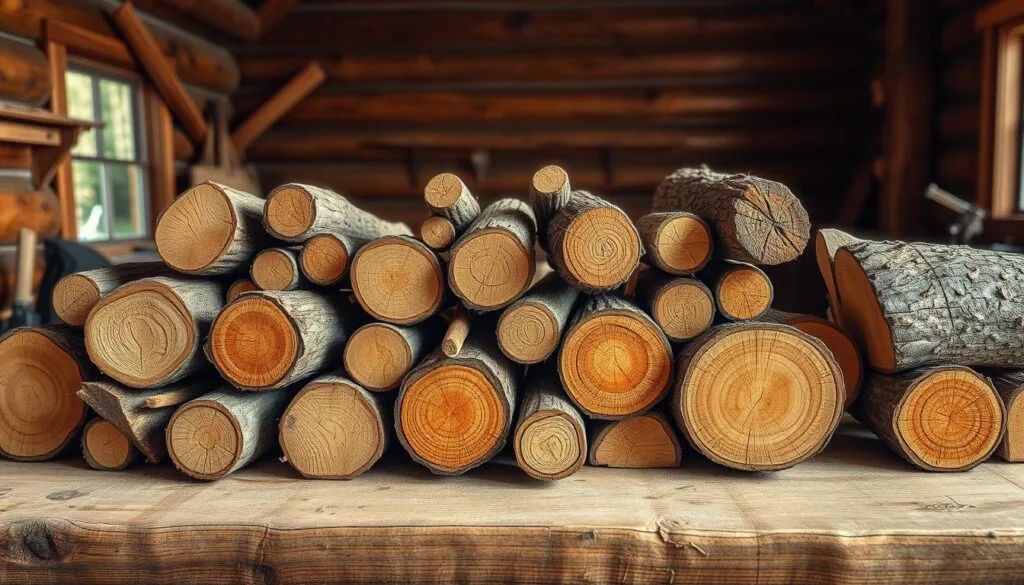
Chestnut is very durable and works well for door frames and support points. Oak logs are hard to work with because of their irregular shapes. Hard woods are harder to cut and shape, slowing down your work.
Fresh-Cut Versus Dried Logs: Making the Right Choice
Fresh-cut logs are easier to work with but may settle more. Dried logs are harder to cut but settle less. Knowing the difference helps you choose the best for your project.
Fresh-cut logs are soft and easy to work with. They debark easily and are lighter to move. But, they shrink a lot as they dry.
Dried logs are harder to cut but settle less. They cost more if you buy them. But, they are more stable.
A good middle approach is to cut logs in late fall or winter. Debark them right away and let them air-dry for 2-3 months. This makes them easier to work with and reduces settling.
Harvesting at the right time prevents cracking and improves durability. Avoid direct sunlight when drying logs to prevent checking and splitting.
Determining Log Diameter and Length for Your Walls
Most walls use logs between 8 and 14 inches in diameter. This size is strong and easy to handle. Smaller logs are easier to lift but need more courses. Larger logs are impressive but harder to move.
Log diameter affects how fast you can build. A wall with 8-inch logs takes more courses than one with 12-inch logs. But, moving larger logs is harder.
Measure your wall span and add 2-3 feet for corners. Add 12-18 inches for overhangs. A 20-foot wall needs logs about 22-23 feet long.
Use the thickest logs for the bottom courses. They face moisture and provide stability. This helps prevent settling and supports the wall.
| Wood Species | Workability | Rot Resistance | Best Application |
|---|---|---|---|
| Pine | Moderate (difficult debarking) | Low to moderate | Upper wall courses, budget builds |
| Eucalyptus | Excellent when green | High when properly dried | All courses, premium construction |
| Cedar/Cypress | Good | Excellent (natural oils) | Lower courses, moisture exposure areas |
| Chestnut | Moderate | Excellent | Door frames, structural elements |
| Oak | Poor (irregular shape) | Moderate to high | Not recommended for log walls |
Choosing the right logs is key to a successful cabin. Consider the species, your tool skills, and the design. The right timber makes building easier and creates strong walls for years to come.
Essential Tools and Equipment You’ll Need
Building a log cabin today is easier with the right tools. You’ll need both old and new tools. Having the right log cabin tools helps you work faster and better.
Tools fall into three main groups: hand tools, power tools, and safety gear. Each group has its own role in building a log cabin. Knowing what you need helps you plan and save money.
Hand Tools for Log Preparation
Hand tools are key for precise work in log building. A sharp drawknife or bark spud is very important. It helps remove bark without damaging the wood.
A good felling axe is also essential. It’s used for notching and shaping logs. A two-person crosscut saw is great for cutting logs with a partner.
Measuring and marking tools are important for straight walls. Keep a carpenter’s level, framing square, and measuring tape handy. A log scribing tool is needed for fitting logs tightly together.
Don’t forget smaller tools like wood chisels and sharpening stones. Sharp tools make work easier and safer. Spend time keeping your tools sharp.
Power Tools for Efficient Construction
Power tools make building a log cabin faster. A good chainsaw for cabin building is essential. Choose a chainsaw with a 16 to 20 inch bar. Buy spare chains to avoid delays.
Quality chainsaw chains are important. They cut well and last longer. Regular maintenance keeps your chainsaw running smoothly.
A portable electric planer makes lumber smooth. It helps fit logs together tightly. Use a drill and bits for pre-drilling holes.
Use a small tractor or ATV to move logs. This saves you from lifting heavy logs. A log dolly or cant hook can also help.
Other power tools like an electric disc saw and chainsaw mill speed up work. A power sander makes finishing easier. These tools save a lot of time.
| Tool Category | Essential Items | Approximate Cost | Primary Function |
|---|---|---|---|
| Hand Tools | Drawknife, axes, saws, measuring tools, scribing compass | $300-$600 | Precision fitting, debarking, marking, and fine adjustments |
| Power Equipment | Chainsaw, electric planer, drill, sander, saw | $800-$2,000 | Heavy cutting, surface preparation, faster material processing |
| Safety Gear | Chaps, boots, gloves, eye protection, hearing protection, hard hat | $250-$500 | Personal protection from injuries during all construction phases |
| Material Handling | Log dolly, cant hook, chains, come-along winch | $200-$400 | Moving and positioning heavy logs safely |
Safety Equipment and Protective Gear
Safety gear is the most important part of your tools. Log work is dangerous and can cause serious injuries. Always wear safety gear to avoid accidents.
Wear chainsaw chaps or protective pants with cut-resistant layers. These pants can save you from serious cuts. Steel-toed boots are also important for safety.
Eye protection is vital because of flying wood chips and sawdust. Use a face shield or safety glasses to protect your eyes. Hearing protection is also important to avoid hearing damage from loud tools.
A hard hat keeps your head safe from falling objects. Heavy-duty work gloves protect your hands from injuries. Choose gloves that are tough but let you control tools well.
Always have a well-stocked first aid kit nearby. It should have supplies for common injuries like cuts and splinters. It’s also important for more serious injuries until help arrives.
Preparing Your Logs for Construction
Turning rough logs into building materials takes time and the right steps. This prep work affects your cabin’s strength and the building process. Spending time on each log now saves trouble later.
There are three key steps for log prep. Each step helps logs fit well and last longer. Skipping these steps can ruin your project, but doing them well means success.
Debarking and Cleaning Your Logs
Removing bark is key for cabin building. Bark holds moisture, causing rot. It also attracts insects, which can infest your walls.
Debarking works best in early summer. Use a drawknife, bark spud, or sharpened spade. Apply steady pressure to remove bark in long strips.
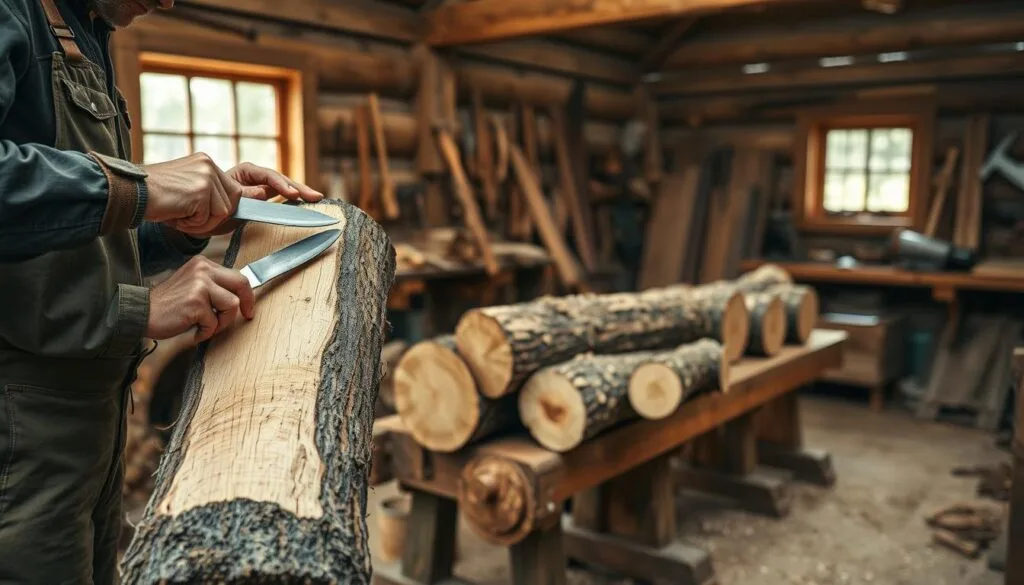
Pine logs are harder to debark. They leave stubborn patches that need extra effort. Cedar and spruce bark comes off more easily.
After debarking, brush logs to remove debris. Check for insect damage. Cut away any damaged sections before using the logs in your walls.
Treating Logs for Pest and Rot Resistance
Wood treatment extends your cabin’s life, protecting it from weather and moisture. Commercial treatments are effective but expensive. They cost around $50-60 per liter, with small cabins needing 10-12 liters.
For a cheaper option, consider used cooking oil. It protects wood and improves its look. It can even cover up stains from chinking work.
Here are some affordable log treatment options:
- Borate-based solutions: Inexpensive and fights insects and decay
- Semi-transparent stains with preservatives: Protects from UV and water
- Concentrated treatments diluted properly: Stretch commercial products further
- Diesel fuel mixtures: Traditional for bottom courses, but has environmental concerns
Focus on the bottom three courses for wood treatment. They face the most moisture. Treat cut ends well to prevent moisture damage.
| Treatment Type | Cost Per Gallon | Coverage Area | Protection Level |
|---|---|---|---|
| Commercial Preservative | $180-220 | 200-250 sq ft | Excellent (20+ years) |
| Borate Solution | $40-60 | 300-400 sq ft | Very Good (15+ years) |
| Stain with Preservative | $80-120 | 250-300 sq ft | Good (10-15 years) |
| Used Cooking Oil | Free-$10 | 400-500 sq ft | Moderate (5-8 years) |
Sorting and Organizing Logs by Size
Organizing logs makes building easier and ensures your structure is strong. Start by grouping logs by diameter. This makes it easy to find the right size when needed.
Use your thickest logs for the bottom courses. They bear the most weight and face the most moisture. Working with these logs early saves on scaffolding and lifting.
Save straight logs for long walls. Use crooked logs for shorter sections. Extremely twisted logs can be cut into smaller pieces.
Set up a staging area near your foundation. Stack logs by category, with the heaviest on the bottom. Label piles clearly so helpers know what they need.
Many building codes require larger logs for lower courses. This sorting system keeps you compliant. It makes building easier when you’re ready to start.
Building a Proper Foundation for Log Walls
The foundation is key to a log cabin’s success. It’s not the most exciting part, but it’s vital. A good foundation means your cabin will last for generations.
Building a foundation requires patience and precision. Every log you add depends on this foundation. It protects your cabin from moisture and settling.
Your foundation must do several things at once. It needs to be stable and level. It also must keep the bottom logs dry and follow local building codes.
Foundation Types Suitable for Log Cabins
Choosing the right foundation depends on your budget and soil. Each type has its own benefits and drawbacks.
A full concrete slab foundation is the most stable but expensive. It’s best for basements or tough soil. You’ll need to prepare the site first.
The concrete pier foundation is a good middle choice. It works well on slopes and prevents moisture. It’s cheaper than a slab but strong.
A continuous concrete wall foundation is traditional for big cabins. It has a crawl space and is stable. It’s great for storage and utilities.
For small cabins, a treated wood skid foundation is simple and cheap. It uses big timbers on gravel. But it’s not durable.
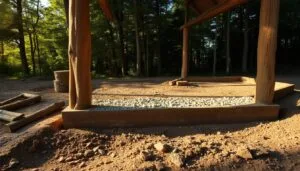
Many builders use a mix of cost and performance. They dig trenches, fill them with stone, and top with concrete. Then, they build a low wall with concrete blocks.
This method protects the bottom logs from moisture. It keeps them from rotting too fast. Logs last longer when they’re not in damp soil.
While some skip rebar to save money, most codes require it. It adds stability and protects your investment. Always check local codes before starting.
Installing the Sill Plate
The sill plate is a critical barrier between the foundation and walls. It’s worth the extra effort.
Builders use pressure-treated lumber for the sill plate. They bolt it to the foundation with anchor bolts. The bolts must cure in the concrete.
When the concrete is set, lay out the sill plate. Mark where it meets the bolts. Drill holes for the bolts, then place the sill plate and secure it.
This treated lumber gives a flat surface for the first log. It also adds a moisture barrier. The treatment fights rot and insects.
Some builders skip the sill plate and lay logs directly on the foundation. This method needs careful leveling of the first logs. It’s less precise but works.
Ensuring Level and Square Base
A level foundation is essential for a stable cabin. It requires patience and attention to detail.
Use a laser or water level to check the foundation’s level. A carpenter’s level is good for short sections. But for longer spans, you need better tools. Check many points to ensure accuracy.
Squareness is just as important as level. Measure diagonally to check for squareness. If the measurements match, your foundation is square. Even a small difference can cause problems later.
If your foundation is not level, you can fix it. Use shims or mortar for small issues. For bigger problems, you might need to grind or add material before adding logs.
Errors in the foundation will multiply as you build. A small mistake can become a big problem at the roof. Taking time to get it right saves a lot of trouble later.
Double-check your work before moving on. Have someone else check your measurements. Take a break and come back with fresh eyes. Your foundation supports everything you’ll build, so get it right.
Understanding Log Notching Techniques
Corner joints do two things in log building: they lock walls together and keep out moisture and pests. Many new builders find corner notching hard, but knowing your options makes it easier. The notches you cut are not just for looks; they keep your walls from spreading.
Different ways to join logs vary in difficulty, weather-tightness, and strength. Your choice depends on your skill, tools, and how important traditional looks are. Even simple notches can make a cabin work well.
All log notching aims to make corners where logs fit tightly together. Old guides said notched corners need more than just timber weight; they need mechanical resistance too.

Saddle Notch Method
The saddle notch is easy for beginners. It’s a traditional American method that cuts a curved cradle into logs. This makes joints tight without needing expert skills.
Start by making the bottom of your log flat. Place the log across the corner logs, with it sticking out 12 inches. Use a scribe to draw the curved line where the logs meet.
Cut the notch about a quarter of your log’s diameter deep. Use a chainsaw first, then an axe or chisel for a better fit. Remember to notch both the top and bottom of each log at corners.
The upper log gets a notch on its bottom, and the log below gets one on its top. These notches lock the walls together. Test your logs often, trimming them until they fit well.
Historical builders used a smart trick: alternating thick and thin log ends at corners. This keeps your walls even and prevents them from spreading.
Dovetail Notch Technique
The dovetail notch makes corners stronger with angled cuts. These cuts pull the corners together as weight presses down. This makes dovetail joints very strong and weather-resistant.
But, dovetail notches need more skill and precision than saddle notches. The angles must be cut right on both logs, and mistakes are hard to fix. The design also shows more at corners, making it look traditional.
If you’re thinking about dovetail notches, practice a lot on scrap wood first. The time you spend practicing is worth it when you use your real cabin logs. Many builders say to master the saddle notch on a small project before trying dovetail on a big one.
Butt-and-Pass Corner System
The butt-and-pass system is the simplest way to do corners. You build vertical corner posts first, and then your logs either butt against them or pass by them. Some builders cut shallow notches for the posts.
This method looks less traditional and uses more fasteners like spikes. The joints aren’t as tight as interlocking notches, so you might need more chinking. But, it’s faster because you don’t spend hours fitting notches.
Beginners or those who want to build fast might like butt-and-pass. It works well with dimensional lumber or when logs are different sizes. Modern chinking materials seal these joints well when applied right.
Choosing the Right Notch for Your Skill Level
Knowing your carpentry skills helps pick the right notch method. Trying a hard technique too soon can lead to frustration and weak corners. Start with something simpler.
Beginners should try the saddle notch or butt-and-pass system. Saddle notches look traditional but are forgiving. Butt-and-pass is faster and simpler when looks don’t matter as much.
Intermediate builders with woodworking skills can try dovetail notches after practicing. Watch videos, study history, and don’t rush. Your first dovetail corners will take longer as you get better.
Advanced craftsmen might try complex methods like lock notches or Scandinavian scribe-fit. These look stunning and are weatherproof but need a lot of skill and tools.
Many cabins use different notching methods. You might use saddle notches on visible corners and butt-and-pass on hidden ones. This balances looks, strength, and building speed.
| Notching Method | Skill Level Required | Structural Strength | Weather Resistance | Construction Time |
|---|---|---|---|---|
| Saddle Notch | Beginner to Intermediate | Good – mechanical interlock prevents spreading | Good with proper fitting and chinking | Moderate – 2-3 hours per corner initially |
| Dovetail Notch | Intermediate to Advanced | Excellent – self-tightening under load | Excellent when cut precisely | Longer – 3-5 hours per corner for beginners |
| Butt-and-Pass | Beginner | Fair – relies on mechanical fasteners | Fair to Good with adequate chinking | Fast – 30-60 minutes per corner |
| Lock Notch | Advanced | Excellent – multiple locking surfaces | Excellent – minimal gaps when done correctly | Very Long – 4-6 hours per corner minimum |
The table shows how different joining methods compare. Simple methods are easier but less strong. Advanced techniques are better but harder to do. Think about your project’s purpose, the weather, and how fast you need to build.
Practice notching on scrap wood before using real logs. Set up logs on sawhorses and practice the whole process. This builds confidence and shows which tools work best for you.
Laying Your First Course of Logs
Laying your first logs can seem scary. But with the right prep and patience, you’ll lay a strong base for your walls. This first log course is the blueprint for all that comes next. Any mistakes here will show up more as your walls grow.
Think of this step as setting the blueprint for your entire build. Make sure your foundation logs are perfectly placed, level, and square. This will make building the rest of your cabin easier.
Positioning the Foundation Logs
Start by picking your best logs for the first course. Choose the longest, straightest, and heaviest logs for your front and back walls. They should have few knots and a thick diameter.
Before placing the logs, flatten their bottom surface. A rounded bottom causes instability. Use a chainsaw to make cuts, then clean it up with an axe or adze for a flat surface.
Place your two longest logs parallel to each other. These will be the front and back walls of your cabin. Some builders use mortar or adhesive on the foundation before setting the logs.
This helps seal against air and cushions minor foundation issues. But remember, adhesive makes adjustments hard once logs are set.
Next, place your side wall logs perpendicular to the ends of your front and back logs. These should extend 12-18 inches beyond the intersection point. This creates corner overhangs that protect your notches and give your cabin a classic look.
Take your time during this step. Walk around your foundation several times to check the log alignment from different angles before setting anything in place.
Securing Logs to the Sill Plate
Traditionally, the weight of upper courses holds everything in place. But modern building codes often require mechanical fasteners between the first course and foundation.
Mechanical fastening methods ensure your cabin meets code and provides stability during construction. Here are your best options:
- Long galvanized spikes: Drill pilot holes through the logs into the sill plate, then drive 12-inch spikes to pin everything down
- Rebar sections: Use 24-30 inch lengths of rebar driven through drilled holes for maximum strength
- Lag bolts with washers: These allow for easier disassembly if you ever need to make adjustments or repairs
- Hurricane straps: Metal connectors that wrap around logs and bolt into the foundation provide lateral stability
Space your fasteners about every 4-6 feet along each log. Use a long drill bit to create pilot holes that go through the log and into the sill plate below.
The pilot hole should be slightly smaller than your fastener diameter. For 12-inch spikes, use a 3/8-inch bit. For rebar, match the diameter exactly.
Drive fasteners carefully to avoid splitting the wood. If you encounter resistance, stop and redrill instead of forcing it through.
Checking for Level and Alignment
Before moving on to the second course, make sure everything is right. These four logs set the footprint for your entire cabin, so precision is key.
Start with level checks. Place a long carpenter’s level on top of each log and check its entire length. Also, check level across the width between parallel logs.
If you find any deviations, use cedar shingles or composite shims underneath the low spots. Never use organic materials like wood chips that will compress or rot over time. Shim in multiple locations instead of stacking too much height in one spot.
Next, verify your corners are square using a framing square at each intersection. For larger cabins, this method becomes less accurate, so use the diagonal measurement technique instead.
Measure from one corner to the opposite diagonal corner, then measure the other diagonal. If both measurements match exactly, your base is perfectly square. If they don’t match, adjust log positions until they do.
Here’s what to check before declaring your first course complete:
- Each log is level along its length (side to side)
- Opposite logs are level with each other (front to back)
- All four corners form 90-degree angles
- Diagonal measurements are identical
- Logs are securely fastened without any movement
- Corner overhangs are consistent on all four sides
Don’t rush this verification process. Spend an extra hour here to avoid problems later. Many experienced builders check everything twice, make small adjustments, then check a third time before adding the next layer.
Your first log course determines whether your walls will stack straight or lean. Getting this right gives you confidence for every course that follows.
Stacking and Securing DIY Log Cabin Walls
Building your log cabin walls is the hardest part. It takes a lot of time and effort. Each log must be placed carefully, checked for level, and secured before moving on.
As walls get taller, lifting logs gets harder. But, seeing your cabin grow is rewarding. You’ll see your walls rise with each course.
Start by making sure the first course is level and secure. Then, place the second course at a right angle to the first. Most builders alternate the direction of logs to create a strong corner system.
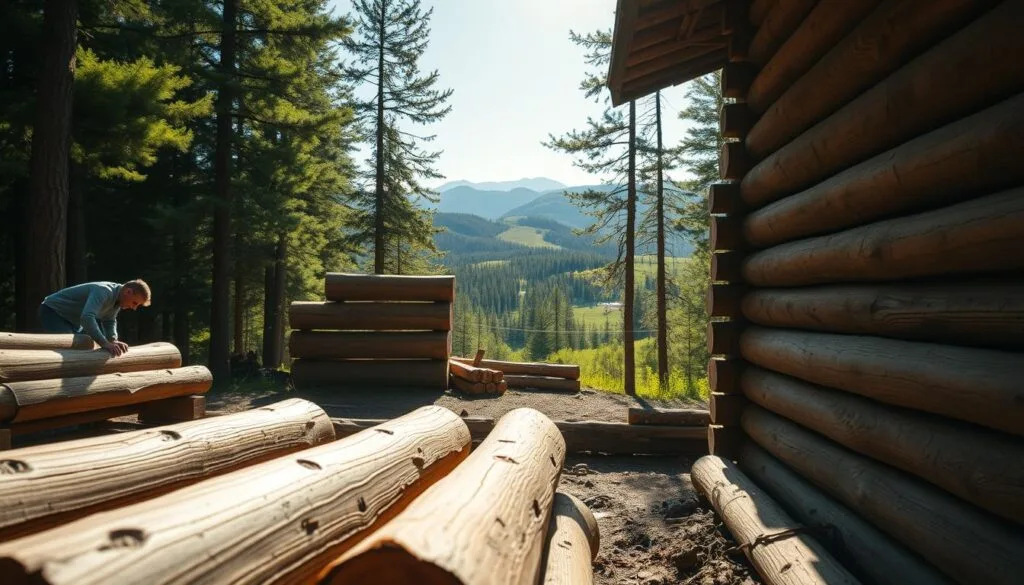
Creating the Longitudinal Groove
The longitudinal groove makes your walls better. It’s a small channel that fits logs tightly together. This groove is key to a professional look.
This groove is about 1 to 2 inches wide and half an inch to 1 inch deep. It helps your walls keep heat in. It’s worth the extra effort.
To make this groove, place a log on top and trace the bottom log’s shape. Then, use a chainsaw or chisel to carve it out.
This step is time-consuming. Many builders skip it. But, it makes your walls better.
Placing Insulation Between Courses
Insulation makes your walls better. Use foam sealant or fiberglass strips between logs. This keeps your cabin warm and saves on heating costs.
Historic cabins used moss or nothing. Modern materials are better and cost less. They make your cabin more energy-efficient.
Insulation gets thinner as logs are stacked. This creates a tight seal. It stops drafts and saves on heating.
Using Spikes and Rebar for Stability
Spikes and rebar keep your walls stable. They prevent logs from moving over time. This is important for your cabin’s safety.
Drill holes and insert spikes or rebar every 3 to 4 feet. This adds strength to your walls. It also helps with wind resistance and settling.
Fasteners are needed for stability. They’re not just for looks. They keep your walls strong and secure.
Maintaining Consistent Wall Height
Logs are different sizes, making height control hard. Your walls must be the same height. This is important for your cabin’s structure.
Measure wall height often. This helps catch any problems early. It saves you from big issues later.
Use logs of the right size to keep walls even. If needed, use shims or plan logs for better fit. This keeps your walls straight and even.
Check your walls often. Small problems are easier to fix early. This makes your cabin look better.
Remember, your cabin’s interior space is less than you think. Log thickness and corner extensions reduce space. Plan your cabin’s size carefully.
| Construction Aspect | Traditional Method | Modern Approach | Time Investment |
|---|---|---|---|
| Between-Course Sealing | Moss or nothing; gaps filled later | Foam sealant or fiberglass strips applied before each log | Additional 15 minutes per log |
| Log Fitting | Stack round logs directly; accept gaps | Cut longitudinal groove for tight fit | Additional 1-2 hours per log |
| Fastening System | Reliance on notched corners alone | Spikes or rebar every 3-4 feet along length | Additional 30 minutes per course |
| Height Management | Compensate during chinking and finishing | Constant measurement and log selection | Continuous throughout build |
Securing logs takes a lot of time. One builder needed almost a day for just four logs. Adjusting logs for a tight fit is hard work.
This is normal with natural materials. Don’t worry if it takes time. Each course you finish brings you closer to your dream cabin.
Building scaffolding helps when walls get high. It’s safer and more efficient than working from ladders. This is important for your safety.
Keep stacking until your walls are as tall as you want. Most builders aim for 8 feet of interior height. This usually takes 12 to 16 courses, depending on log size.
Cutting Openings for Doors and Windows
Creating openings in solid log walls might seem tough at first. But, two easy methods make it simple. You can use the old “cut after building” way or the new “frame as you go” method. Both work well, depending on your skill and how fast you want to build.
Logs are heavy and stick together. Cutting them removes support, so you need bracing and framing to keep walls strong.
Planning Window and Door Placement
Plan where to put openings before starting. This affects furniture and how much light gets in. Mark these spots on your foundation with bright paint and keep drawings handy.
Think about the sun when placing windows. South-facing windows get lots of winter sun in cold places. Also, think about views and privacy.
Use standard sizes for doors and windows. Doors are usually 36 inches wide by 80 inches tall. Windows vary, but planning for standard sizes saves money.
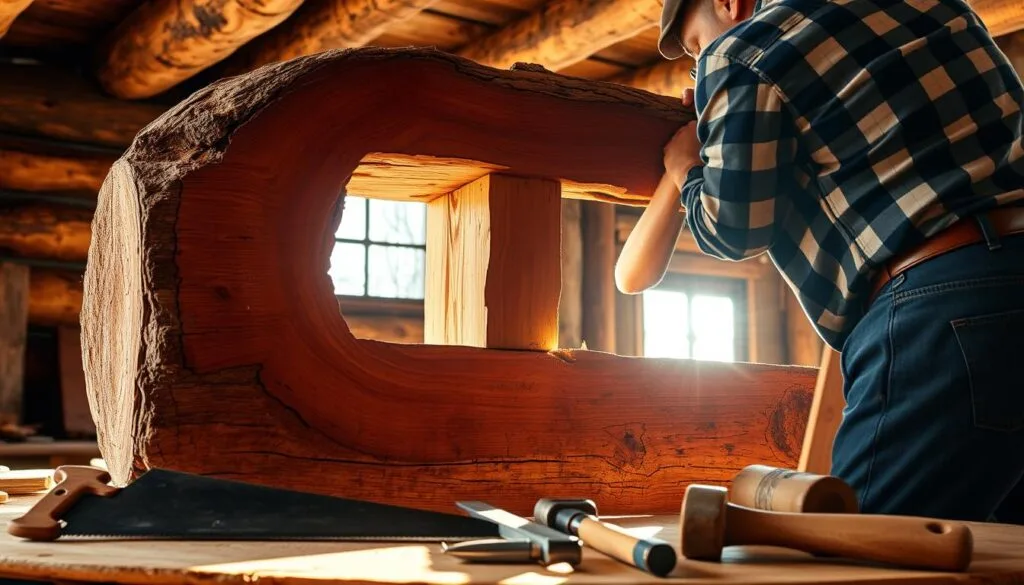
Building codes have rules you must follow. Bedrooms need egress windows that meet size standards. Check local rules before you start.
| Opening Type | Standard Rough Opening | Height from Floor | Code Requirements |
|---|---|---|---|
| Entry Door | 38″ x 82″ | 0″ (floor level) | 36″ minimum width, 80″ height |
| Interior Door | 32″ x 82″ | 0″ (floor level) | 30″ minimum for accessibility |
| Standard Window | 36″ x 60″ | 36-40″ (sill height) | Varies by room function |
| Egress Window | 44″ x 48″ minimum | 44″ maximum (sill height) | 5.7 sq ft minimum opening area |
Temporary Bracing During Construction
Bracing is key for safety and keeping walls stable. When you cut logs, you remove support. Logs can move or even fall without bracing.
Put up temporary braces before cutting. Use strong 2×6 or 2×8 boards nailed to logs on both sides. Make sure they go from the foundation up past the opening by two feet.
Space braces every 16 to 24 inches for best support. Nail them to logs with 3-inch screws or 16d nails. This creates a strong frame that stops log movement during cutting.
Check your bracing often as you cut. If logs move or you hear cracking, stop and add more support. It’s better to be safe than to risk a wall collapse.
Some builders add horizontal cross-bracing for extra stability. This makes a complete frame that keeps everything stable until you install permanent framing.
Cutting Openings After Wall Completion
The traditional way of cutting openings after building walls has big advantages. You can build faster without stopping for openings, and the wall is stronger while you work. This method has been used for generations.
Here’s how it works. Keep building walls without gaps for openings. Stop when you reach the height for the top of your door or window. This is usually 7-10 courses for doors and 6-8 for windows.
Mark and saw a section from one log for your opening. Make it wider than your opening by 4-6 inches. Support this log with a cleat to prevent it from sagging. This gap is where you’ll saw later.
Keep building logs above this gap until you reach the roof. Once the roof is up, you can cut the opening. The roof helps keep the wall stable.
Install temporary bracing as before. Then, saw through the gap you made. Cut carefully along your lines on both sides. The braces keep logs from moving as you cut.
After cutting, remove the log sections. You’ll have a space for permanent framing. Use 2×8 or larger boards as jambs against the cut ends. Secure these jambs with lag bolts or long screws into each log end.
These jambs keep the cut ends from moving and provide a flat surface for doors or windows. Add a header at the top and a sill at the bottom to finish the framing.
The “frame as you go” method involves installing jambs during wall building. Notch logs to fit around them as you stack. This method is simpler but tricky for beginners. It requires precise notching and keeping jambs straight as walls rise.
Whether you choose to cut openings before or after building, make sure logs project 12 inches beyond notches. This allows for working space and settling. You can trim excess later, but you can’t add length to cut logs.
Dealing with Log Settling and Shrinkage
Many DIY builders are surprised to learn that log walls can drop several inches as they dry. This happens because logs have a lot of moisture that slowly escapes over time. If you don’t plan for this, you could face serious structural problems later.
The good news is that log cabin settling is completely manageable if you understand the science and build right. Let’s explore what happens and how to handle it.
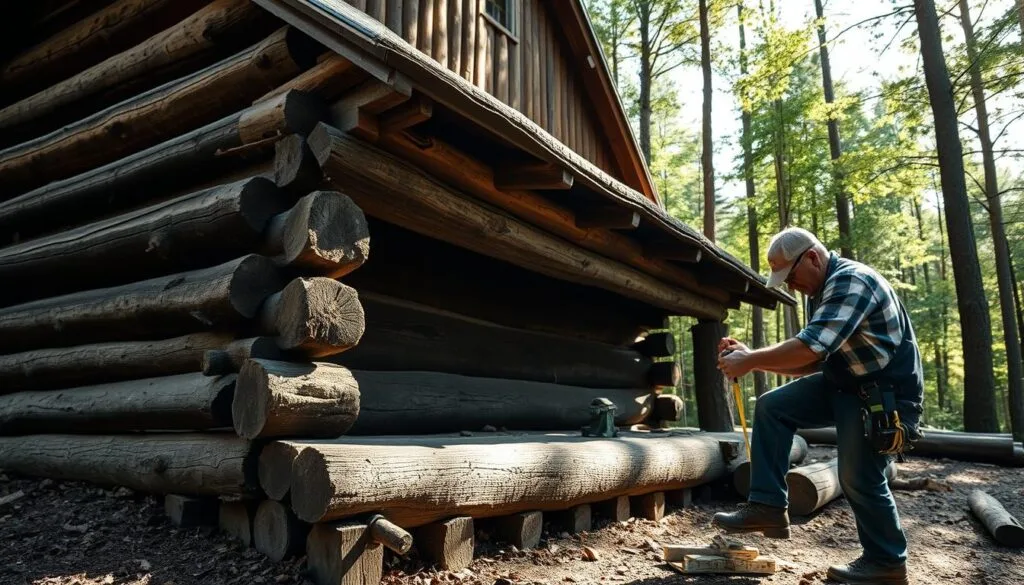
The Science Behind Settling
Logs shrink mainly across their diameter, not lengthwise. As moisture leaves, logs can lose 1/4 to 1/2 inch in diameter. This depends on the wood species and how wet it is.
In an 8-foot-tall wall with 15 log courses, you could see 3 to 6 inches of vertical settling. Green logs settle more than kiln-dried ones, but even dried logs move a bit.
The most settling happens in the first two years after building. But managing settling in the log home is key for the whole cabin’s life. Walls keep moving a little with humidity changes.
| Log Type | Moisture Content | Expected Settling (per 8 ft wall) | Primary Settling Timeframe |
|---|---|---|---|
| Green Logs | 40-60% | 4-6 inches | 1-3 years |
| Air-Dried Logs | 20-30% | 2-4 inches | 1-2 years |
| Kiln-Dried Logs | 12-15% | 1-2 inches | 6-12 months |
| Standing Dead Logs | 15-25% | 1-3 inches | 6-18 months |
Creating Space Above Doors and Windows
Your door and window frames don’t shrink like logs do. This creates a big challenge: settling spaces must be built into every opening or the logs will crush the frames.
Without these spaces, doors won’t open, windows will crack, and frames will get damaged. The fix is simple but very important.
Make a gap between the top of your door or window frame and the log above. For green logs in an 8-foot wall, this gap should be 3 to 4 inches. Dried logs need less space—usually 1.5 to 2.5 inches.
Use fiberglass insulation in this gap that can compress as settling happens. Then, cover it with trim boards that only attach to the frame, not the logs. These trim boards have slotted nail holes that let them slide down while keeping weather out.
To figure out your settling space, multiply the number of log courses above the opening by the expected shrinkage per log. Add 10% as a safety margin. This ensures enough room for log shrinkage during settling.
Installing Adjustable Supports for Vertical Posts
Vertical supports like porch posts and interior columns also settle. If you install a fixed-height post, the settling ceiling will push down on it hard.
This can cause serious damage: cracked logs, tilted posts, or even structural failure. The solution is adjustable jack systems that let you lower posts as needed.
These screw jacks go at the top or bottom of posts. They work like giant screws that you can tighten to lower the post a little at a time. As your walls settle, just turn the jack to keep the spacing right.
Here’s your maintenance schedule for adjustable jacks:
- Check monthly for the first six months after construction
- Adjust quarterly during the first two years
- Inspect annually after the primary settling period
- Make small adjustments of 1/8 to 1/4 inch at a time
Log shrinkage isn’t just for new cabins. Your walls will keep moving a bit with the seasons. This is why flexible chinking and proper sealants are key for your cabin’s whole life.
Knowing these settling principles helps you build better from the start. Plan for movement, install the right systems, and your log walls will settle smoothly without causing problems later.
Sealing and Chinking Your Log Walls
Chinking makes your log walls tight and saves energy. It keeps cold air and moisture out. Even with perfect logs, gaps form where logs meet.
Sealing is key to keep your cabin warm. Without it, your walls won’t stay cozy. You’ll use more energy and might face water damage.
Knowing your sealing options helps you choose wisely. The right choice balances looks, function, and cost for your cabin.
Traditional vs. Modern Chinking Materials
Old log cabins used local materials like mud and straw. It looked rustic and cost little. But, it needed constant upkeep.
Today, we have better choices. Modern chinking lasts longer and works better. It’s made from acrylic and lasts 20+ years without needing to be replaced.

Mud chinking needs a lot of work. You must fix cracks often. Rain can wash it away, leaving your cabin exposed.
Modern synthetic chinking lasts longer and works better. It stays flexible as logs settle. It sticks well to wood and resists weather for decades.
Choosing synthetic chinking costs more. It’s $25-40 per tube or $200+ per 5-gallon pail. A small cabin might need 5-10 gallons, which is a big investment.
A mix of cement and sand is a good middle choice. It’s cheaper than synthetic and easier to apply. But, it may crack as logs settle.
| Material Type | Cost per Gallon | Lifespan | Maintenance Needs |
|---|---|---|---|
| Clay/Mud Mix | $0-5 | 1-2 years | Annual re-plastering required |
| Cement/Sand | $10-20 | 5-10 years | Occasional crack repair |
| Acrylic Synthetic | $40-60 | 20+ years | Minimal inspection only |
| Construction Adhesive | $8-15 per tube | 10-15 years | Touch-ups as needed |
Construction adhesive works for small gaps. It’s flexible and sticks well to wood. Builders often use it during stacking and after finishing.
Proper Application Techniques
Chinking needs careful prep and application. Wait until your logs settle for a year. This prevents cracking as they shrink.
For big gaps, use foam backer rod first. It supports the chinking and saves material. Press it into the gap with a putty knife or screwdriver.
Apply chinking in layers for deep gaps. Use a putty knife or chinking iron to fill spaces. Make sure to remove air pockets to prevent moisture.
The surface profile is important. Make the chinking slightly concave to shed water. This prevents water from pooling and damaging the seal.
Work on your cabin systematically. Finish the exterior first to protect it from weather. Then, do the interior. It takes several days for a small cabin.
Temperature affects chinking. Apply when it’s above 50°F for best bonding. Avoid hot days over 85°F to prevent cracking.
Caulking for Weather Resistance
Small gaps need caulking, not full chinking. It’s cheaper and seals well. Use exterior-grade caulking made for log homes.
Good caulking stays flexible in extreme temperatures. Look for products that handle 25% joint movement. This prevents cracking.
Your cabin needs to be sealed to keep air and water out. Even small gaps can cause drafts and increase heating costs. A quarter-inch gap is like leaving a window open.
Apply caulking in continuous beads. Use steady pressure and tool it immediately for a smooth surface.
Check your sealing work yearly for damage. Look for cracks and where material has fallen out. The first few years need more attention.
Re-apply caulking or chinking in high-stress areas every 3-5 years. Corner joints and openings need touch-ups first. Catching small problems early prevents big repairs.
Good maintenance keeps your cabin weatherproof for decades. The effort you put in now saves energy and keeps your cabin strong. Your log walls will protect you for many seasons.
Finishing and Protecting Your Log Walls
Your log walls need protection from weather, sun, and time. The final touches decide if your cabin will age well or need constant fixes. These steps turn raw logs into a strong home that lasts for many years.
Choosing how to finish your cabin depends on what you like and how much work you want to do. Some like the look of weathered wood, while others prefer a fresh appearance with regular care.
Sanding and Smoothing Log Surfaces
Smoothing your logs is optional, based on the look you want. Many cabins keep their logs natural, with marks from tools adding charm. Others prefer smooth surfaces.
If you smooth your logs, start with coarse 60-80 grit sandpaper to remove rough spots. Then, use finer grits—100 and 120—to smooth areas people touch often.
Focus on smoothing interior walls near doors, railings, and seats. Exterior walls often look better with their natural texture. Avoid over-sanding to keep the logs’ unique marks.
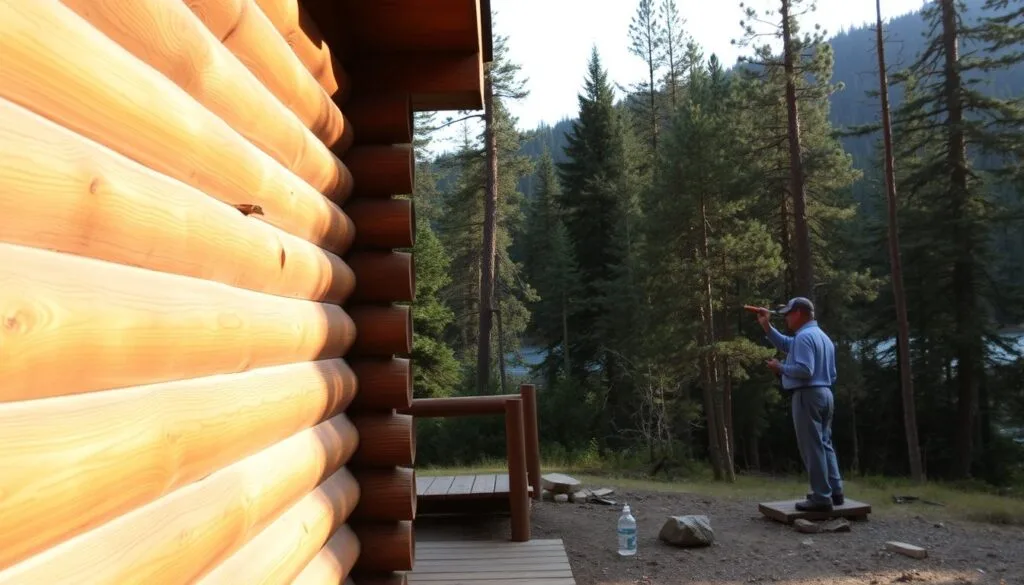
Applying Stains and Sealants
Choosing the right stain is key to protecting your cabin. You can pick from natural or synthetic options, each with its own benefits. For more info, check out the complete guide to log cabin wood.
Here’s what each treatment offers for log protection:
| Treatment Type | Protection Level | Appearance | Reapplication Frequency |
|---|---|---|---|
| Untreated Natural | Minimal (decay-resistant species only) | Weathers to silver-gray over time | Never (maintenance-free) |
| Penetrating Oils | Moderate moisture protection | Enhances natural wood color | Every 2-3 years |
| Clear Sealants with UV Blockers | Good UV and moisture protection | Maintains natural appearance | Every 3-5 years |
| Semi-Transparent Stains | Excellent all-around protection | Adds color, shows grain | Every 4-6 years |
| Solid-Color Stains | Maximum protection | Hides wood grain completely | Every 6-8 years |
Untreated wood works well with resistant species like cedar or eucalyptus. Eucalyptus, when dried right, is very durable without treatments. It weathers to a soft gray that many like.
For most, a good penetrating stain is best. Apply two coats outside and one inside, focusing on where water collects. Pay extra attention to end grain, as it absorbs moisture fast.
One builder used cooking oil for protection. It worked well and even improved the wood’s look. This shows you don’t always need expensive products for good results.
Regular Maintenance Requirements
Log cabins need regular care to stay in good shape. Knowing what maintenance is needed helps plan your time and budget. A well-kept cabin can last for decades, while neglect can lead to costly repairs in just 10-15 years.
Here’s what to do every year:
- Check chinking and caulking for gaps, fixing them right away
- Look for insects or rot, focusing on the foundation
- Clean off dirt and cobwebs from the logs
- Check the roof for leaks that could harm the walls
- Make sure all hardware is tight
Reapply your chosen stain to exterior walls every 3-5 years. Start with south and west sides, as they get the most sun. You’ll know when it’s time to reapply—the wood will feel dry and water won’t bead up.
Every 5-10 years, do a deeper check. Look for damage on lower logs, as they’re more exposed to moisture. Sometimes, you’ll need to replace the bottom logs while the top ones are fine. This is normal if you catch problems early.
Regular maintenance saves a lot of money. Spending a few hours each year on upkeep prevents big problems. It’s like protecting your investment—the time you spend now saves you money later.
Keep a log of your maintenance work. Note when you applied treatments, what you used, and any issues. This helps you find the right schedule for your cabin and climate. Over time, you’ll develop a routine that keeps your cabin looking great with little effort.
Bringing Your Log Cabin Wall Vision to Life
You’ve done something amazing. Building log cabin walls is hard work. It needs patience, strength, and problem-solving skills.
You started with planning and picking the right timber. Then, you cut your final notch. You’ve learned a lot from this experience.
Your journey included many steps. You planned, prepared logs, and built the foundation. You also learned about notching, stacking, and finishing touches.
You might have used traditional, mixed-material, or modern methods. Your walls show your hard work and determination. Each method has its own strengths, and you chose what worked best for you.
Even pros face surprises. You might need to adjust things or change plans. These challenges are part of the journey, not failures.
Now, your cabin needs a roof, floors, utilities, and personal touches. These steps will make it a real home. Keep in mind the tips you learned as you move forward.
Your cabin is special. It’s not like a mass-produced house. It shows your effort in every detail. The skills you’ve gained are valuable and rare.
Your cabin will change over time. It will settle, weather, and gain character. Taking care of it is part of your bond with this building you’ve made.