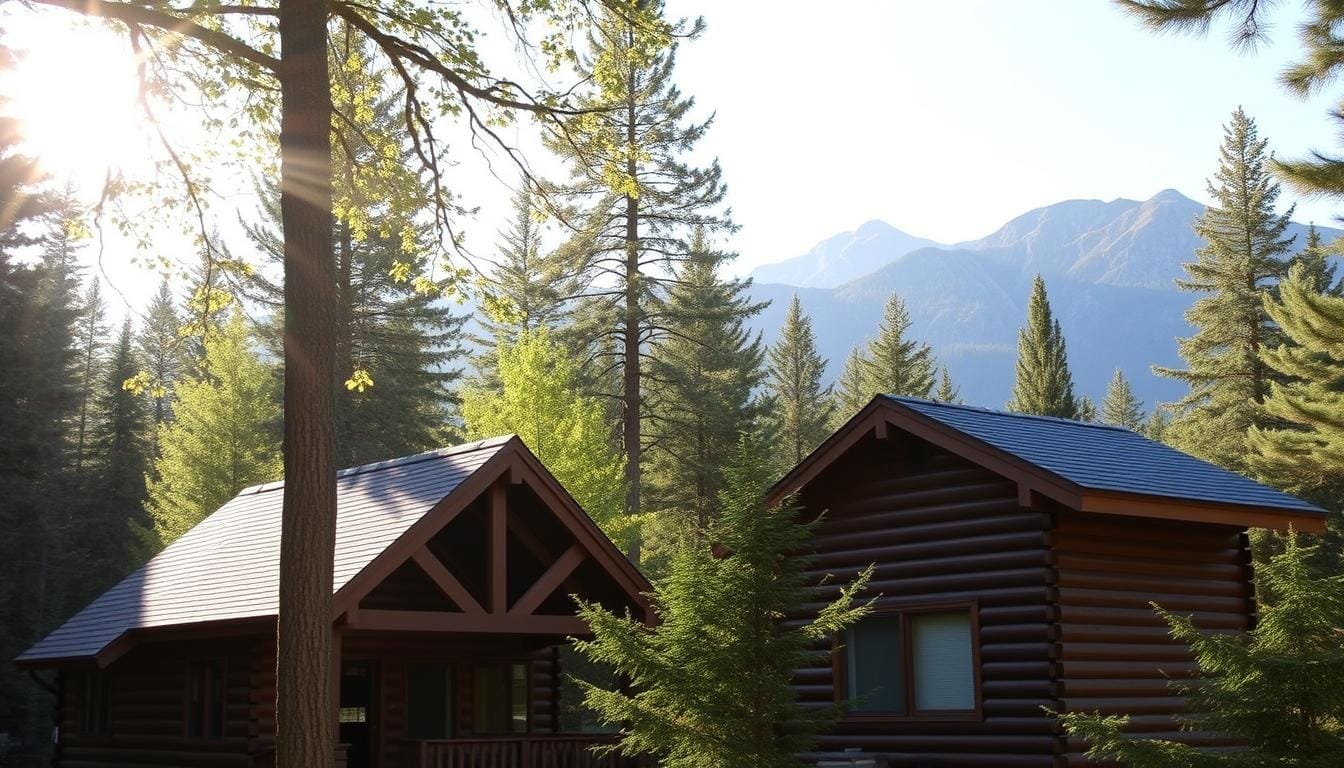

Building your dream cabin in the woods is a big decision. Choosing the right roof is key. It affects how your cabin handles weather and your construction costs.
The choice between gable and shed roofs is more than looks. It’s about how well each roof works in your area. Cost, durability, maintenance, and how it fits with nature are all important.
Here’s the good news: both styles have their benefits. There’s no single best choice. The right roof depends on your budget, location, use, and taste.
By the end of this guide, you’ll know which roof is best for you. We’ll cover key points that matter to builders and owners. This will help you choose confidently for your cabin.
Understanding Your Cabin Roofing Decision
Your cabin’s roof does more than just keep out the rain—it shapes everything from your budget to your building timeline. Unlike suburban homes, cabins face unique challenges. The right choice protects your investment, while the wrong one can lead to expensive repairs.
When building in remote or wilderness settings, several roofing decision factors come into play. Weather patterns hit harder in mountain and forest locations. Your cabin’s roof needs to handle these conditions year after year without constant maintenance trips.
Location makes cabin building considerations different from standard home construction. If your cabin sits three hours from the nearest hardware store, you can’t easily run out for supplies or call a roofer on short notice. This reality means choosing a roof design that’s durable, practical, and suited to your specific climate zone matters more than aesthetic preferences alone.
The roof choice importance extends beyond just weather protection. Your roof determines how much usable space you’ll have inside, whether you can add a loft or extra storage, and how your cabin looks from the outside. It also affects your heating and cooling costs, which is important if you plan to use your cabin year-round.
Understanding these factors helps you make a smarter cabin roof selection that fits your actual needs. A weekend retreat in mild climates has different requirements than a full-time mountain residence facing harsh winters. Your budget, construction timeline, and future plans all play important roles in this decision.
| Decision Factor | Why It Matters for Cabins | Impact on Roof Choice |
|---|---|---|
| Local Climate | Remote locations often face extreme weather conditions | Determines pitch angle, material strength, and drainage needs |
| Access and Maintenance | Repairs are harder and more expensive in isolated areas | Favors simpler designs with proven durability |
| Budget Constraints | Material transport and labor costs run higher | Affects complexity of design and material selection |
| Intended Use | Weekend vs. full-time living changes priorities | Influences insulation, ventilation, and space planning |
Smart planning now saves headaches later. Taking time to evaluate roofing decision factors before breaking ground means you’ll avoid costly mistakes. Your roof will last decades, so getting it right the first time pays off in comfort, safety, and peace of mind.
The good news is that understanding cabin building considerations doesn’t require an engineering degree. By focusing on your specific situation—where your cabin sits, how you’ll use it, and what weather challenges you’ll face—you can confidently choose between a gable or shed roof design. Both options have distinct advantages, and the right choice depends on matching roof characteristics to your unique cabin needs.
What Is a Gable Roof and How Does It Work?
A traditional cabin often has a gable roof. This roof is shaped like a triangle with two slopes meeting at the top. It’s a classic design that works well in many weather conditions.
The roof’s design is based on simple shapes and gravity. Two sides slope up and meet at a ridge beam. This shape helps rain and snow slide off, keeping the roof dry.
Core Design Elements and Structure
The roof has key parts like rafters or trusses. These support the roof’s weight and shape. They slope up from the walls to the peak.
The ridge beam is at the top where the slopes meet. It connects the rafters and holds the roof together. Think of it as the roof’s backbone.
Wall plates are at the top of the cabin’s walls. They help the rafters connect to the cabin. The gables at each end are framed and covered with siding.
https://www.youtube.com/watch?v=B2Y9CLveXSU
An A-frame roof cabin is a special type of gable roof. It slopes all the way to the ground, making it the walls. This design is dramatic and space-saving.
One big plus of this design is the usable attic space it offers. Unlike flat roofs, gable roofs have vertical space for storage or living areas. The peaked design also helps with ventilation, letting warm air escape.
Popular Gable Roof Variations for Cabins
There are many gable roof designs for cabins. These variations keep the roof’s benefits but add style and function. They make your cabin stand out.
Cross Gable Designs
Cross gable roofs have two or more gable sections at right angles. This creates an L or T shape. Each section has its own ridge.
This design is great for bigger cabins or those with wings. It adds architectural depth and visual interest. Cross gables also let in more natural light through windows.
But, cross gables need extra care at the valley where sections meet. This area must be well-flashed to avoid leaks. Yet, the design’s beauty and benefits make it worth the extra effort.
Dutch Gable Configurations
A Dutch gable combines hip and gable roof features. The lower part is a hip roof, and the top is a small gable. This mix offers wind resistance and storage space.
This design is a good choice for windy and snowy areas. The hip base is stable, and the gable peak sheds water and snow well.
| Gable Roof Type | Best For | Complexity Level | Key Advantage |
|---|---|---|---|
| Standard Gable | Simple rectangular cabins | Low | Easy construction and excellent drainage |
| Cross Gable | L-shaped or complex floor plans | Medium | Architectural interest and multiple light sources |
| Dutch Gable | Wind-prone areas needing traditional aesthetics | Medium-High | Wind resistance with gable character |
| A-Frame | Small cabins maximizing vertical space | Medium | Dramatic appearance and efficient use of materials |
Each gable roof design has its own strengths. The standard gable is simple and affordable. Cross gables are for those who want a more complex look.
Dutch gables are for those who want traditional looks but need better wind protection. Think about your climate, budget, and style when choosing a gable roof.
What Is a Shed Roof and How Does It Work?
If you’re looking for a simple cabin roof, the shed roof design is worth checking out. It’s all about simplicity. Instead of a peak or multiple slopes, it has just one flat surface. This style is also known as a skillion roof or mono-pitch roof.
This roof style is popular for its clean look. It’s perfect for modern cabins and saves money. Knowing how it works can help you decide if it’s right for your cabin.
Single-Slope Design Fundamentals
The single slope roof cabin works on a simple idea. One wall is taller than the other, and a single roof connects them at an angle. It’s easy, with no valleys or ridges.
The roof’s slope is usually between 3:12 and 6:12. This helps water flow down to the lower edge. This means fewer leaks than more complex roofs.
This roof needs fewer materials than others. You’ll need rafters, sheathing, and roofing material. It’s simpler and saves materials.
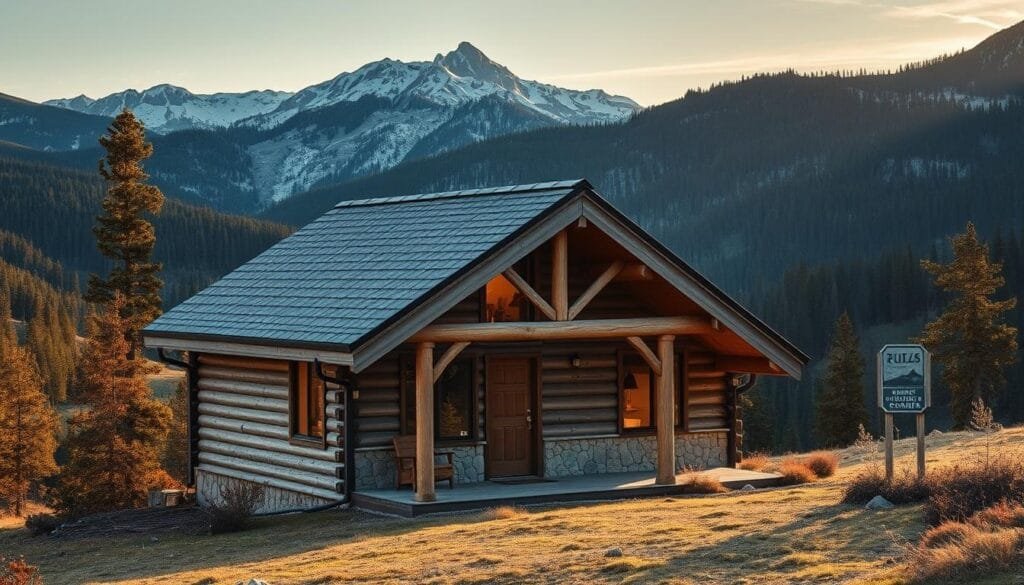
Modern Shed Roof Applications
Today, the modern cabin roof often uses shed roofs. They’re great for solar panels because you can face them to catch the sun. This is good for saving energy.
The roof’s design lets you have different ceiling heights. This adds interest and keeps some areas cozy. It’s a great way to make your cabin feel special.
Clerestory Window Integration
Clerestory windows are a big plus of shed roof design. They’re vertical windows on the high wall, just before the roof starts. They let in natural light and keep things private.
These windows are perfect for cabins in the woods. They let in sunlight even when trees block it. Your cabin stays bright and cozy.
Adding clerestory windows needs careful planning. The wall must support the windows and the roof. But the extra light and air make it worth it.
Multiple Shed Roof Combinations
Creative designers like to mix shed roofs for a unique look. You can try a butterfly roof or stack sheds for a cascading effect. These designs make a simple idea into something special.
Using multiple shed roof design can also improve how your cabin works. You can add windows on different sides for better air flow. This helps cool your cabin without needing air conditioning.
Adding more roofs makes things a bit more complex. But each shed roof is simple. This lets you start small and add more as you need it.
Comparing Costs: Gable vs Shed Roof for Cabin Projects
Choosing between gable and shed roofs is a big decision. It’s not just about the initial cost. Your cabin’s budget should include upfront costs, labor, and future maintenance.
Many think shed roofs are cheaper because they’re simpler. But, there’s more to it. Both roofs have their own costs that affect your wallet over time.
Initial Material Investment
Gable roofs cost between $6 to $12 per square foot for materials. This is because they need more lumber for the design. Shed roofs seem cheaper at first, costing $1 to $7 per square foot. But, they might need more reinforcement, which can increase costs.
Here’s what affects material costs for each roof:
- Lumber requirements: Gable roofs need more framing members but use standard-sized materials
- Roofing coverage: Shed roofs have less total surface area for the same footprint
- Structural support: Shed roofs often require larger beams to span without center support
- Hardware and fasteners: Gable designs use more connection points and specialized brackets
- Insulation needs: Both styles require similar insulation volumes for proper thermal performance
The cost difference between gable and shed roofs narrows when you look at the whole project. Prefabricated trusses for gable roofs can save 25-30% on materials. Shed roofs use fewer pieces but lack this efficiency.
| Cost Component | Gable Roof Range | Shed Roof Range | Key Difference |
|---|---|---|---|
| Framing Lumber | $3-5 per sq ft | $1-3 per sq ft | Gable needs more pieces |
| Roofing Material | $2-4 per sq ft | $1.50-3 per sq ft | More surface area to cover |
| Support Beams | $1-2 per sq ft | $2-4 per sq ft | Shed requires stronger spans |
| Total Material Cost | $6-12 per sq ft | $5-10 per sq ft | 15-25% difference typical |
Labor and Installation Pricing
Labor costs vary with design complexity and contractor experience. Gable roofs are familiar to most framers, leading to faster installation and lower labor costs. Expect to pay $3 to $6 per square foot for gable roof labor.
Shed roof labor costs might surprise you. The simpler design suggests easier installation, but precise slope calculations and reinforcement placement can increase labor time. Expect to pay $2.50 to $5.50 per square foot for professional installation, with costs rising if custom beam work is required.
DIY builders face different challenges with each design. Gable roofs require more cuts and connections but follow straightforward patterns. Shed roofs involve fewer pieces yet demand precise angle calculations and structural understanding to prevent future problems.
The learning curve matters significantly for owner-builders trying to manage their cabin roof cost comparison. Gable construction benefits from abundant tutorials, standard lumber sizes, and forgiving design tolerances. Shed roofs offer less margin for error in beam sizing and support placement, potentially requiring professional consultation even on DIY projects.
Long-Term Maintenance and Repair Expenses
The true cost difference between these roof styles emerges over decades of ownership. Maintenance expenses, repair accessibility, and replacement timing all factor into your long-term financial commitment. Understanding these ongoing costs helps you make a smarter initial investment.
Gable roofs distribute weather stress across multiple surfaces and support points. This design typically requires inspection every 3-5 years and minor repairs averaging $300-800 per incident. The symmetrical design makes damage assessment straightforward, and repairs usually involve replacing individual shingles or addressing isolated flashing issues.
Shed roofs concentrate all weather exposure on a single slope, which can accelerate wear in harsh climates. Plan for inspections every 2-3 years and potentially repairs costing $400-1,200 as issues often affect larger continuous areas. The single plane makes problems easier to spot but sometimes more expensive to fix comprehensively.
Weather impacts create different maintenance patterns for each style. Heavy snow loads stress shed roof support beams, occasionally requiring mid-winter clearing to prevent structural strain. Gable roofs shed snow naturally but may develop ice dams at eaves that need management. Wind damage typically costs more to repair on gable roofs due to multiple vulnerable edges and ridge exposure.
Replacement costs down the road favor shed roofs slightly. When your cabin needs a complete roof overhaul after 20-30 years, the shed roof replacement cost runs about 15-20% less than gable alternatives due to reduced surface area and simpler tear-off processes. But, gable roofs often last longer before requiring total replacement, potentially offsetting this advantage.
Accessibility affects maintenance expenses significantly. Gable roofs provide easier access from multiple sides and distribute work areas across manageable sections. Shed roofs may require specialized scaffolding for high-end work and concentrate all maintenance activity on one large surface. These practical considerations add $200-500 to typical maintenance visits depending on your cabin’s height and terrain.
Climate and Weather Performance
When storms hit and it gets cold, your cabin roof is the first defense. The roof you choose affects how well it handles nature’s challenges. Gable and shed roofs have their own strengths based on your area’s weather.
Knowing how climate affects building choices helps pick a roof that lasts for decades. Where you live greatly impacts how well your roof performs. A cabin in Montana faces different challenges than one in coastal Oregon.
Heavy Snow Load Management
Gable roofs are great at shedding snow because of their steep slopes. This design helps snow slide off before it becomes too heavy. This makes managing snow easier during winter.
Gable roofs spread the weight evenly, which is good for the structure. Most designs can handle 20-40 pounds per square foot without extra support.
Shed roofs, on the other hand, have all the snow on one side. This means they need stronger support in snowy areas. Engineers often add thicker beams and extra bracing for these roofs in places like the Rocky Mountains or Northeast.
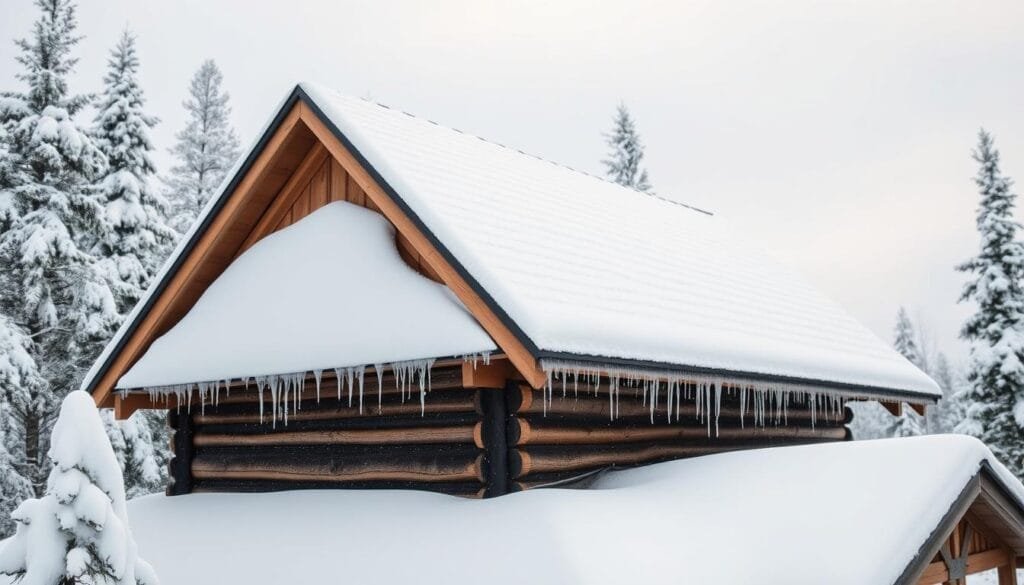
The roof’s angle is key to managing snow. Steeper slopes shed snow better than gentler ones. FEMA suggests slopes of 8:12 or more for over 50 inches of snow a year.
High Wind Resistance Capabilities
Wind affects both roof types differently. A wind-resistant roof must fight against forces trying to lift it. Good bracing is essential for survival in storms.
Gable roofs are vulnerable at the ends where wind can lift them. But, with hurricane straps and strong connections, they can handle winds up to 110 mph.
The ends of gable roofs catch wind like sails. Builders use continuous structural sheathing and extra bracing to make them strong. This turns a weak point into a strong one.
Shed roofs are lower and can handle strong winds better in some places. But, they need good sealing to prevent wind from getting underneath and lifting them.
Coastal areas benefit from shed roofs with strong overhang bracing. The key is to secure the low edge to prevent wind from lifting it. Metal roofing adds weight and helps resist wind.
Rainfall and Water Drainage Efficiency
Good roof drainage keeps your cabin dry and strong. Both gable and shed roofs work well if designed right. The main difference is how they handle water near the foundation.
Gable roofs direct rainwater to two sides, splitting the load. This makes it easier to manage water flow. The steep pitch helps water move fast, preventing it from pooling.
Gable roofs make it easy to place gutters. You can put them on one side if needed. This saves money and keeps your cabin safe.
Shed roofs send all rain to one edge, which means they need strong gutters to handle it. But, they’re good for rainwater harvesting systems.
Shed roofs need careful slope planning. A slope of 2:12 to 4:12 is usually best. Steeper slopes can cause erosion near the edge.
| Weather Factor | Gable Roof Performance | Shed Roof Performance | Best Climate Match |
|---|---|---|---|
| Heavy Snowfall | Excellent shedding, balanced load distribution | Good with reinforcement, concentrated loads | Gable for 50+ inches annually |
| High Winds | Good with proper bracing, vulnerable ends | Lower profile advantage, requires edge sealing | Shed for coastal hurricane zones |
| Heavy Rainfall | Dual drainage, even gutter load | Single-edge drainage, high flow capacity needed | Either with proper pitch design |
| Mixed Conditions | Versatile across multiple weather types | Performs best in specialized climates | Gable for variable weather regions |
Ice Dam Prevention
Ice dams form when heat escapes through the roof, melting snow that refreezes at the cold eaves. This creates barriers that trap water, leading to leaks and structural damage. Ice dam prevention cabin strategies differ significantly between roof types.
Gable roofs offer natural ventilation advantages through ridge vents and soffit intake systems. This airflow keeps the roof deck cold, preventing the temperature differential that causes ice dams. The attic space provides room for adequate insulation without compromising ventilation.
Proper attic insulation combined with continuous soffit-to-ridge ventilation virtually eliminates ice dam problems on gable roofs. The R-value should reach at least R-49 in cold climates, with sealed air leaks preventing warm air from reaching the roof deck.
Shed roofs require more creative solutions because they lack traditional attic ventilation space. Building a raised ceiling with ventilation channels above the insulation maintains the cold roof deck necessary for ice dam prevention cabin protection. This adds construction complexity but proves essential in freezing climates.
Heat tape and metal roofing at eaves provide backup protection for both designs. These systems melt ice before dams form, protecting vulnerable edges. But, proper insulation and ventilation remain the primary defense against this common winter problem.
Space Utilization and Interior Benefits
Your roof design changes how much space you have inside your cabin. It affects where you can put furniture and if you can fit holiday decorations. Gable and shed roofs make your cabin feel different, either spacious or cramped.
Knowing these differences helps you use every inch of your cabin. Let’s look at how each roof type changes your daily life and storage.
Ceiling Height and Living Comfort
Gable roofs have a peaked center point for lots of headroom in the middle. You’ll have 8 to 10 feet of clearance, getting less as you go to the walls. This lets you walk comfortably in most of the space.
The ceiling height changes with the roof pitch. A steeper pitch means more space in the middle but less near the walls. You can put tall furniture like bookcases or wardrobes in the center without worry.
Shed roofs offer a different feel with their single-slope design. One wall is full height, often 10 to 12 feet, while the other drops to 7 or 8 feet. This creates a modern look with vaulted ceilings that make rooms seem bigger.
The sloped ceiling in shed roof cabins means you need to plan furniture placement carefully. Place beds, couches, and dining tables where you have enough headroom. Lower areas are great for built-in storage, desks, or reading nooks.
Storage Solutions Above Living Areas
Gable roofs are great for attic storage cabin spaces without taking up more space. The triangular area above your ceiling joists is perfect for storing seasonal items, camping gear, and less-used belongings.
A 24×24-foot cabin with a gable roof can have 300 to 400 square feet of attic storage. This is enough for holiday decorations, winter sports equipment, and luggage. You’ll need a pull-down ladder or fixed stairs to access it, depending on how often you’ll use it.
The attic’s height and usability depend on the roof pitch. A 6:12 pitch or steeper gives enough room in the center for easier organization. Shallower pitches offer storage but require more crawling and careful planning.
Shed roofs usually don’t have attic space because of their single-slope design. The ceiling follows the roofline directly, leaving no space for storage. You’ll need to find other ways to store things in your main living areas, like closets or built-ins.
Some shed roof designs might have a small storage area on the tall side. But this space is usually much smaller than what gable roofs offer naturally.
Adding Upper-Level Living Space
Gable roofs are perfect for loft cabin design that adds sleeping or living areas without the cost of a full second floor. A sleeping loft can double your usable space while keeping the area below cozy and open.
Most cabin lofts are 80 to 200 square feet, great for guest beds, kids’ sleeping areas, or quiet reading spots. Gable roofs naturally provide enough headroom in the center for lofts, thanks to their moderate to steep pitches.
Access to lofts can be through standard stairs, ship ladders, or spiral staircases, depending on your space. Stairs are safest and easiest but take up more room. Ship ladders offer a balance between comfort and space efficiency.
Shed roofs can also have loft and mezzanine areas if designed with enough pitch. A 6:12 or steeper slope on the high side allows for a partial loft. The main difference is that shed roof lofts only occupy the tall end, not the full width.
Safety railings are key for any loft design, and most codes require 36 to 42-inch guardrails around open edges. Plan for these early to ensure compliance and safety.
| Interior Feature | Gable Roof Benefits | Shed Roof Benefits | Best Use Case |
|---|---|---|---|
| Central Headroom | Consistent 8-10 feet down center, symmetrical layout | Dramatic 10-12 feet on tall side, modern vaulted feel | Gable for traditional layouts; Shed for contemporary open designs |
| Attic Storage | 300-400 sq ft possible in 24×24 cabin, full-width access | Minimal to none, ceiling follows roofline directly | Gable provides significant storage advantage for smaller cabins |
| Loft Space | Full-width sleeping loft, 80-200 sq ft typical, spans entire cabin | Partial loft possible on tall end only, requires steeper pitch | Gable maximizes upper-level living; Shed works for single sleeping area |
| Furniture Placement | Best along center line, taper limits wall use on sides | Flexible on tall wall, creative built-ins on low side | Shed offers more dramatic design opportunities for modern furnishings |
Your choice between gable and shed roofs affects your daily life in your cabin. Gable roofs offer vertical storage and sleeping spaces without needing more land or money. They have a familiar, traditional feel.
Shed roofs create modern, open interiors with high ceilings on one side. They sacrifice overhead storage for a more airy feel that makes small spaces seem bigger. The sloped ceiling becomes a design feature, not hidden attic space.
Think carefully about what you need. Do you need extra storage for seasonal gear and equipment? Gable roofs naturally offer that. Do you prefer modern, open interiors? Shed roofs are better for that. Both designs can make your cabin beautiful and functional if they match your needs.
Architectural Style and Curb Appeal
Roof design sets the first impression of your cabin. It shows if you like tradition or modern style. The roof’s look affects your property’s value, neighborhood feel, and how visitors feel when they see it.
Choosing the right roof is key for cabin curb appeal. It meets your style and practical needs.
Your cabin’s style shows your personality and values. Some like their cabin to blend with nature. Others want it to stand out.
Both styles work well if done right with the right materials and size.
Timeless Appeal of Traditional Peaked Roofs
Gable roofs give your cabin a classic cabin aesthetic. They look welcoming and evoke a sense of history. This traditional cabin design has been loved for years.
Gable roofs are versatile. You can choose wood shakes for a rustic look or metal for durability. Architectural shingles are affordable and add texture.
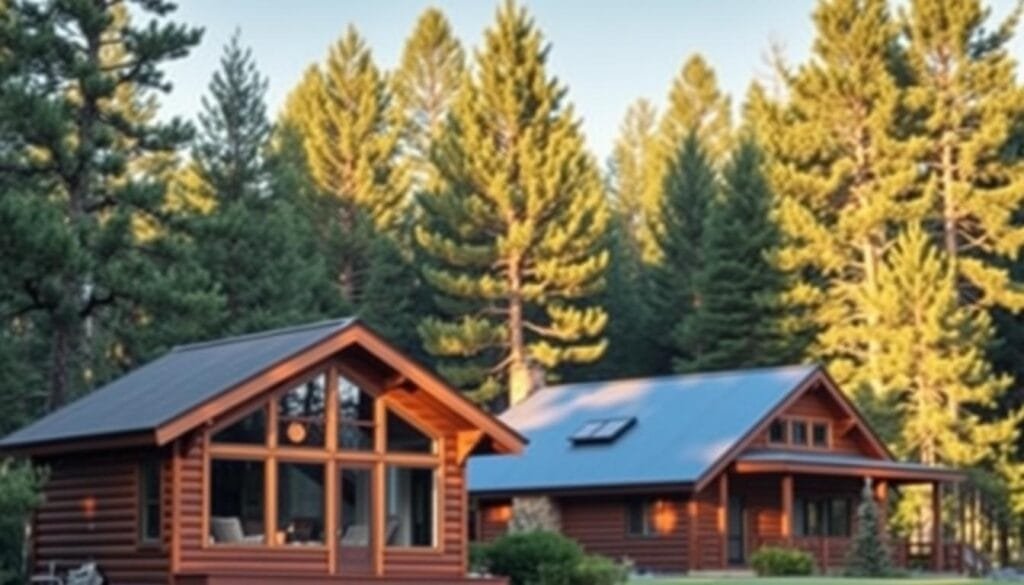
Gable roofs can have special touches that boost cabin curb appeal. You can add decorative elements without losing function. These details make your rustic cabin roof stand out.
In some areas, gable roofs are preferred for their consistency. They often meet community design rules. Knowing this can save you from costly changes later. For more on roof designs, check out this article.
Sleek Minimalism of Single-Slope Designs
Shed roofs are perfect for modern cabin architecture. They have clean lines and stand out against nature. This style is for those who see their cabin as art.
Shed roofs look great with big windows and modern materials. They create a unique look that’s perfect for social media. This style is all about making a statement.
Inside, shed roof cabins have amazing spaces with high ceilings. They’re great for showing off modern decor. The outside shows off the inside, making a bold architectural statement.
Geographic Preferences and Local Traditions
Roof styles vary by region. In New England and the Midwest, gable roofs are common. They match colonial and farmhouse styles.
In the Pacific Northwest and mountain West, shed roofs are more popular. These areas love new ideas in cabin design. They see cabins as a chance to try new things.
Think about how your cabin fits in with the area. You can blend in or stand out. Both can work if done well. Your roof choice is part of a bigger conversation about personal style and community.
Construction Complexity and Build Time
Choosing between gable and shed roofs isn’t just about looks. The building process is different. This affects your project timeline, labor costs, and if you can do it yourself. Knowing these differences helps you plan better and set realistic goals for your cabin roof project.
Before starting, know what you’re getting into. Shed roofs are simpler with straightforward framing and fewer materials. Gable roofs need more technical knowledge but offer prefab options and detailed instructions. Your choice affects the tools you need and how many weekends you’ll spend building.
Can You Build It Yourself?
The DIY feasibility of each roof type varies a lot. Shed roofs are easy for beginners or those with basic woodworking skills. The single-slope design makes it simple with no complex angle cuts.
Building a shed roof is like making a slanted flat surface. It’s simple and great for weekend projects. Many cabin enthusiasts finish framing a shed roof in two to three days with help.
Gable roofs are a different challenge. They need understanding roof pitch, cutting precise angles, and assembling ridge beams. This construction complexity can scare beginners, but it’s doable with planning.
Prefabricated roof trusses make building cabin roof structures easier. These pre-cut components arrive ready to install. This makes gable roof construction less hard. You’ll need help lifting and positioning, but the technical part is easier.
Here’s the truth: if you’ve never framed before, start with a shed roof or hire pros for a gable design. If you have some carpentry skills and are willing to learn, either option is possible with good instructions and patience.
What Tools and Skills Do You Need?
Your tool needs change a lot between these roof types. For a DIY cabin roof with a shed design, you can use basic tools most homeowners have or can rent affordably.
Essential tools for shed roof construction include:
- Circular saw for straight cuts
- Cordless drill with various bits
- Framing square and tape measure
- Level (a 4-foot level works well)
- Hammer or framing nailer
- Safety equipment (harness, gloves, glasses)
Gable roof projects need more specialized tools. A compound miter saw is key for precise angle cuts on rafters. A speed square is essential for marking complex cuts. If you’re cutting custom rafters, expect to spend more time measuring and cutting.
Shed roofs focus on measuring and basic framing skills. You need to attach joists to a ledger board and ensure the slope is right. These skills are basic and can be learned through tutorials and practice.
Gable roof framing requires understanding roof geometry and load paths. You must calculate rise and run, cut bird’s mouth notches, and connect ridge beams. These skills take more time to develop, but prefab trusses simplify this.
How Long Does Construction Actually Take?
The cabin construction time depends on roof complexity, your experience, and if you’re working alone or with help. Having realistic expectations helps avoid frustration and ensures you plan around weather and other commitments.
Framing Time Comparison
Shed roof framing goes quickly once you set the wall heights. A small cabin (200-400 square feet) with a shed roof takes two to four days for an experienced DIY builder with one helper. Beginners might need five to seven days, including learning time.
Gable roof framing takes longer due to its complexity. The same small cabin with a gable roof requires four to seven days for experienced builders using custom-cut rafters. Prefab trusses reduce this to two to four days, needing less cutting and fitting.
Larger cabins take longer. A 600-800 square foot cabin might need a week for shed roof framing and up to two weeks for custom gable framing. Weather delays, material delivery, and your work hours affect these estimates.
Roofing Material Installation
Installing roofing material—shingles, metal panels, or membrane—takes different times for each roof type. Shed roofs are faster because you work on a single plane. There are no valleys, hips, or complex intersections.
Metal roofing panels go up quickly on shed roofs. You can finish material installation in one to two days for smaller cabins. Asphalt shingles take a bit longer but are easy to install without complex cuts.
Gable roofs need careful work around the ridge line and precise shingle alignment on both planes. You’ll spend more time ensuring proper overlap at the peak and cutting shingles to fit. Expect to add 30-50% more time for the same square footage compared to shed roofs.
| Construction Phase | Shed Roof Timeline | Gable Roof Timeline | Key Difference |
|---|---|---|---|
| Framing (small cabin) | 2-4 days experienced 5-7 days beginner | 4-7 days custom rafters 2-4 days prefab trusses | Gable doubles time without prefab components |
| Sheathing installation | 1-2 days | 2-3 days | Multiple roof planes increase gable time |
| Roofing material | 1-3 days | 2-5 days | Ridge work and plane transitions slow gable installation |
| Total project time | 4-9 days | 8-15 days | Shed roofs complete nearly twice as fast |
These timelines assume good weather and working most of the day. Weekend builders should double or triple these estimates for setup and shorter work sessions. Don’t forget to include material delivery waits and any inspection needs in your area.
Professional contractors work much faster than DIY builders. A crew of three experienced framers might finish either roof in half the time listed above. But, you’ll pay high labor rates for that speed, which brings us back to cost considerations.
The bottom line on building cabin roof projects: shed designs are quicker and easier for DIY fans and those with tight schedules. Gable roofs take more time and skill but offer that classic cabin look many builders want. Choose based on your honest assessment of your abilities, available time, and willingness to learn.
Energy Efficiency and Insulation
Choosing between gable and shed roofs can save or cost you hundreds of dollars a year. Your roof design affects heating and cooling costs, comfort, and your cabin’s lifespan. Both energy efficient cabin roof options manage heat and moisture well, saving on utility bills.
Understanding how each roof type handles heat, moisture, and air is key. The right design, cabin insulation, and ventilation make your space comfortable and energy-efficient. Let’s look at how gable and shed roofs compare in these areas.
Heat Retention and Rejection Differences
The thermal performance roof of gable and shed roofs differs. Gable roofs have an attic space that acts as a thermal buffer. This keeps your cabin cooler in summer by preventing heat transfer.
In winter, this attic space insulates well when sealed and insulated. The triangular design helps hot air rise away from living spaces, reducing cooling needs.
Shed roofs manage heat differently. Their single-slope design means cathedral ceilings with no attic buffer. This makes your cabin insulation work harder to keep temperatures comfortable.
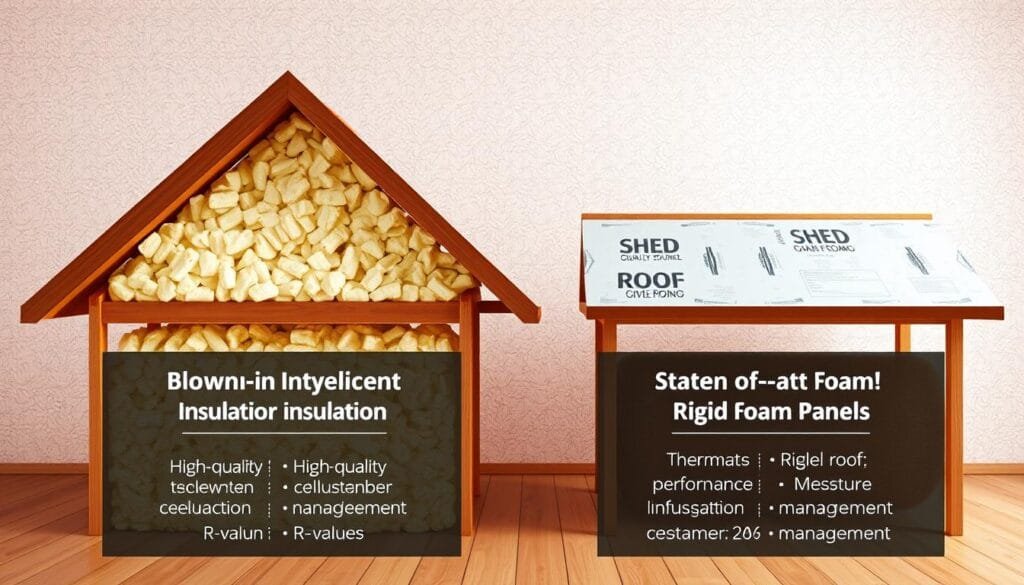
Yet, shed roofs have their own benefits. Their compact profile means less volume to heat or cool, saving energy in smaller cabins. The sloped ceiling also prevents hot air from pooling, distributing temperature evenly.
R-value requirements differ between these roof types. R-value measures insulation’s heat resistance. Gable roofs need R-38 to R-60 in the attic floor. Shed roofs with cathedral ceilings require R-30 to R-49, depending on your climate zone.
Roof pitch also affects insulation effectiveness. Steeper pitches in gable roofs allow for thicker insulation layers. Shed roofs with gentler slopes may need higher-density materials to achieve the same R-value in less space.
Air Circulation and Moisture Prevention
Proper cabin ventilation prevents moisture buildup that leads to mold and damage. Gable roofs excel at passive air movement through their ventilation pathways. Ridge vents at the peak work with soffit vents at the eaves to remove moisture and excess heat.
This airflow happens naturally without fans or electricity. Warm, moist air rises to escape through the ridge vent. Cooler fresh air enters through soffit vents. This keeps your attic dry and extends roof lifespan by preventing condensation.
For gable roofs, learn more about optimizing natural ventilation through proper design considerations that balance aesthetics with performance.
Shed roofs need more intentional cabin ventilation planning. Without proper design, cathedral ceilings can trap moisture, leading to damage. The solution involves creating ventilation channels above the insulation using baffles or raised-heel trusses.
Many modern shed roof cabins have high clerestory windows on the tall wall. These windows provide excellent ventilation and daylighting while allowing hot air to escape. This passive cooling strategy reduces air conditioning needs in warmer months.
Cross-ventilation is key in shed roof designs. Operable windows on opposite walls create air movement patterns that keep your cabin fresh. Strategic window placement takes advantage of prevailing breezes for maximum cooling.
Installation Techniques and Materials
Installing insulation correctly is key to an energy savings cabin. Gable roofs offer straightforward insulation installation in the attic floor. You can use blown-in cellulose, fiberglass batts, or spray foam between ceiling joists with relatively easy access for DIY or professional installation.
The attic space allows you to achieve high R-values by adding thicker insulation layers. You can add more insulation later if energy costs rise or you want to improve comfort. This flexibility makes gable roofs forgiving for homeowners on initial budgets who plan future upgrades.
Vapor barriers in gable roof attics go on the warm side of the insulation—underneath it in cold climates. This prevents moisture from living spaces reaching cold roof decking. Proper air sealing around penetrations like light fixtures and exhaust fans prevents common energy waste in attic insulation systems.
| Insulation Factor | Gable Roof Approach | Shed Roof Approach | Performance Impact |
|---|---|---|---|
| Installation Location | Attic floor between joists | Between or under roof rafters | Gable allows thicker layers and easier access |
| Best Insulation Types | Blown cellulose, batt fiberglass, spray foam | Spray foam, rigid foam boards, dense-pack cellulose | Shed roofs need materials that perform in limited depth |
| Ventilation Integration | Soffit-to-ridge passive airflow above insulation | Rafter bays with baffles or unvented assembly with spray foam | Gable provides natural moisture control; shed requires careful design |
| Typical R-Value Range | R-38 to R-60 in attic floor | R-30 to R-49 in cathedral ceiling | Both can meet code requirements with proper materials |
| DIY Difficulty | Moderate – good attic access | Challenging – overhead work, precision needed | Gable more homeowner-friendly for upgrades |
Shed roof cathedral ceilings present more complex insulation challenges. The most effective approach uses closed-cell spray foam applied directly to the underside of roof decking. This creates an unvented “hot roof” assembly where the entire roof structure stays within the building’s thermal envelope.
Spray foam provides excellent air sealing and high R-value per inch—critical when rafter depth limits insulation thickness. The foam adheres to irregular surfaces and fills gaps that batt insulation would leave. Professional installation ensures proper thickness and complete coverage without thermal bridges.
An alternative for shed roofs involves rigid foam insulation boards above the roof decking, combined with batt insulation between rafters. This method maintains a vented airspace but requires careful detailing at all edges and penetrations. The exterior foam provides continuous insulation that eliminates thermal bridging through wooden rafters.
Vapor barrier placement in cathedral ceilings requires expert knowledge of your climate zone. In cold climates, vapor barriers typically go on the interior (warm) side of insulation. Some thermal performance roof assemblies use vapor-permeable materials that allow drying in both directions, preventing moisture problems from either interior humidity or roof leaks.
Regardless of which roof style you choose, proper insulation and ventilation work together as a system. Skimping on either component compromises your cabin’s energy efficiency and durability. Investing in quality materials and correct installation pays dividends through lower utility bills, better comfort, and fewer maintenance headaches over your cabin’s lifetime.
Water Management and Gutter Systems
Water flow off your cabin roof is key before you start building. Poor drainage causes many problems, like foundation cracks and mold. Gable and shed roofs need different gutter systems.
Your roof must direct water away from your cabin. Gable and shed roofs handle this differently. Knowing this helps plan a good drainage system.
How Gable Roofs Direct Water Flow
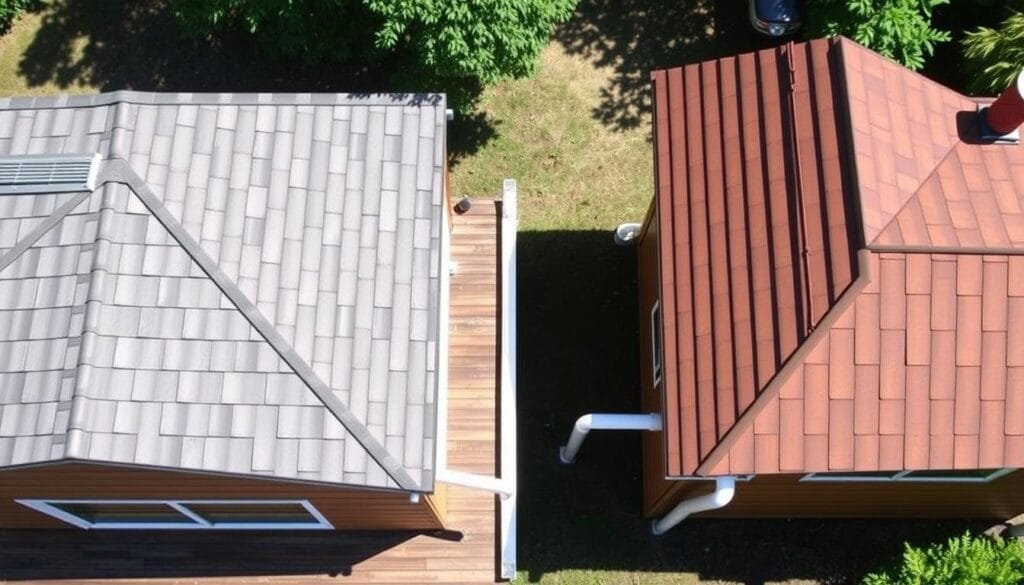
Gable roofs split water runoff between two sides. Rain flows down both sides to the eaves. This spreads the load evenly across two gutters.
This balanced flow is good for managing water. Each gutter handles half the roof area. This reduces overflow risk during storms.
But, gable roofs have special needs at roof valleys. These areas need careful flashing to avoid leaks.
How Shed Roofs Channel Water
Shed roofs direct all water to one side. This creates challenges for managing runoff. You need strong gutters to handle the flow.
Shed roofs dump all water into one gutter. A 20×30 cabin’s runoff is huge. You need bigger gutters and more downspouts.
Downspout placement is critical. You need them every 30-40 feet. Think about where water goes after it leaves the roof.
| Drainage Factor | Gable Roof Pattern | Shed Roof Pattern | Key Consideration |
|---|---|---|---|
| Water Distribution | Split between two sides (50/50) | Concentrated on one side (100%) | Affects gutter sizing requirements |
| Gutter Capacity Needed | Standard 5-inch gutters typically sufficient | 6-inch or oversized gutters recommended | Larger capacity prevents overflow |
| Number of Gutter Lines | Minimum two sides | One primary side | Impacts installation cost and maintenance |
| Downspout Spacing | Every 40-50 feet per side | Every 30-40 feet on main edge | Closer spacing handles higher volume |
| Problem Areas | Valleys where planes meet | Foundation erosion on low side | Requires specific protection strategies |
Getting Gutter Placement Right
Proper gutter placement is key for your cabin. Sizing your gutters right prevents damage from heavy rain or snowmelt. Gable roofs usually need 5-inch gutters, while shed roofs need 6-inch ones.
Make sure downspouts are 6-10 feet from your foundation. This prevents foundation problems. On hills, work with the slope.
Cold climates add extra challenges. Ice dams can damage your roof. Use heated gutter cables or design your roof to prevent ice dams.
Clean your gutters twice a year. This keeps water away from your cabin. Gutter guards help but don’t eliminate cleaning.
Plan your roof and drainage system carefully. Whether it’s a gable or shed roof, good planning protects your cabin for years.
Step-by-Step: Evaluating Which Roof Suits Your Cabin
Your cabin needs a roof that fits your needs, budget, and location. Here’s how to find the right one. Breaking down the roof selection into four steps makes it easier. This way, you can focus on one factor at a time and feel confident in your choice.
This method helps you decide what’s most important for your cabin. Every cabin is different. What works in one place might not work in another. By following these steps, you’ll have all the info to make a smart choice about your cabin’s roof.
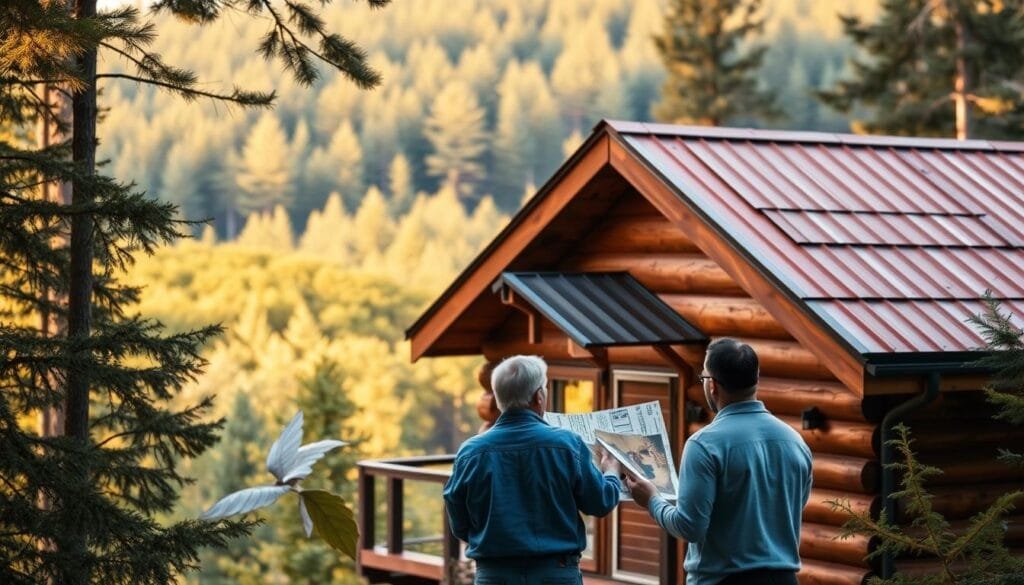
Step 1: Analyze Your Local Climate Conditions
Your local weather should guide your roof choice. Start by looking at average snowfall, rainfall, and wind speeds in your area. The National Weather Service website has detailed climate data for the U.S.
Also, consider extreme weather events in your area. Does your area get ice storms, heavy snow, or severe thunderstorms? These events can stress a roof, so knowing them helps you choose the right one.
Ask these climate questions:
- Does your location get more than 50 inches of snow annually?
- Are wind speeds over 50 mph during storms?
- Do you have frequent freeze-thaw cycles that damage roofing?
- Is your cabin in a high-rainfall area with over 40 inches per year?
Gable roofs work well in heavy snow areas because they shed snow effectively. Shed roofs are good in moderate climates but might need extra support in extreme snow areas. Talk to neighbors to see what roof types work best in your area.
Step 2: Calculate Your Available Budget
Plan your budget carefully to avoid surprises. The roof selection process involves more than just material costs. Create a spreadsheet to compare upfront and long-term costs of gable and shed roofs.
Get three quotes from local contractors for both roof types. This gives you real prices, not just estimates. If you’re building it yourself, calculate your time value—your labor is worth something.
Compare these budget elements carefully:
- Materials cost (lumber, roofing, flashing, fasteners)
- Labor expenses (professional installation or your time value)
- Tool purchases or rentals needed for construction
- Anticipated maintenance over 10-20 years
- Potential repair costs based on local weather conditions
The cheapest option upfront isn’t always the best over time. A shed roof might save money initially but could need more maintenance in certain climates. Think about the total lifecycle cost, not just the construction cost.
Step 3: Determine Space and Functionality Needs
How you plan to use your cabin affects the best roof type. A weekend getaway cabin has different needs than a full-time home. Your cabin should match your lifestyle and needs.
Think about your current and future space needs. Do you need extra storage for gear or tools? Will you want a loft for more space? These questions are important when choosing a roof.
Gable roofs offer natural attic space for storage or living areas. Shed roofs have high ceilings on one side but less storage unless you build tall. Consider these factors:
- How many people will sleep in the cabin?
- Do you need storage for outdoor gear?
- Would a loft bedroom or mezzanine add valuable space?
- Is maximum interior height important for your comfort?
- Will the cabin be your primary residence or occasional retreat?
Choose a roof that matches your space needs. If you prefer openness, a shed roof might feel more spacious. If storage is key, a gable roof’s attic is very valuable.
Step 4: Match Roof Type to Cabin Style
Your roof should match your cabin’s design and the surrounding structures. The cabin design process includes thinking about aesthetic harmony. A mismatched roof can make your cabin look awkward.
Look at other cabins in your area for architectural trends. Some areas favor traditional gable roofs, while others prefer modern shed roofs. Understanding these trends helps your cabin fit in.
Consider your personal style preferences honestly. Do you like the cozy feel of a peaked roof or the modern look of a single-slope roof? Your cabin should reflect your personality and make you happy.
Check if your property has any design restrictions. Some communities have specific guidelines about roof styles and materials. Knowing these early on can prevent costly redesigns later.
Think about how the roof interacts with other design elements:
- Does the roof style match your window placement and sizes?
- Will the roofline complement your porch or deck design?
- Does the pitch work visually with your cabin’s proportions?
- Will the roof style look appropriate in ten or twenty years?
Choosing between gable and shed roofs depends on your climate, budget, space needs, and style preferences. Take your time and trust that the best option will become clear.
Building Codes and Permit Requirements
Building your cabin roof needs to follow the law. Both gable and shed roofs must meet cabin building codes for safety. Knowing these rules before you start saves time and money.
Getting a permit might seem hard. But, working with your local building department helps a lot. Most problems come from skipping this step, not because the rules are too strict.
Local Jurisdiction Requirements
Building rules change a lot depending on where you are. What’s okay in rural Montana might not be in suburban Colorado. Your local building department sets rules for roofing permits and how to build.
Roof pitch needs vary by area. Places with a lot of snow might need steeper roofs. Other areas might focus on wind or fire safety.
How close your roof can be to property lines also matters. Your roof might stick out beyond your cabin walls. Checking this early can save you from costly changes later.
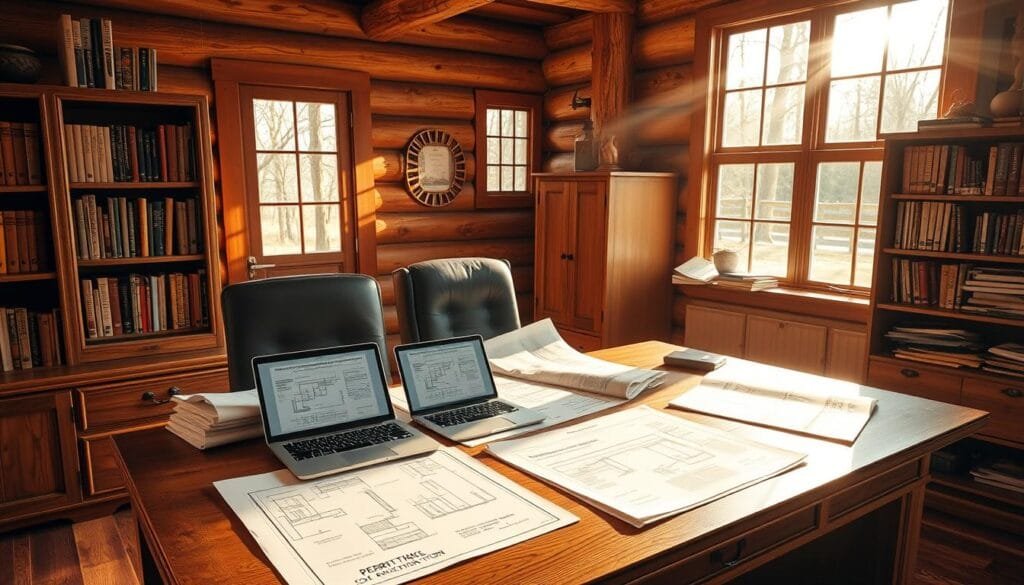
When you apply for a permit, you need to show detailed plans. These plans should include dimensions, materials, and sometimes engineer stamps. It can take a few days to several weeks to get a permit, so plan ahead.
Structural Safety Standards
Engineering standards keep your roof safe. Snow load requirements tell how much weight your roof can handle. Mountain areas might need roofs that can hold 50 to 100 pounds per square foot or more.
Wind rating standards keep your cabin safe in storms. Building codes classify wind zones based on past weather. Coastal and mountain areas have stricter rules than valley areas.
Both gable and shed roofs can meet safety standards if designed right. Gable roofs shed snow to two sides, while shed roofs focus on one side.
Your roof framing must use approved lumber sizes and spacing. Building codes specify rafter sizes, spacing, and how to connect them. These rules ensure your roof works well, no matter the style.
Professional engineers can figure out exact load needs for your area. Many building departments offer free plan review services. Using these resources can save you from expensive mistakes.
Community and Association Rules
Some cabins face extra rules beyond building codes. Homeowners associations and planned communities have their own rules. These HOA rules cabin owners must follow can affect roof design.
Some areas prefer traditional gable roofs for classic looks. Others might like modern shed roofs. Always check your community’s rules before planning.
Historic areas or conservation zones might limit certain roof styles or materials. These rules protect the area’s look. They also keep property values up by keeping things consistent.
Deed restrictions might set rules for roof pitch, overhang, or colors. Missing these can mean big design changes. Get copies of all rules from your HOA or title company early.
Getting HOA approval can take time. Some meet monthly, others on a rolling schedule. Plan ahead to avoid delays.
| Regulatory Aspect | Gable Roof Considerations | Shed Roof Considerations | Typical Requirements |
|---|---|---|---|
| Minimum Pitch | Usually 4:12 to 6:12 slope | Typically 3:12 to 6:12 slope | Varies by climate and materials |
| Snow Load Capacity | Naturally sheds to both sides | Concentrated load on low side | 30-100+ lbs per square foot |
| Wind Resistance | More surface area exposed | Lower profile reduces wind catch | Based on local wind zone rating |
| Permit Processing | Standard residential timeline | May require additional review | 1-6 weeks typical approval time |
| HOA Restrictions | Often preferred in traditional areas | Favored in modern communities | Varies by covenant language |
Knowing the rules helps you plan better from the start. Following the law means safer, longer-lasting roofs. It also adds value to your cabin.
Working with licensed contractors who know local building regulations makes things easier. They avoid common mistakes and save you money.
Get in touch with your local building department early. They can answer questions and guide you before you apply. This approach ensures your roof project goes smoothly from the beginning.
Solar Panel and Green Energy Integration
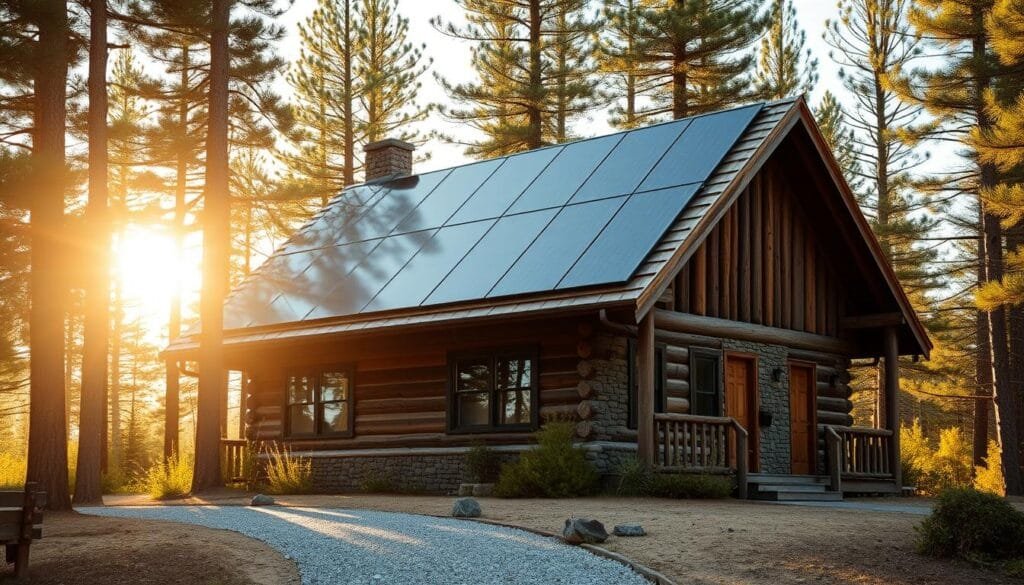
Your cabin roof choice is key for solar panel efficiency and saving money. More cabin owners are choosing off-grid living and green energy. Roof design affects solar performance, with gable and shed roofs having different benefits and challenges.
Adding solar panels cabin roof systems needs careful thought. Your roof’s shape, direction, and strength affect energy capture. Modern green energy solutions are now affordable and accessible for remote places.
Optimal Roof Pitch for Solar Efficiency
The angle of solar panels affects their energy output. The best solar roof pitch varies by location, but most US spots work best at 30 to 40 degrees. This angle gets the most sun during peak hours.
Shed roofs are great because you can design the whole roof for solar. You can point the single slope south at the perfect angle for your area. This makes every square foot useful for energy.
Gable roofs are trickier for solar. Only one slope is usually right, limiting space. But, you can adjust panel angles with mounting systems to help.
In northern areas, steeper angles help panels catch winter sun. Southern spots do better with shallower angles to avoid summer heat. Knowing your latitude helps pick the best roof for solar.
Installation Ease and Structural Considerations
Installing solar installation roof projects varies by roof type. Shed roofs are easier and faster because of their simple design. This can save on labor costs.
Gable roofs need more planning. Workers must navigate complex angles and ensure panels are at the right angle. This can make installation riskier and more expensive, adding 15 to 25 percent to costs.
Adding solar panels also adds weight to your roof. Most roofs can handle this, but older ones might need checks. Shed roofs spread weight evenly, making calculations easy. Gable roofs might need extra support for big arrays.
Cost-Benefit Analysis
Knowing the costs of solar integration is key for cabin owners. A small cabin system costs $10,000 to $15,000. Costs vary by roof type, location, and system complexity.
Shed roofs are cheaper because they’re simpler to mount and install. Their design needs less material and time. Gable roofs need more complex systems and safety gear, adding $1,500 to $3,000 to costs.
Efficient energy production affects how fast you get your money back. A well-designed green energy cabin system on a shed roof can produce 10 to 15 percent more energy. This makes a big difference in payback time.
Most systems pay back in 8 to 12 years, based on local rates and incentives. Tax credits cover 30 percent of costs, and states offer rebates. These incentives make renewable energy cabin projects more appealing, regardless of roof type.
| Solar Performance Factor | Shed Roof | Gable Roof | Impact on Energy Production |
|---|---|---|---|
| Optimal Angle Alignment | Entire roof can be optimally angled | One slope may face wrong direction | Shed roofs produce 10-15% more energy |
| Installation Complexity | Simple single-plane mounting | Multi-plane racking systems needed | Shed installation costs 15-20% less |
| Usable Roof Area | 100% of surface available | 50-70% of surface optimally oriented | Shed roofs accommodate larger arrays |
| Maintenance Access | Easy low-slope access | Steep slopes complicate cleaning | Better maintenance extends system life |
| Average Payback Period | 8-10 years | 10-12 years | Shed roofs recover costs faster |
Long-term maintenance also affects costs for solar panels cabin roof systems. Regular cleaning and checks keep panels efficient. Shed roofs are safer and easier to maintain, saving on service costs over 25 to 30 years.
Shed roofs are best for solar, but don’t overlook gable roofs. With the right planning and racking, gable roofs can work well. It’s about setting realistic goals for system size and payback time.
Durability and Long-Term Performance
When picking between gable and shed roofs, think about how long they last as much as the cost. The roof’s durability comes from how well it’s built and the materials used, not the style. Both can last for decades if done right.
Knowing what to expect helps with budgeting and avoiding surprises. Each roof type has its own strengths and weaknesses. Let’s look at how they hold up over time and what upkeep they need.
How Long Your Roof Will Last
The lifespan of a cabin roof depends more on the materials than the design. Asphalt shingles last 20-30 years on either roof. Metal roofing can last 40-50 years or more, no matter the style.
Gable roofs have a proven track record for centuries. Their design is reliable in many climates. Shed roofs are newer but also last well in modern cabins.
Weather affects how long a roof lasts more than the design. Harsh weather speeds up wear, no matter the roof. Quality construction is key to reaching the roof’s full lifespan.
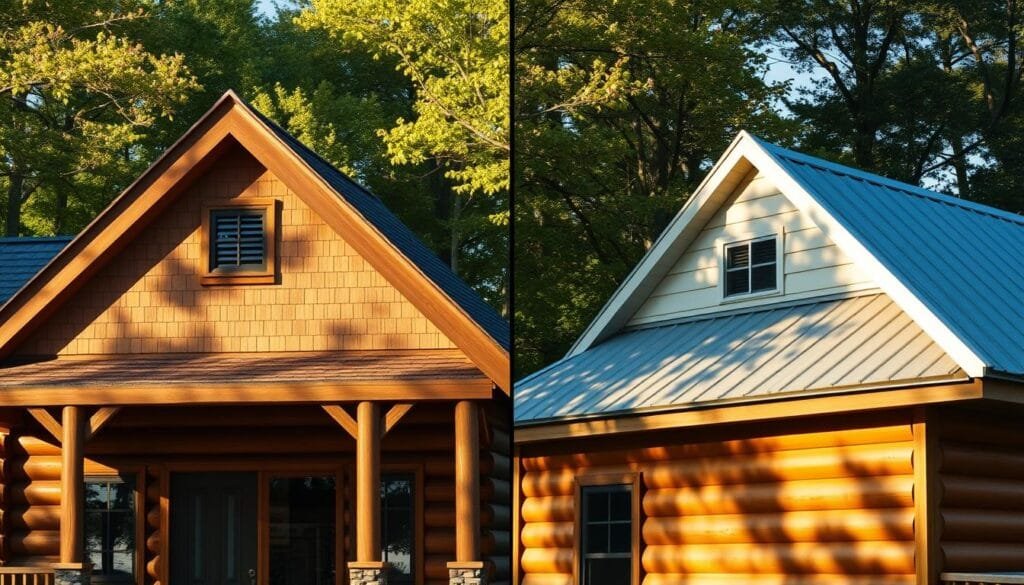
The materials you choose are the most important. High-quality products last longer than cheaper ones. When comparing shed vs gable roof longevity, focus on the materials, not the style.
Typical Upkeep Challenges
Gable roofs need special care because of their shape. Valleys can get clogged and leak if not cleaned. Ridge vents and caps need checks to stay sealed.
Common gable roof problems include:
- Valley deterioration from water and debris
- Ridge cap damage from wind and temperature changes
- Flashing failures around chimneys and skylights
- Ice dam formation at eaves in cold weather
Shed roofs need gutter care because all water flows to one edge. The roof’s edge where it meets the wall is a weak spot. It needs vigilant flashing inspection to keep water out.
Shed roof maintenance priorities include:
- Gutter cleaning to handle all the water
- High-wall flashing checks for gaps or damage
- Drainage monitoring to keep water away from the foundation
- Fastener inspection along the single slope for wind resistance
Repair Access and Expense
Gable roofs are easier to fix because of their design. Workers can move around safely. This makes repairs less expensive because problems are often in small, easy-to-reach areas.
Fixing gable roofs costs $300-800 for small repairs to $1,500-3,000 for bigger jobs. Most repairs are small and don’t cost much.
Shed roofs can be harder to access, depending on the slope. Steeper roofs need more safety gear and planning. But, they have fewer places where problems can happen.
Shed roof repairs cost $250-600 for small fixes and $1,200-2,500 for bigger jobs. Gutter repairs might cost more because they handle a lot of water.
Both roofs benefit from regular maintenance. Annual checks can catch small problems before they get big. Spend $200-400 a year for inspections and small fixes, no matter the roof type.
The best way to keep your roof going is to use quality materials, get it installed right, and keep up with maintenance. Neither gable nor shed roofs last longer by design. It’s your care and attention that make the difference.
Property Value and Investment Returns
Your cabin’s roof is more than just a cover for rain. It’s a key factor in your property’s value and investment. Whether it’s a weekend home or a future resale, the roof you choose today affects tomorrow’s value. The roof’s design shapes the first impression, impacting buyer perception and value.
Smart owners balance personal taste with market needs. You want a roof you’ll love, but knowing how designs impact returns is key. Both gable and shed roofs can add value, depending on your market and materials.
What Buyers Look For
Cabin buyers want comfort, character, and durability. Traditional gable roofs appeal to those who love timeless looks and proven performance. They’re popular in family cabins, showing quality and reliability.
Gable roofs attract a wide range of buyers. They’re safe and predictable, perfect for first-time buyers. Shed roofs, on the other hand, attract design lovers willing to pay more for unique architecture.
Shed roofs may take longer to sell but often fetch higher prices. In vacation rental markets, modern cabins stand out, boosting rental income and ROI.
Comparing Investment Returns
Calculating return on investment for roofs is complex. Shed roofs seem cheaper but perceived value is key. Gable roofs cost more but appeal to more buyers, potentially selling faster.
Gable roofs add $8,000-$15,000 to costs. But, they sell faster, saving on carrying costs. Shed roofs offer strong returns in design-focused markets.
The table below compares key financial factors for both roof types:
| Financial Factor | Gable Roof | Shed Roof | Impact on Returns |
|---|---|---|---|
| Initial Construction Cost | $12,000-$18,000 | $8,000-$12,000 | Shed saves 30-40% upfront |
| Maintenance Costs (20 years) | $3,500-$6,000 | $2,500-$4,500 | Shed offers modest savings |
| Buyer Pool Size | Broader appeal | Niche but premium | Gable sells faster typically |
| Resale Price Premium | Market standard | 10-15% higher in design markets | Context-dependent advantage |
| Average Days on Market | 45-75 days | 60-90 days (varies widely) | Gable often moves quicker |
Roof type alone doesn’t determine returns. Quality, materials, and overall condition matter more. A well-built shed roof outperforms a poorly made gable roof.
Geographic Market Differences
Location greatly influences roof design returns. Regional preferences vary so significantly that the “best” choice in Vermont might be the worst in Southern California. Investors should research local trends before deciding.
In Wisconsin, Minnesota, and Michigan, gable roofs are preferred. They’re seen as authentic cabin character. Shed roofs might lower resale value in these markets.
In Colorado, Montana, and the Pacific Northwest, modern designs are more accepted. Shed roofs fit well in these landscapes, maximizing views. Buyers here seek unique architecture.
In Arizona, New Mexico, and parts of California, shed roofs are popular. They match desert styles and suit areas with little snow. Gable roofs might seem outdated here.
Before choosing a roof, research recent sales in your area. Talk to local agents and observe new constructions. This gives you insights into buyer behavior.
Consider your ownership goals. If you plan to keep the cabin for decades, choose what you love. But, if you’re selling soon, match your roof to local preferences for better returns.
Making Your Final Roof Selection
It’s time to pick a roof that fits your cabin’s needs. You’ve looked at costs, climate, looks, and long-term value. Now, choose based on what’s most important for your project.
Choosing a roof type is easier when you know what you need. Gable and shed roofs have worked well in many cabins. The right roof style is key to success.
Let’s look at when each roof type shines. We’ll also see how mixing them might be the best choice.
When Gable Roofs Are the Best Choice
Gable roofs are top for those who value tradition and practicality. This classic design handles certain challenges better than others.
Go for a gable roof in snowy areas. Its steep pitch sheds snow well, unlike flatter designs. Many mountain cabins in Colorado to Vermont use gable roofs for this reason.
Gable roofs also offer great storage. The peaked design creates attic space that shed roofs can’t match. If you need space for a loft or lots of gear, gable roofs are great.
Traditional aesthetic preferences make gable roofs a natural choice. Buyers often want the classic cabin look. Gable roofs appeal to the widest market, which is good for resale.
In windy areas, gable roofs are a good choice if well-supported. Their symmetrical design spreads wind loads evenly. Builders know gable roofs can handle extreme weather better than many others.
Choose gable roofs if these factors are important to you:
- Your location gets more than 40 inches of snow a year
- You need attic storage or loft space
- Traditional cabin looks are what you want
- Resale value is important to you
- You’re building in areas with traditional architecture
When Shed Roofs Are the Best Choice
Shed roofs are smart for modern projects. This design has unique benefits for certain situations.
Shed roofs save money. They need fewer materials and less specialized labor. If you’re watching your budget but want quality, shed roofs are a good choice.
Solar energy optimization makes shed roofs great for green projects. The single slope allows for full sun exposure. Modern cabin owners who want energy independence choose shed roofs.
Shed roofs are perfect for modern designs. If you want a cabin that stands out, shed roofs fit well with minimalist styles.
Shed roofs are also good for small spaces. Zoning rules might limit your building height. Shed roofs help you use space better while staying within limits.
Shed roofs are best when these conditions apply:
- Construction budget is tight but quality is key
- Solar panels are a priority from the start
- Modern design is what you’re aiming for
- Building codes limit your height
- Your cabin is a weekend retreat, not a family home
Combination and Hybrid Roof Options
You don’t have to pick just one. Hybrid cabin roof designs mix the best of both worlds.
Many modern cabins have a main gable roof and shed roof extensions. This mix offers traditional appeal and snow management with modern flair.
Architects sometimes use shed roofs at different angles for visual interest. These designs keep modern looks while adding depth and character.
Professional design assistance is key for hybrids. Planning different roof planes ensures proper water management and structure. But, the effort can lead to unique, striking results.
Hybrid designs are great for phased construction. Start with a shed roof cabin and add a gabled workshop or garage later.
| Decision Factor | Choose Gable Roof | Choose Shed Roof | Consider Hybrid |
|---|---|---|---|
| Climate Priority | Heavy snow regions, high winds | Moderate climates, solar optimization | Mixed conditions requiring flexibility |
| Budget Range | Moderate to high, storage value matters | Tight budget, cost efficiency critical | Flexible budget, willing to invest in uniqueness |
| Aesthetic Goal | Traditional cabin character | Modern contemporary design | Transitional style blending both approaches |
| Space Needs | Maximum attic/loft space required | Single-level living, minimal storage | Varied spaces serving different functions |
| Resale Consideration | Broad market appeal important | Niche modern buyers targeted | Unique properties commanding premium prices |
Your roof choice depends on what you really need. Neither option is wrong if it fits your situation.
Gable roofs offer proven performance, traditional looks, and lots of space. Shed roofs save money, offer solar benefits, and are modern. Hybrid designs solve complex needs creatively.
Trust your analysis of climate, budget, and style. The best roof for your cabin is the one that meets your needs best. Both options have built many successful cabins in America.
Move forward with confidence. Choosing the right roof type based on your needs will bring satisfaction for years.
Taking Action on Your Cabin Roof Project
You’ve learned about gable and shed roofs. Now, it’s time to start your cabin roof project. You have all the info you need to make a good choice.
Begin by picking your roof. Think about your budget, climate, and style. Write down your top three priorities to guide your choice.
Then, make a detailed plan for your roof project. Include time for permits, material delivery, and weather. Most projects start in late spring or early summer.
If you’re hiring a contractor, get quotes from at least three. Share your roof choice and ask for detailed estimates. Check their references and licenses before choosing.
For DIY, find plans that fit your skills. Buy materials with 10-15% extra for cuts and mistakes.
Choosing a gable or shed roof is a smart move. Your cabin roof will protect and add character for years. Take your time and refer to this guide as needed.