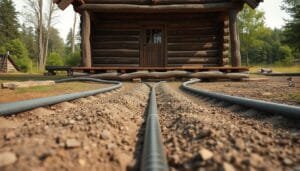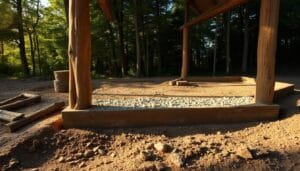

Building your dream cabin starts with a big choice: picking the right cabin foundation. This choice impacts your budget and upkeep. Once you lay the foundation, it’s there forever.
Did you know 95% of cabin owners pick concrete slab options? A slab is a thick, poured material, at least 4 inches thick in the middle. It’s both the base and floor of your cabin.
This guide will help you decide if a concrete slab is right for you. We’ll look at the benefits like saving money and lasting long. But we’ll also talk about the downsides. Different foundation types fit different needs, climates, and budgets. You’ll get the facts to make the best choice for your cabin.
Understanding Slab Foundations for Cabin Construction
First, let’s dive into what a slab foundation is. It’s different from basements or crawl spaces. Knowing the basics helps you decide if it’s right for your cabin.
A slab foundation is both the base and floor of your cabin. It’s a single, solid piece of concrete. This design makes building faster and simpler.
What Is a Slab Foundation?
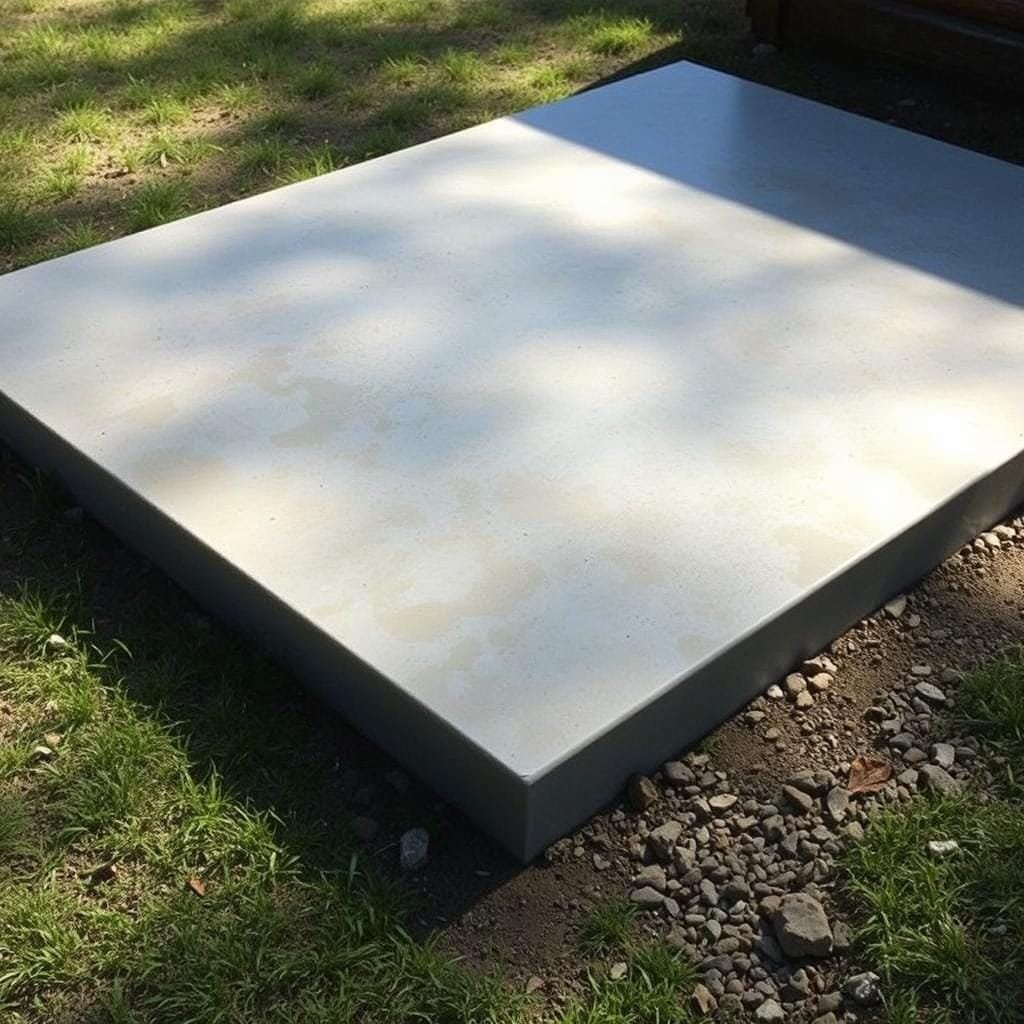
A slab foundation is a thick concrete pad poured on the ground. It supports your cabin’s structure and floor. Imagine a big concrete slab on the ground.
The slab’s center is 4 to 6 inches thick. This is enough for most cabins. The edges, or footings, are thicker and go deeper into the ground.
These footings go below the frost line to prevent frost heave. Frost heave happens when freezing ground pushes against your foundation. The thicker edges also help carry the weight of your cabin walls.
Types of Slab Foundations for Cabins
There are three main types of slab foundations for cabins. Each has its own features. Your choice depends on the soil, climate, and budget.
Monolithic Slab Foundations
A monolithic slab is poured in one go. The footings and main slab are done together. This is the quickest and cheapest option.
The concrete pour takes just one day. Labor costs are low because there’s no waiting. This method works best on stable, well-drained soil.
Stem Wall Slab Foundations
Stem wall slabs start with a wall built on footings. Then, the interior slab is poured. This two-step process offers more elevation options.
The stem wall protects against moisture and frost. It also makes insulation easier to place. This type costs more but is more versatile.
Post-Tension Slab Foundations
Post-tension slabs use steel cables that are tightened after curing. These cables resist cracking and movement. This makes the slab stronger and more flexible.
This method is great for areas with unstable soils. The tensioning system helps the slab move as a unit. While more expensive, it can save on repairs later.
How Slab Foundations Differ from Other Options
Builders often choose between three foundation types. Each has its own benefits and drawbacks. Knowing these differences helps understand why slabs are chosen for some projects.
A basement foundation has full-height excavation. This creates space below your main floor. Basement foundations are more expensive due to excavation and waterproofing.
Crawl space foundations elevate your cabin on short walls. This creates a partial-height area for utilities and ventilation. It’s easier to access plumbing and electrical systems than with slabs.
Slab foundations sit directly on the ground with minimal excavation. They’re the most economical and fastest to construct. But, they offer no storage or utility access below your cabin floor.
| Foundation Type | Installation Time | Relative Cost | Below-Floor Access | Best Climate |
|---|---|---|---|---|
| Monolithic Slab | 1-3 days | Lowest | None | Warm, stable soil |
| Basement Foundation | 2-4 weeks | Highest | Full height room | Cold climates |
| Crawl Space | 1-2 weeks | Moderate | Limited access | Various climates |
| Stem Wall Slab | 5-7 days | Moderate-Low | None | Variable climates |
The foundation you choose affects your cabin’s construction timeline and budget. It also impacts maintenance and energy efficiency. Slabs eliminate moisture and flooding concerns.
Each foundation type reacts differently to soil and climate. Slabs work well in warm areas with stable soils. But, they’re harder in cold or expansive soil areas.
Now you know about slab foundations and their advantages. The next sections will explore the cost savings and benefits of using slabs for cabin projects.
Cost-Effectiveness of Slab Foundations
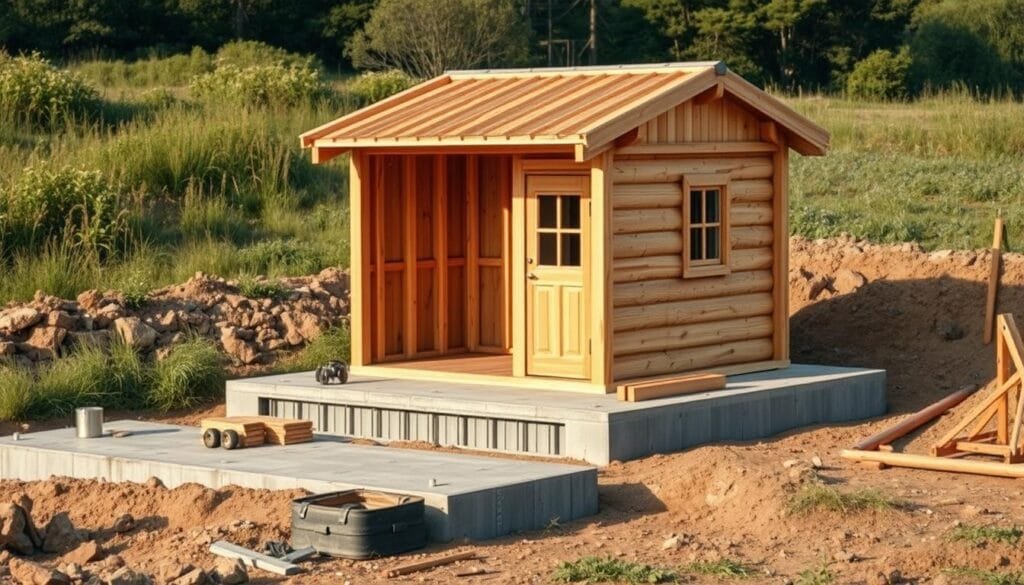
Many cabin builders choose slab foundations because they save a lot of money. When you’re on a tight budget, foundation costs are key. Slab foundations are cheaper than others, making them great for both new and experienced builders.
Lower Initial Construction Costs
Recent data shows that a monolithic slab foundation costs about $4-$14 per square foot. Most basic installations cost between $4 and $5. This means a typical cabin foundation costs between $4,000 and $14,000.
Other options are more expensive. Crawl space foundations cost around $7 per square foot, with total costs ranging from $7,000 to $21,000. Basement foundations are the priciest, costing about $18 per square foot.
Here’s a comparison of crawl space vs slab foundations:
| Foundation Type | Cost Per Square Foot | Total Cost Range | Potential Savings vs. Slab |
|---|---|---|---|
| Slab Foundation | $4-$14 | $4,000-$14,000 | Baseline |
| Crawl Space | $5-$16 | $7,000-$21,000 | Save 30% with slab |
| Basement | $15-$25 | $18,000-$35,000 | Save 60-70% with slab |
Choosing a slab over a basement could save you 30% to 70% on your foundation budget. For a 1,000 square foot cabin, that’s saving $10,000 to $20,000. You could use that money for better windows, solar panels, or insulation.
Reduced Labor and Time Requirements
Slab construction is faster, saving on labor costs. It needs only 4 to 6 inches of excavation for the slab and footings. This is less than crawl spaces (18-24 inches) or basements (8 feet or more).
Less digging means fewer hours of equipment rental and lower operator fees. Contractors work faster on slab foundations than on basements.
The concrete pour for most cabin projects takes just a few hours. After curing (7 to 14 days), you can start framing. This quick process saves time and money.
Slab foundations also need less specialized labor than basements or crawl spaces. A smaller crew can do the work, saving on labor costs.
Material Savings Compared to Other Foundation Types
Slab foundations save on materials too. They don’t need lumber, subfloor materials, formwork, rim joists, or crawl space systems.
With a slab, you won’t need:
- Floor joists and beams – Crawl space and basement foundations require extensive lumber framing to support the main floor
- Subfloor materials – No plywood or OSB sheathing needed as the concrete serves as your floor base
- Extensive formwork – Basement walls need complex forming systems; slabs use simple perimeter forms
- Rim joists and blocking – The structural elements that connect floor systems to foundation walls become unnecessary
- Crawl space vapor barriers and ventilation – These moisture control systems add hundreds to thousands in material costs
The slab itself uses less concrete than basement walls. Even though it’s a large surface, its thickness (4-6 inches) requires less concrete than 8-foot-tall basement walls (8-10 inches).
These savings add up throughout the project. Every item you don’t need to buy, transport, and install saves money and time.
Budget-Friendly Option for Off-Grid Cabins
Remote cabin builders face unique challenges. Slab foundations are practical for off-grid locations. They require fewer material deliveries, saving money and time.
Slab construction needs only concrete, rebar, and basic forming supplies. This is simpler than crawl space or basement alternatives. It’s essential when your site is hard to reach.
The simplicity of slab foundation installation makes it ideal for owner-builders. Many cabin owners do site prep, forming, and finishing themselves. Hiring concrete contractors only for the pour can cut costs in half or more.
Off-grid builders appreciate slab foundations for their staged construction. You can finish the foundation first, cure it, and then start framing when you can afford it. The slab’s simplicity means it can sit for months without deteriorating.
For cabin builders watching every dollar, these savings are critical. The foundation is 15-20% of your budget. Saving 30-70% on this can mean starting your project sooner.
Energy Efficiency Benefits
Slab foundations can make your cabin more energy-efficient. They keep your cabin comfortable while cutting down on heating and cooling costs. Unlike foundations with crawl spaces or basements, a concrete slab blocks energy loss. This makes your cabin’s temperature more stable.
Slab foundations offer more than just design benefits. They use concrete’s unique properties and smart insulation. These elements work together to save you money over time.
Natural Temperature Regulation Through Thermal Mass
Concrete has amazing thermal mass properties. The thick concrete slab acts like a thermal battery. It absorbs heat when it’s warm and releases it when it’s cold.
This natural temperature control is perfect for places with big temperature changes. During hot afternoons, the concrete absorbs excess heat. Then, it releases that warmth at night, reducing the need for heating.
This passive temperature control happens without any mechanical systems. The concrete mass helps control your cabin’s temperature, saving energy. This is very helpful in desert or mountain areas with big temperature swings.
Eliminating Air Leaks and Energy Waste
Traditional foundations lose a lot of energy through air infiltration. Crawl space foundations let cold air in during winter and hot air in during summer. This makes your heating and cooling systems work too hard.
Slab foundations solve this problem. There’s no cold air or hot air under your floor. Without floor vents, you don’t have to fight against air leaks and heat loss.
Proper foundation insulation is key to enjoying these benefits. Insulation around the slab edges and under the slab keep your cabin warm. This stops energy from escaping.
Quality insulation strategies include:
- Perimeter insulation: Rigid foam boards installed vertically around slab edges, typically extending 2-4 feet below grade
- Under-slab insulation: Horizontal rigid foam placed across the entire footprint before concrete pouring
- Vapor barriers: Polyethylene sheeting that prevents moisture migration from ground to slab
- Edge details: Careful sealing where slab meets walls to eliminate thermal breaks
These insulation layers turn your slab into an energy-saving powerhouse. Without them, you’d lose a lot of heat through the ground.
Perfect Platform for Radiant Floor Heating
Slab foundations are great for radiant heating systems. Hydronic tubes in the concrete make your floor warm. This creates a cozy and efficient heating system.
Radiant heating has many advantages. It heats evenly, avoiding cold spots. It’s quiet and doesn’t have the noise of traditional furnaces. Plus, it uses less energy than traditional heating systems.
The concrete slab works well with radiant heating. It stores heat from the tubes and releases it slowly. This keeps your cabin warm with less energy needed.
Getting the radiant tubes in before pouring concrete is important. This makes slab foundations perfect for radiant systems. It creates a long-lasting and efficient heating solution.
Measurable Reductions in Energy Bills
These efficiency features lead to lower heating costs. Slab foundations with good insulation can save 15-25% of energy compared to crawl space foundations. Adding radiant floor heating can save even more.
The savings come from several factors:
| Energy Efficiency Factor | Typical Savings | Key Requirement |
|---|---|---|
| Eliminated crawl space heat loss | 8-12% reduction in heating costs | Proper perimeter insulation |
| Reduced air infiltration | 5-8% lower energy bills | Quality vapor barrier and edge sealing |
| Thermal mass temperature moderation | 3-6% efficiency gain | Adequate slab thickness (minimum 4 inches) |
| Radiant heating integration | 12-20% heating cost reduction | Professional system design and under-slab insulation |
These savings add up over time. A cabin with $1,500 annual heating bills could save $225-$375 yearly. Over 20 years, that’s $4,500-$7,500 saved.
These benefits also help with cooling. The thermal mass keeps your cabin cool in summer, reducing air conditioning needs. In mild climates, some owners don’t need air conditioning at all.
But, these benefits only happen with proper insulation. An uninsulated slab loses heat to the ground. Investing in good foundation insulation during construction saves energy and money for decades.
Durability and Longevity Advantages
Durability is key in cabin foundations, not just a nice feature. A concrete slab foundation can last between 50 to 100 years. This makes it a top choice for cabin construction.
Concrete slabs are durable because of their properties. Unlike wood, concrete gets stronger over time. This means your foundation gets better with age.
Slab foundations also protect your cabin from moisture and pests. These are big threats to any foundation.
Resistance to Moisture and Pest Issues
Concrete slabs resist environmental challenges well. They don’t have the weak spots that other foundations do. This makes them great at keeping moisture and pests out.
With the right vapor barriers, slabs block moisture. This is key in humid areas. The solid construction stops water and condensation.
Concrete slabs don’t attract pests like wood does. Termites can’t eat through concrete. This means your cabin is safer from pests.
Slabs also keep rodents out. They have few entry points. This is unlike crawl spaces, which are easy for rodents to get into.
This means you spend less on foundation care over time. You won’t need to worry about pest treatments or inspections.
Reduced Risk of Mold and Wood Rot
Mold and wood rot love damp places. Slab foundations remove these risks by not having wood in contact with moisture. This stops mold and rot before they start.
The vapor barrier keeps moisture out. This stops mold from growing. Without moisture and wood, mold can’t grow under your cabin.
This also means better air in your cabin. Mold spores from crawl spaces can get into your home. Slab foundations stop this.
Structural Stability in Suitable Conditions
Concrete slabs are very stable when built right. They don’t settle much. This is because they’re one solid piece.
This stability means your cabin doesn’t move much. You won’t have floors that shift or doors that stick. The foundation stays level all year.
But, this depends on the ground and soil. Slabs can have problems on certain soils. We’ll look at this more later.
| Durability Factor | Slab Foundation Performance | Expected Lifespan Impact | Maintenance Requirements |
|---|---|---|---|
| Termite Resistance | Excellent – no underground wood structure | Eliminates wood replacement needs | Minimal inspections needed |
| Moisture Protection | Very good with proper vapor barrier | Prevents rot and mold damage | Periodic sealant checks |
| Structural Stability | Excellent on suitable soils | 50-100 years with proper construction | Low – mainly crack monitoring |
| Pest Entry Points | Minimal compared to crawl spaces | Reduces long-term damage | Seal perimeter edges periodically |
| Overall Durability | Superior in appropriate conditions | Often outlasts cabin structure | Lower than most alternatives |
Slab foundations are great because they resist pests, moisture, and are stable. They also need little maintenance over time. This makes them a smart choice for your cabin.
Low Maintenance Requirements
Looking for a foundation that’s easy to forget about? Concrete slabs are your answer. They’re perfect for cabin owners who want to relax without worrying about maintenance. A well-made concrete slab can last 50 years or more with little upkeep.
This is great for vacation homes or cabins where you’re not always around. With a slab foundation, you can leave your cabin without worrying about foundation problems.
Minimal Ongoing Care Needs
Keeping your cabin’s foundation in check is easy. Just do an annual visual inspection to spot any cracks or issues. This quick check takes 15-30 minutes and doesn’t need any special tools.
During your inspection, look for any obvious problems around the foundation. Make sure water drains away and that plants and roots aren’t too close. Roots can cause pressure and cracks over time.
That’s it for your maintenance routine. No complicated steps, no special gear, and no need for professional help. Your concrete slab will keep working year after year with almost no attention from you.
No Crawl Space or Basement Maintenance
Slabs have a big advantage over crawl spaces or basements. Those areas need constant care and attention.
Crawl space owners have a long list of tasks to keep up with:
- Installing and replacing vapor barriers to control moisture (every 10-15 years)
- Monitoring humidity levels and running dehumidifiers during wet seasons
- Inspecting for pest infestations like rodents, insects, or termites
- Checking wood structural members for rot, mold, or decay
- Maintaining foundation vents (opening in summer, closing in winter)
- Dealing with standing water or occasional flooding after heavy rains
With a slab foundation, there’s no space beneath your cabin to worry about. This means no pests, no mold, and no need for constant checks. It’s a big win for cabin owners.
Long-Term Maintenance Savings
Slab foundations save you money over the long run. While they might cost a bit more upfront, the savings add up. You avoid the costs of crawl space maintenance, which can be thousands of dollars.
Think about the costs of crawl space maintenance over 25 years. Replacing vapor barriers costs $1,000-3,000 every 10-15 years. Fixing moisture problems can cost $2,000-6,000. And don’t forget the cost of foundation vent maintenance and repairs.
Pest control is also cheaper with a slab foundation. Without crawl spaces, pests have fewer places to hide. This can save you $200-500 a year in prevention and treatment costs.
| Maintenance Category | Slab Foundation (25 Years) | Crawl Space Foundation (25 Years) | Your Savings |
|---|---|---|---|
| Vapor Barrier Replacement | $0 | $2,000-4,500 | $2,000-4,500 |
| Moisture Control & Remediation | $0 | $1,500-5,000 | $1,500-5,000 |
| Vent Maintenance & Repairs | $0 | $500-1,200 | $500-1,200 |
| Enhanced Pest Control | $2,000-3,500 | $5,000-12,500 | $3,000-9,000 |
| Total Maintenance Investment | $2,000-3,500 | $9,000-23,200 | $7,000-19,700 |
For those on a fixed income or looking to save money, slab foundations are a smart choice. The money you save can go toward improving your cabin or enjoying it more.
The time you save is just as valuable. Without the need for crawl space inspections, you can enjoy more time outdoors. This means more time for hiking, fishing, or just relaxing with loved ones.
Slab Foundation Pros and Cons: The Drawbacks Begin
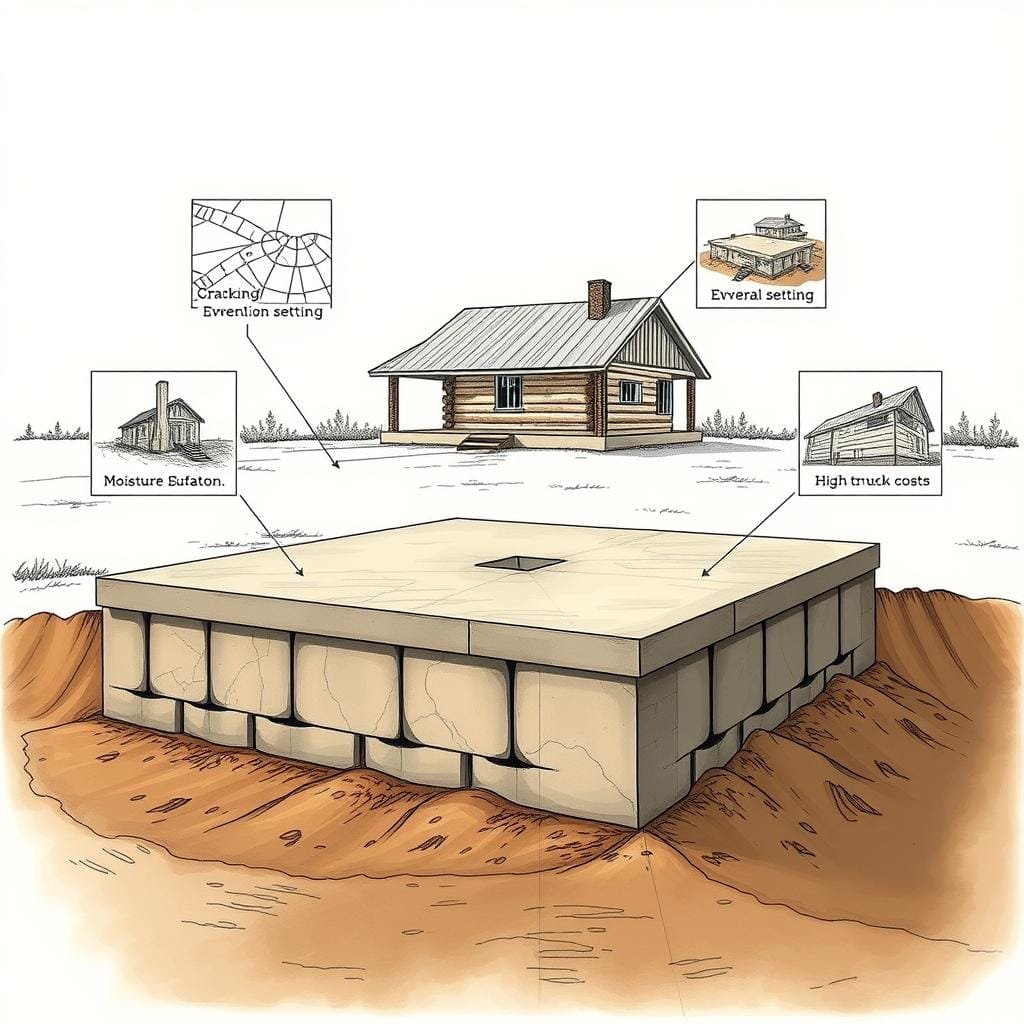
The story of slab foundation pros and cons wouldn’t be complete without looking at the downsides. We’ve talked about the good things slabs offer—like being cheaper, saving energy, lasting long, and needing little upkeep. These points are true and have made slabs a favorite for many cabin builders.
But, no foundation is perfect for every situation. The good things about slabs can turn into problems in other cases. Before choosing a slab foundation for your cabin, you must know both sides.
Transition from Benefits to Challenges
Choosing a cabin foundation is like picking a car. A sports car is great for speed but not for hauling lumber. Slabs are good in some situations but not in others.
The slab’s design, which saves money and energy, also limits you. You can’t access crawl spaces or basements later. And, there’s no elevation above ground level. These are things to think about carefully.
Many builders focus only on the initial cost without thinking about the future. They see the low price and decide without considering the climate, soil, or future plans. This can lead to problems later on.
Why Understanding the Disadvantages Matters
Foundations are forever—and that’s true. You can’t easily change your foundation like you can other parts of your cabin. Changing foundation types later would be very expensive.
This means you must choose the right foundation the first time. A foundation that works in one place might not in another. The wrong choice can cause expensive repairs or limit your cabin’s use for years.
Knowing the downsides helps you make a better choice. You can compare the pros and cons based on your situation—like the climate, soil, budget, and future plans for your cabin.
The next sections will talk about specific challenges with slabs, like access problems and soil issues. These aren’t meant to scare you off from slabs. They’re to help you decide if the benefits are worth the drawbacks for your cabin project.
The best foundation is the one that fits your site, climate, budget, and needs. By knowing both the good and bad about slabs, you can make a confident choice.
Limited Access to Plumbing and Utilities
When pipes and electrical lines run through or underneath your concrete slab, repairs become complicated and expensive. This challenge is seen as the biggest drawback of slab foundations for cabins.
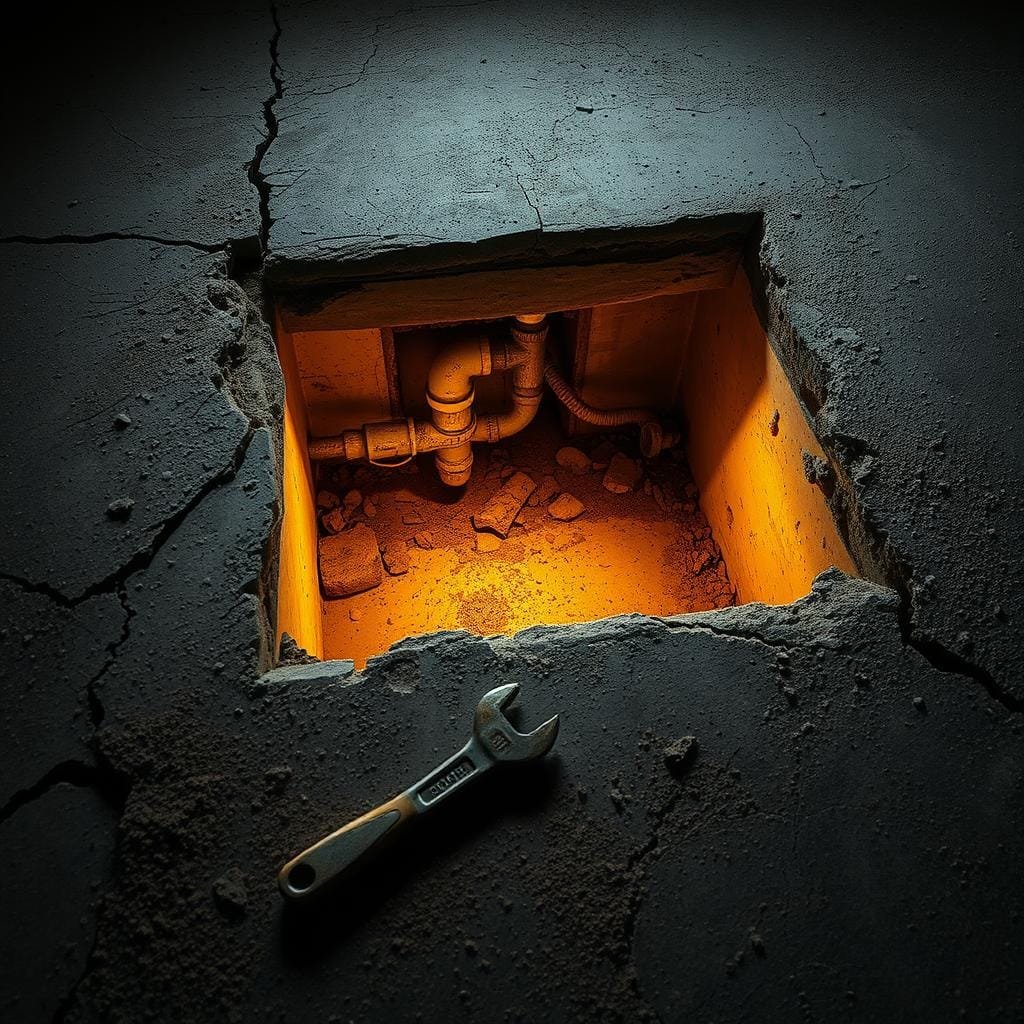
During construction, plumbing pipes, electrical conduits, and HVAC lines must be installed before the final concrete pour. Once the concrete cures, these systems become permanently embedded in your foundation. Any future problems require breaking through the solid surface to reach the issue.
Understanding these limitations helps you make an informed decision about whether a slab foundation suits your cabin project and long-term plans.
Challenges with Repairs and Modifications
The difficulty of plumbing access creates real headaches when problems develop years after construction. Unlike crawl space foundations where you can simply access pipes from below, slab repairs require invasive procedures.
If you need to relocate a drain line or add plumbing for a new bathroom addition, the work becomes significantly more complex than with other foundation types. Every modification means cutting through your cabin floor.
Breaking Through Concrete for Access
When a water leak develops or you need to modify utility lines, the repair process starts with concrete cutting equipment. Contractors use specialized concrete saws or jackhammers to cut through your cabin floor.
This process creates noise, dust, and disruption throughout your living space. After repairing the underlying problem, workers must patch the concrete and refinish your floor surface. The entire process can take several days and leaves your cabin in disarray.
The mess and inconvenience extend beyond the immediate repair area. Dust from concrete cutting can spread throughout your cabin, requiring extensive cleanup even in rooms far from the work site.
Complex Detection of Leaks
Identifying exactly where a leak occurs presents another challenge with embedded plumbing systems. You might notice unexplained increases in your water bill or hear water running when fixtures are off, but pinpointing the problem’s location requires specialized services.
Professional leak detection typically costs between $300 and $800 before any actual repair work begins. Technicians use acoustic sensors, thermal imaging cameras, or other diagnostic equipment to locate the problem without randomly breaking through your floor.
This detection step adds both time and expense to what might have been a simple repair with accessible plumbing. Without precise location data, contractors risk cutting into the wrong area and creating additional damage.
Pre-Planning Requirements for Utility Lines
Slab foundations demand meticulous planning before the concrete pour. You must determine the exact location of every drain, water supply line, electrical conduit, and future utility connection.
This planning requirement can feel overwhelming, as cabin owners may not know their long-term needs. Want to add an outdoor shower connection in five years? That hookup needs to be planned and installed now, before the concrete cures.
Changes after construction range from difficult to nearly impossible. Adding a bathroom, relocating kitchen plumbing, or installing a utility sink becomes a major foundation repair project.
Smart planning includes:
- Installing extra stub-outs for future fixtures
- Mapping and photographing all utility line locations before the final pour
- Consulting with experienced cabin designers about common modification requests
- Considering your lifestyle needs for the next 20-30 years
Potential Repair Costs and Complications
When foundation repair becomes necessary, expect significant expenses beyond typical plumbing costs. Breaking through a concrete slab, accessing utilities, making repairs, and restoring your floor typically runs between $2,000 and $5,000 or more.
The exact cost depends on several factors. These include the repair’s complexity, how deep the utilities are embedded, your floor’s finished surface, and your cabin’s accessibility for equipment.
Modern cabin builders have a silver lining. Cross-linked polyethylene plumbing supply lines, commonly called PEX plumbing, have dramatically reduced the likelihood of needing these invasive repairs.
PEX tubing offers several advantages over older copper or galvanized pipes:
- Greater flexibility reduces stress on connections
- Better freeze resistance in cold climates
- Fewer joints and connection points where leaks typically develop
- Longer expected lifespan with minimal maintenance
Many modern slab foundations use PEX exclusively for supply lines, with the more failure-prone connections located in accessible walls. This strategic approach minimizes the risk while maintaining the cost and efficiency benefits of slab construction.
Despite these improvements, the fundamental limitation remains. Your concrete slab foundation locks utility systems in place, making accessibility a permanent consideration throughout your cabin’s lifetime.
Vulnerability to Ground Movement and Soil Issues
Soil conditions can cause serious damage to slab foundations, leading to costly repairs. Modern construction methods have reduced these problems but not eliminated them. The ground can shift, expand, contract, or freeze, causing concrete slabs to crack.
Understanding soil-related risks is key to deciding if a slab foundation is right for your site. Some areas are not suitable for slab construction, no matter how well the foundation is built.
Expansive Soil Problems
Expansive soil is a major enemy of slab foundations. It changes volume a lot based on moisture. This uneven pressure can crack concrete and cause uneven settling.
Clay-heavy soils are common in the U.S. and can cause big problems. If your site has this soil, you’ll need special precautions or consider other foundation options.
Clay Soil Challenges
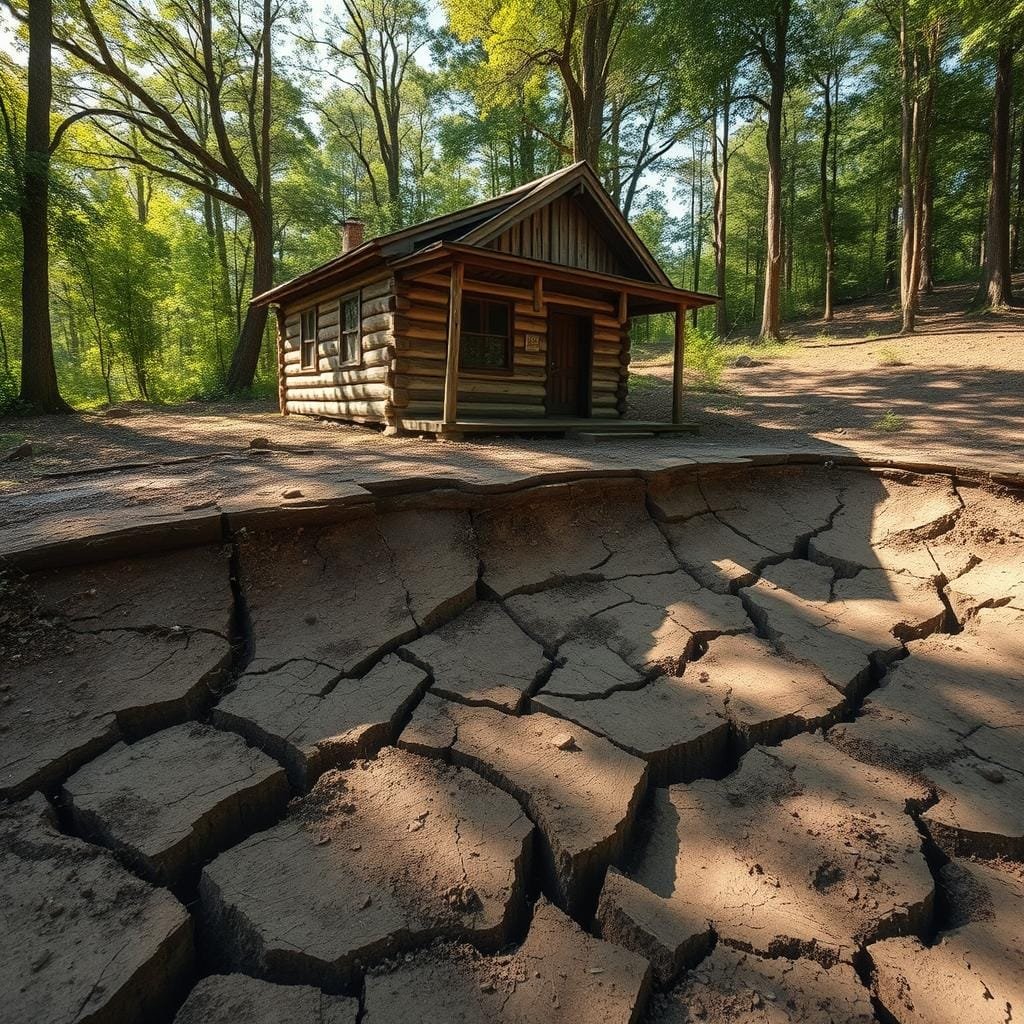
Clay soil absorbs water like a sponge and expands several inches when wet. It then shrinks back as it dries out. This cycle creates a lot of pressure under your slab.
- Doors that suddenly stick or won’t close properly
- Diagonal cracks appearing at window and door corners
- Floors that feel uneven or seem to slope
- Visible cracks in the concrete slab itself
- Gaps developing between walls and floors
These symptoms usually develop gradually over several years. Small cracks can widen over time and eventually allow water infiltration or provide entry points for pests.
Soil Stabilization Requirements
Building on expansive soil requires special techniques that add to your construction budget. Professional soil testing before construction is essential and can save you tens of thousands in future repair costs. A geotechnical engineer can evaluate your soil conditions and recommend appropriate solutions.
Common stabilization methods for problematic soils include:
- Deep moisture barriers extending several feet down to minimize moisture changes in the soil beneath the slab
- Engineered fill replacement where native clay is removed and replaced with more stable material
- Post-tension slab systems that use steel cables to reinforce the concrete against movement
- Proper drainage systems to control water flow around the foundation perimeter
In severe cases with highly expansive soil, upgrading to a pier and beam foundation or basement might actually cost less than trying to stabilize the soil for a slab. Your soil test results will guide this decision.
Frost Heave Concerns in Cold Climates
Cold climate regions face a different soil movement problem: frost heave. When ground temperatures drop below freezing, moisture in the soil expands as it turns to ice. This expansion creates powerful upward pressure that can crack slabs or push them upward unevenly.
The frost line marks how deep the ground freezes in your area during winter. This depth varies dramatically across the United States, from just a few inches in southern states to over 60 inches in northern regions. Building codes require foundation footings to extend below the frost line to prevent heave damage.
While properly designed slabs have perimeter footings anchored below the frost line, the center of the slab can be vulnerable to heaving. This is why slab foundations are much less common in northern states, Minnesota, Wisconsin, and throughout Canada.
If you’re building in a cold climate, ask your contractor about these frost protection strategies:
- Insulated slab edges to reduce heat loss and keep ground temperatures more stable
- Thickened perimeter footings that extend well below your local frost line
- Gravel drainage layers beneath the slab to move water away before it can freeze
- Heated basement or crawl space alternatives that eliminate frost heave risks entirely
Cracking and Settling Risks
Foundation cracking can occur even with proper construction when soil conditions change over time. Drought periods can cause soil to shrink and create voids beneath your slab. Heavy rainfall or plumbing leaks can saturate soil and cause expansion. These environmental factors remain beyond your control.
Even hairline cracks deserve attention because they tend to grow wider over time. What starts as a barely visible line can eventually become a structural problem requiring expensive intervention.
Repair costs for foundation cracking vary widely depending on severity:
| Repair Method | Problem Addressed | Typical Cost Range | Timeline |
|---|---|---|---|
| Epoxy Injection | Sealing small to medium cracks | $2,000 – $5,000 | 1-2 days |
| Slab Jacking | Leveling settled areas | $3,000 – $8,000 | 1-3 days |
| Underpinning | Stabilizing severely compromised sections | $8,000 – $15,000 | 1-2 weeks |
| Slab Replacement | Complete structural failure | $15,000 – $40,000+ | 2-4 weeks |
These repairs are disruptive and expensive, often requiring you to move furniture, cut through flooring, and sometimes even temporarily relocate. Prevention through proper site assessment and construction techniques is far more cost-effective than dealing with foundation problems later.
The relationship between soil conditions and foundation performance can’t be overstated. A thorough geotechnical investigation before construction is your best insurance against these expensive problems. Spending $1,500-$3,000 on professional soil testing might seem like a lot upfront, but it’s minimal compared to the tens of thousands you could spend fixing a cracked foundation.
Elevation and Flooding Considerations
The height of your cabin above the ground is very important. It affects flood protection and how easy it is to sell your cabin. Slab foundations are close to the ground, which can make managing water and site conditions hard. Knowing about these elevation factors helps decide if a slab foundation is right for your cabin.
Height Limitations and Site Accessibility
Slab foundations make your cabin floor just a few inches above ground level. This design means easy entry without steps. Builders often add a small weather step to keep snow and water out.
This close-to-earth design has big advantages. It’s great for elderly visitors or those with mobility issues. Building stays simpler without stairs or porches at every entrance.
But, there are downsides. If your site has a slope, you’ll need to grade the land a lot. Steep terrain might need expensive walls or a lot of earthwork, making slabs less cost-effective.
Other foundation types like crawl spaces, basements, or pier designs elevate your cabin more. This elevation helps on uneven land and protects against moisture.
Flood Zone Limitations
If your cabin site is prone to flooding, a slab foundation offers little flood protection. Water can easily flow across the slab and into your cabin. This risks damage to your floors, walls, and belongings.
Elevated foundation types keep your cabin safe from floods. Crawl spaces raise it 18 to 36 inches above ground level. Pier foundations can go even higher, providing great protection during floods.
In flood-prone areas, some places ban slab foundations for new homes. Others require expensive flood insurance for slab homes, adding to long-term costs. Always check FEMA flood maps and talk to your local building department before choosing a slab.
Even without regular flooding, severe storms can cause water issues. Climate changes mean what was safe before might not be now.
Water Drainage Challenges
With slab foundations, proper grading and drainage are key. The ground must slope away from the slab to prevent water pooling. This ensures water flows away from your foundation.
You’ll need good gutters and downspouts to direct water away from the foundation. Slab foundations often need French drains or other systems, mainly in areas with poor drainage or heavy rain.
Water against or flowing across a slab can enter through small cracks. This causes flooring damage, mold growth, and unhealthy indoor air. Fixing water damage can cost more than installing proper drainage.
Elevated foundations, like crawl spaces, let water flow under your cabin without harming the living space above.
| Foundation Type | Typical Elevation | Flood Protection Level | Drainage Requirements |
|---|---|---|---|
| Slab Foundation | 0-6 inches above grade | Minimal protection | Critical grading and drainage systems needed |
| Crawl Space Foundation | 18-36 inches above grade | Moderate protection | Standard drainage adequate for most sites |
| Pier Foundation | 24-60+ inches above grade | Excellent protection | Water flows freely beneath structure |
| Basement Foundation | 12-24 inches above grade | Good protection for living space | Requires waterproofing and drainage systems |
Impact on Cabin Resale Value
Elevation and flooding issues can hurt your cabin’s resale value. Buyers in flood-prone areas often worry about slab foundations. This can reduce your pool of interested buyers and lower your selling price.
Properties with flooding issues or high flood insurance costs take longer to sell. Even without flooding, being in a flood zone can worry buyers.
In safe locations with good drainage, slabs can be a selling point. They’re low maintenance and easy to access, appealing to retirees or those planning to stay long-term.
The right foundation type depends on your site. A slab foundation works well on well-drained, elevated land in low-risk areas. But in flood zones or poorly drained locations, it’s a liability that can cost you when selling.
Climate and Geographic Suitability
Not all places are good for slab foundations. The right spot depends on the weather, moisture, and soil.
Choosing a foundation isn’t just about what you like or can afford. Where you live is key to whether a slab works well or not.
Weather patterns greatly affect how foundations last. Knowing this helps protect your cabin for years.
Best Regions for Slab Foundations
Some areas in the U.S. are perfect for slab foundations. These places have conditions that let slabs work well with little trouble.
In Texas, Louisiana, and Oklahoma, almost no homes have basements. Most are built on slabs.
But, in the upper Midwest, 84% of homes have basements. This shows how different places have different building styles.
Warm Climate Advantages
The South is great for slab foundations. Texas, Louisiana, Oklahoma, Florida, Arizona, New Mexico, Georgia, and similar places benefit a lot.
These areas don’t have to worry about frost heave. This is a big problem for slabs in colder places.
Concrete slabs help keep homes cool in the summer. They absorb heat during the day and release it at night.
Building in warm places is simpler and cheaper. You don’t have to worry about deep frost lines.
Dry Climate Benefits
The Southwest and parts of California are also good for slabs. These areas have less moisture, which helps slabs last longer.
Low humidity means less chance of water damage. This keeps your foundation safe from mold and moisture problems.
Sandy soils in these areas drain well. This stops water from gathering around your foundation, making your slab last longer.
Challenging Climates and Terrain
Not every place is right for slab foundations. Some areas make building more expensive and less reliable.
Knowing these challenges helps avoid costly mistakes. If your site is tough, you might want a different foundation.
Mountain and Sloped Locations
Slabs struggle on sloped or uneven land. Creating a flat area costs a lot, making slabs less affordable.
In mountains, you might need expensive retaining walls to keep soil from washing away. This can make your foundation much more expensive.
Pier or post foundations work better on hills. They cost less and fit the land better.
Rocky soil in mountains is another problem. Digging for slab footings is too expensive. Other foundations need less digging.
Cold Weather Limitations
Northern areas are hard on slab foundations. The Midwest, New England, and Canada usually choose basements instead.
Frost heave is a big issue in cold places. It can crack slabs and damage the foundation.
The frost line is important in cold areas. It tells you how deep to dig footings to avoid freezing. This makes slabs more expensive and complicated.
Basements avoid frost heave and offer extra space. This is why they’re popular in the north, even though they cost more.
Frost Line Considerations Across the United States
The frost line is the depth where water in soil freezes in winter. It changes a lot across the country and affects foundation needs.
In southern Florida, the frost line is zero inches. In northern Minnesota and Maine, it’s 6 feet or deeper.
Slabs in cold areas need deep footings. This makes them more expensive and complex than in warmer places.
Even with deep footings, the center of the slab can be vulnerable to frost heave. If moisture gets under the slab and freezes, it can lift and crack the foundation.
| Region | Frost Line Depth | Foundation Recommendation | Primary Concern |
|---|---|---|---|
| Southern States (FL, TX, LA) | 0-12 inches | Slab (Ideal) | Moisture and drainage |
| Mid-Atlantic (VA, NC, TN) | 12-24 inches | Slab or Crawl Space | Moderate frost protection |
| Northern States (NY, PA, OH) | 30-40 inches | Basement Preferred | Frost heave risk |
| Upper Midwest (MN, WI, ND) | 48-72 inches | Basement (Standard) | Severe frost heave |
| Southwest Desert (AZ, NM) | 10-18 inches | Slab (Excellent) | Expansive soil movement |
Local builders and building departments know a lot about foundations in your area. They understand the soil, weather, and best building methods.
Talking to local experts before choosing a foundation can save you a lot of money. They know your area best and can give you advice no guide can.
Building codes reflect what works best in different places. They show which foundations are best for certain areas.
Cost Comparison: Slab vs. Other Foundation Types
Foundation costs are a big part of building a cabin, making up 10-15% of the budget. Choosing the right foundation can save or spend a lot of money. Knowing the costs of each type helps you decide wisely.
Foundation prices vary a lot. We’re talking thousands or even tens of thousands of dollars. This matters whether you’re building a weekend home or a permanent off-grid cabin.
Comparing Slabs to Crawl Space Foundations
The debate between slabs and crawl spaces is about upfront costs versus long-term ease. Both are good for cabins but fit different budgets and needs.
Cost Differences
Slab foundations cost $4-$5 per square foot, sometimes up to $14. For a 1,000-square-foot cabin, expect to pay $4,000-$5,000.
Crawl space foundations are pricier, at $7 per square foot, up to $16. The same cabin would cost about $7,000 for a crawl space. That’s an extra $2,000-$3,000 compared to a slab.
Why are crawl spaces more expensive? Several factors increase the cost:
- Foundation walls: Crawl spaces need perimeter walls, adding concrete or block and labor
- Support structures: Interior piers are needed for floor joists
- Floor systems: You need floor joists and subfloor materials, unlike slabs
- Construction complexity: The process is more complex, adding time and labor costs
Practical Trade-Offs
The extra $2,000-$3,000 for a crawl space isn’t wasted. It offers real benefits for many cabin owners.
With a crawl space, access to utilities is easy for repairs and upgrades. Better insulation and storage space are also advantages.
In areas where crawl spaces are common, they might increase your cabin’s resale value. Some builders save money, while others see the benefits as worth the cost.
Comparing Slabs to Basement Foundations
Basement foundations are much more expensive than slabs. They cost $18 per square foot, nearly four times as much.
For a 1,000-square-foot cabin, a basement would cost about $18,000. Slabs cost $4,000-$5,000, saving you 30-70% on foundation costs.
Basement foundations are pricey because of the extensive work needed:
- Excavating 8+ feet deep
- Building full-height concrete or block walls
- Waterproofing those walls
- Installing drainage systems and sump pumps
- Creating the basement floor slab
Basements offer extra living space, including storage, living areas, or mechanical rooms. Slabs can’t provide this.
Basements are worth it in cold climates or for extra space. But for simple cabins, they’re too expensive.
Comparing Slabs to Pier and Beam Foundations
Pier and beam foundations are a good choice for specific situations. They elevate your cabin on vertical posts with a wooden floor system above.
Pier and beam foundations cost $5,000-$10,000, depending on the site. They can be cheaper than slabs on flat lots.
But on uneven ground, they might cost more than slabs. The benefit? They avoid the site grading needed for slabs.
Pier and beam foundations are best for:
- Sloped lots: Building on hillsides is easier and cheaper
- Flood-prone areas: Elevating your cabin protects it from water damage
- Challenging access: Sites where heavy concrete trucks can’t reach
- Utility access needs: Easy access for repairs and upgrades
The choice between pier and beam and slabs depends on your site. On flat land, slabs are cheaper. On uneven ground, pier foundations are more cost-effective.
Your decision should consider your budget, site, and cabin use. Knowing the real costs helps you make a smart choice.
Key Factors to Consider Before Choosing a Slab Foundation
Before choosing a slab foundation for your cabin, do your homework. It’s more important than just looking at the cost. You need to think about your property, climate, and future plans.
Understanding these factors now can save you money and headaches later. Let’s look at the key things to consider when choosing a foundation.
Site Assessment and Soil Testing
Your site assessment is the first step in choosing a foundation. Knowing what’s under your land is essential. It helps decide if a slab foundation will work for years or cause problems.
The soil under your land affects your foundation. Clay soils get bigger when wet and shrink when dry. Sandy soils drain fast but might not hold weight well. Rocky land has its own challenges.
Professional Soil Analysis
Getting a professional to test your soil costs between $500 and $2,000. This can prevent expensive foundation problems later.
Soil testing involves taking samples from your land at different depths. Engineers check the soil’s makeup and how much weight it can hold.
The test shows how deep the stable soil is and how well it drains. It also finds bad soils like expansive clays. The report gives advice on the best foundation for your site.
Don’t skip this step. The small cost of soil testing can save you from big foundation problems that could harm your cabin.
Understanding Your Property’s Conditions
Doing a site assessment yourself helps you know your land better. Walk your land in different seasons. Spring shows where water flows and collects.
Look for places where water stays after storms. Check if your land is sloped or flat. Know the frost depth in your area for foundation depth.
Find out the water table depth in your area. High water tables can cause moisture problems and might mean no slab foundation in some places. Local well drillers or your county extension office can help with this.
Local Building Codes and Regulations
Foundation rules change from place to place. What works in Arizona might not in Minnesota. Your local building department decides what’s allowed.
Some places require certain foundations in flood zones. Others need engineering stamps on plans. Frost lines determine minimum footing depths to avoid damage.
Reinforcement needs vary by region. Earthquake areas need more rebar. Cold climates need insulation under slabs to stop frost.
Visit your local building department early—before you decide on a foundation. Knowing the pros and cons of slab foundations in your area helps you make a smart choice.
You’ll need permits, submit plans, and have inspections during construction. Knowing this early prevents delays and redesigns later.
Your Cabin’s Size and Design Requirements
Your cabin’s design affects foundation choice. Slab foundations work for some but not all designs. Think about how your design fits with foundation options.
Slab foundations mean all mechanical systems are on the main floor. This includes HVAC, water heaters, and utilities. Some designs fit this well, while others need basements or crawl spaces.
Single-story cabins often work with slabs. Multi-story cabins need careful planning for weight and structure. Your architect or designer can help decide if slab is right for your design.
Does your design make slab installation hard? Features like walkout basements or split-levels pose challenges. Slab foundations might require changes that affect your cabin’s look or function.
The design you choose affects costs beyond the foundation. Changes to fit slab limitations add to expenses and might cut out features you want.
Long-Term Usage Plans and Future Modifications
Think about how you’ll use your cabin for years to come. A weekend home is different from a future retirement spot. Consider long-term plans.
Will you add plumbing for an extra bathroom in a few years? Slab foundations make this hard and expensive. Accessing utilities means breaking through the slab.
Could you add an extension later? Expanding with a slab foundation is complex. Matching floor heights and connecting new concrete to old needs careful engineering.
If you want to be able to modify your cabin later, consider crawl space or basement foundations. They’re more expensive upfront but easier to modify and upgrade.
Think if this cabin is your forever home or a temporary getaway. Your answer should guide your foundation choice today for future flexibility.
Budget Constraints and Financing
For many, budget drives foundation choices. Slab foundations are cheaper upfront. But, smart budgeting looks at long-term costs too.
Make a detailed budget for site prep, utilities, engineering, permits, and inspections. Add 10-15% for unexpected costs. This is a good rule.
Consider lifetime costs, not just building costs. Slab foundations save on maintenance and energy bills over time. But, think about repair costs too. Fixing problems in slabs is more expensive than in crawl spaces.
Financing options can also affect your choice. Some lenders have specific requirements for cabin loans. Others offer better terms for certain foundations.
| Decision Factor | Key Considerations | Impact on Slab Suitability | Research Required |
|---|---|---|---|
| Soil Conditions | Bearing capacity, drainage, expansive soils, frost depth | High – determines feasibility | Professional geotechnical testing ($500-$2,000) |
| Building Codes | Minimum depths, reinforcement requirements, insulation standards | High – dictates specifications | Local building department consultation |
| Cabin Design | Size, stories, HVAC placement, utility locations | Medium – affects layout options | Architect or designer review |
| Future Plans | Modifications, additions, utility access needs | Medium – limits flexibility | Long-term lifestyle assessment |
| Budget Reality | Construction costs, maintenance expenses, repair, energy savings | Medium – balances priorities | Comprehensive cost analysis and financing options |
This framework helps you decide if a slab foundation is right for you. Don’t let one factor decide. Weigh all considerations to make the best choice for your cabin.
Making the Right Foundation Choice for Your Cabin
You’ve looked at the good and bad of slab foundations for your cabin. Now, it’s time to pick a foundation that will last for years.
Discuss the best options with your Realtor and contractor. The local weather and land shape are key. Also, talk to engineers about the best foundation for your land. They know about soil and local issues that affect your foundation’s life.
Monolithic slab foundations are cheap, strong, last long, and easy to put in. They take days, not weeks. You’ll save a lot compared to basements. They also fight pests and moisture well.
But, fixing problems with plumbing or electrical lines can be hard. Cracks from soil or frost can cost a lot. Sloped land and flood areas also limit your choices.
Despite the risks, most cabin builders choose slab foundations. The right choice for you depends on your situation.
Your land, budget, weather, and future plans are important. With knowledge of slab foundations and advice from experts, you’re set. Your cabin will have a strong base for making memories.