How do you get that warm, lived-in cabin rustic feel without filling every corner with store-bought “country” stuff that looks fake the moment you walk in? The answer starts long before you pick a throw pillow or hang a set of antlers.
If you’re finishing or decorating a cabin you built yourself, you’ve already got a head start. The bones of the structure (the beams, the walls, the floors) can carry most of the visual weight. Decor becomes a layer on top, not the whole story.
These ideas lean into what actually works in real cabins: durable, honest materials and smart built-in choices that make the space feel intentional without costing a fortune.
Built-In Elements Do the Heavy Lifting Before You Buy a Single Accent
If you treat the structure itself as decor, you spend less on accent pieces and get a more authentic result. A cabin where the walls, ceiling, and shelving already tell a story doesn’t need much else. This is the single biggest advantage a builder has over someone decorating a standard apartment.
Exposed Beams and Wood-Treated Walls Set the Tone
Exposed ceiling beams are the fastest way to establish a rustic character, and they cost nothing extra if you’re already framing the ceiling. Leaving them visible instead of drywalling over them saves labor and adds more visual warmth than any light fixture could match.
For walls, tongue-and-groove pine paneling is a workhorse choice. It’s affordable (expect to pay roughly $1.50–$2.50 per linear foot for standard pine), takes stain well, and holds up to the humidity swings that cabins deal with every season. A dark walnut stain on pine gives you that deep, rich tone without needing expensive hardwood. Apply a penetrating oil finish like Rubio Monocoat over the stain and you won’t need to refinish for years.
One thing to get right: seal the wood before the cabin sees its first winter. Unsealed pine on an exterior-adjacent wall will move, crack, and gap. That’s a headache that takes a full weekend to fix.
Handmade Shelving and Built-Ins Cut Your Decor Budget
A set of open shelves built from rough-sawn lumber does three things at once — storage, display space, and texture. You don’t need a finish carpenter to pull this off. A circular saw, a drill, and some 2×10 boards from the local mill get you there in a Saturday.
Built-in bookshelves flanking a window or fireplace anchor the room so completely that you need almost nothing on the walls. Add a few crates or baskets on the lower shelves for functional storage, and the space reads as intentional rather than sparse. That’s the goal: purposeful, not decorated.
10 Cabin Rustic Decor Ideas That Actually Work
The ideas below are ordered by impact. Start with the structural ones and layer from there. The ones at the top change the whole room; the ones at the bottom are finishing details.
Ideas 1–4: The Structural Anchors (Reclaimed Wood, Stone Fireplace, Log Furniture, Exposed Beam Ceilings)
Reclaimed wood accents — A reclaimed barn wood feature wall or mantel adds instant age and character. Salvage yards sell boards for roughly $3–$6 per board foot, and no two pieces look the same.
Stone fireplace — A stacked-stone surround using fieldstone or ledger stone panels grounds the room. Ledger panels run around $8–$15 per square foot and install over a standard framed surround.
Log furniture — A solid log bed frame or coffee table made from white oak or pine sets the tone without competing with the architecture.
Exposed beam ceilings — Already covered above, but worth repeating here: leave them raw or wire-brush them for texture. Don’t paint them white.
Ideas 5–8: Texture and Warmth (Natural Textiles, Earthy Color Palette, Vintage Lantern Lighting, Handcrafted Woodwork Details)
Natural textiles — Wool throws, jute rugs, and cotton canvas curtains add warmth without adding visual clutter. Layer two rugs if the floor is cold stone or tile.
Earthy color palette — Stick to warm browns, forest greens, and deep creams. Avoid gray-toned “greige” palettes. They read as modern, not rustic.
Vintage lantern lighting — Wrought-iron pendant lights or Edison-bulb sconces from a salvage shop or flea market cost a fraction of new fixtures and look far more authentic.
Handcrafted woodwork details — Mortise-and-tenon joinery on a bench or cabinet face, even if it’s just decorative, signals craftsmanship in a way that factory furniture never does.
Ideas 9–10: The Finishing Touches (Antler and Wildlife Accents, Indoor Plants and Functional Rustic Storage)
Antler and wildlife accents — One or two pieces work. A single antler chandelier or a small mount above the fireplace reads as intentional; six mounts across one wall reads as a hunting supply store.
Indoor plants and functional rustic storage — A cast-iron hook rail, a wooden crate stacked with firewood near the hearth, or a galvanized metal bin for blankets all pull double duty. Add a pothos or fern on the windowsill and the room feels alive.
Flooring Choices That Hold Up to Cabin Conditions
Cabin floors take serious abuse. Muddy boots, temperature swings of 40°F or more between seasons, and the occasional spilled drink that sits for a day before anyone notices. Choose flooring for durability first, then appearance. The good news is that the most durable options also tend to look the most authentic.
Flooring Type
Durability
Approx. Cost (installed)
Best For
Watch Out For
Solid hardwood (white oak)
High
$8–$14/sq ft
Main living areas
Needs acclimation; can gap in dry winters
Engineered hardwood
Very High
$6–$12/sq ft
Any level, high humidity zones
Thinner wear layer limits refinishing
Slate or stone tile
Extremely High
$10–$18/sq ft
Entryways, kitchens
Cold underfoot without radiant heat
Wide-plank pine
Moderate
$4–$8/sq ft
Bedrooms, lofts
Dents and scratches easily — plan on it
Luxury vinyl plank (LVP)
Very High
$3–$7/sq ft
Bathrooms, basements
Less authentic look up close
Wide-plank pine is the most cabin-appropriate choice visually, but go in knowing it will dent. That’s not a flaw. Worn pine floors with character marks are part of the look. If you want something that stays pristine, engineered white oak is the better call.
Common Cabin Rustic Decor Mistakes and How to Avoid Them
Most cabin rustic decor mistakes fall into two categories: overdoing the theme or ignoring how the space actually functions day to day. Both are easy to avoid once you know what to watch for.
When “Rustic” Tips Into Kitschy
There’s a real line between rustic and themed, and it’s easier to cross than you’d think. The clearest sign you’ve crossed it: every surface has something animal-related on it. One antler piece works. One mounted fish, one bear figurine, and three deer prints on the same wall tips into novelty territory fast.
Stick to a maximum of two wildlife accent pieces per room. Beyond that, the decor starts competing with itself instead of supporting the space. The same rule applies to novelty signs, mason jar collections, and anything with the word “cabin” printed on it. These items aren’t wrong on their own — they’re wrong in clusters.
Mass-produced “rustic-style” furniture is the other trap. A distressed finish applied at a factory looks different up close than genuine wear on reclaimed wood. The texture is too uniform, the color too consistent. Spend the extra time sourcing from a salvage yard or local woodworker and you’ll get something that actually reads as authentic.
Dark Materials Without Enough Light Sources
Dark wood walls, a stone fireplace, and deep-stained floors look incredible in photos taken with professional lighting. In a real cabin with two small windows, that same combination turns the room into a cave.
Plan for at least three light sources per room — overhead, task, and ambient. Wall sconces at eye level make a bigger difference than a single ceiling fixture ever will. If you’ve already committed to dark paneling, add a lighter-toned wool rug and cream-colored curtains to pull some brightness back in. Lumen output matters here: aim for bulbs in the 800–1,000 lumen range for living areas rather than the dim 400-lumen bulbs that look warm in a showroom but leave corners dark.
Mixing Modern Pieces Into a Rustic Cabin Without Wrecking the Look
The rule is contrast, not competition. One or two clean-lined modern pieces actually make a cabin rustic space feel curated rather than frozen in time. The mistake is adding too many modern items until the rustic character gets diluted.
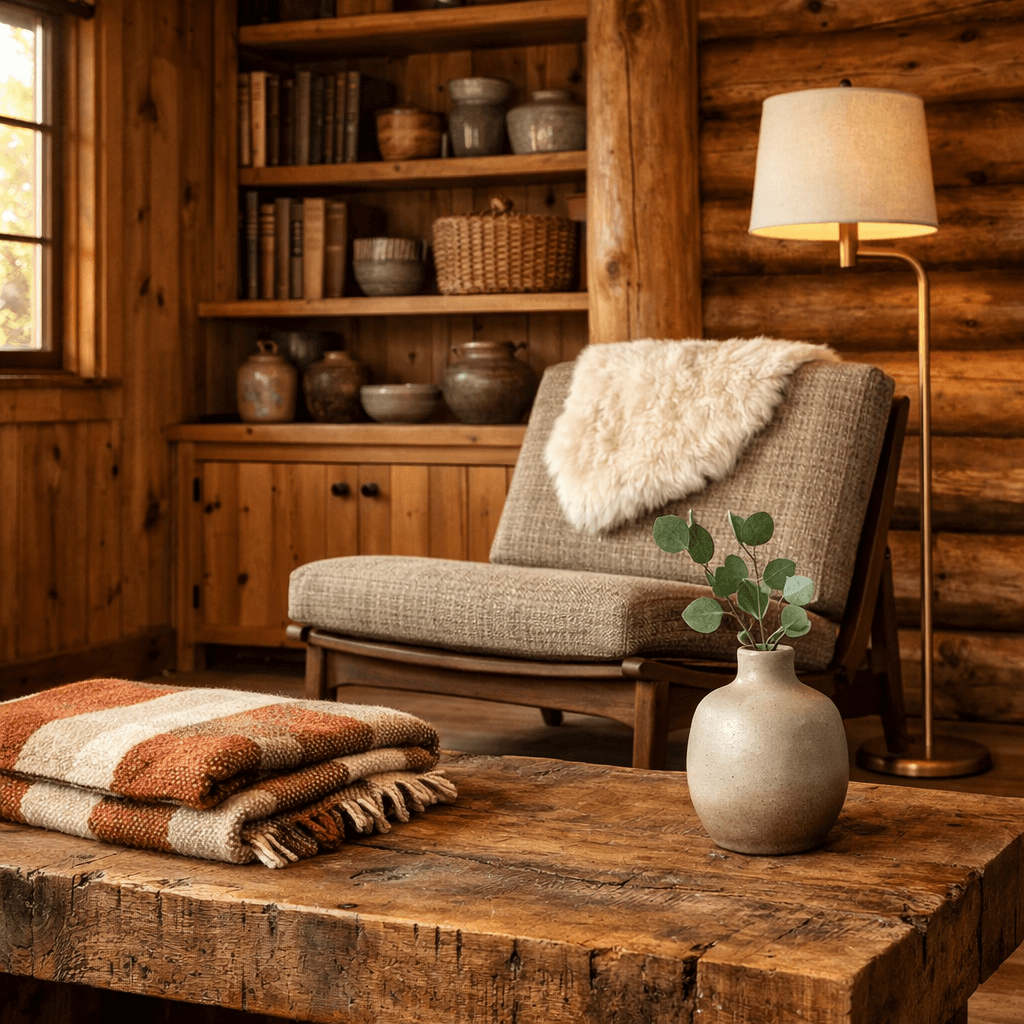
A simple steel-frame floor lamp next to a log sofa works because the materials are honest. Steel and wood both belong in a working cabin. What doesn’t work: a high-gloss lacquered side table or anything with chrome hardware. Matte finishes on modern pieces read as neutral; glossy finishes read as intrusive.
Keep modern additions functional. A mid-century modern wood chair in walnut pulls double duty. It’s comfortable and its warm tone doesn’t fight the surrounding wood walls. A concrete-top kitchen island in an otherwise rustic kitchen is another example where the material is raw enough to fit.
Limit yourself to one modern statement piece per room. That’s the ceiling. Once you go past one, you’re redecorating the whole room, not accenting it.
Decorating a Cabin on a Budget: Where to Spend and Where to Save
Spend on flooring and lighting; save on textiles and accent pieces. That’s the short version. Flooring takes the most abuse and is the most expensive to replace, so cutting corners there costs you more in the long run. A quality engineered hardwood install runs $6–$12 per square foot installed. That’s money well spent.
Lighting fixtures are worth the investment too, but not for the reason most people think. A $40 wrought-iron pendant from a flea market or Habitat for Humanity ReStore looks more authentic than a $200 “rustic-style” fixture from a big-box store. So spending on lighting doesn’t mean spending more. It means spending smarter.
Textiles are where you save. A wool-blend throw from a discount home goods store does the same job as one from a boutique cabin brand at three times the price. Jute rugs, cotton canvas curtains, and linen pillow covers are all available for well under $50 per piece if you shop off-season or secondhand.
Reclaimed lumber for shelving and accent walls is often free or near-free if you ask at local demolition sites or farm auctions. That’s the real budget move in cabin rustic decorating. The most character-rich materials are also the cheapest, if you’re willing to do the work of finding them.
Frequently Asked Questions
How many rustic accent pieces are too many for a small cabin room?
For a room under 200 square feet, cap decorative accents at five to seven total pieces. Beyond that, the space reads as cluttered rather than cozy. Wildlife items specifically (antlers, mounts, figurines) max out at two per room.
Do I need to refinish reclaimed wood before using it indoors?
Not always, but inspect it first. Check for old lead paint (pre-1978 lumber is a real concern), remove any protruding nails, and sand rough edges. A coat of tung oil or a water-based polyurethane seals the wood without changing its weathered character.
What’s the most budget-friendly cabin rustic flooring option?
Wide-plank pine runs $4–$8 per square foot installed and looks the most authentically rustic of any option. It dents and scratches, but on a cabin floor that’s expected wear, not damage. If you want something more durable at a similar price, luxury vinyl plank starts around $3 per square foot installed.
Can I mix different wood tones in the same cabin room?
Yes. Two or three distinct wood tones actually look more natural than everything matching. The key is keeping undertones consistent. Warm amber tones (pine, cedar) work together; cool gray tones (reclaimed barn wood, weathered oak) work together. Mixing warm and cool tones in the same room is where things start to look unintentional.