Standing in the driveway staring at two boxes at the hardware store, you’re probably wondering: does it actually matter which one you grab, or is that just marketing? It matters more than you’d think. The generator or inverter question comes down to what’s inside the box, not just the label on it — a conventional generator spins an engine at a fixed speed to make power, while an inverter generator converts that power electronically into a cleaner, more stable current.
That difference sounds small until you plug a laptop into the wrong one and watch it glitch, or realize your “quiet” job site generator is loud enough to trigger noise complaints from your cabin neighbors. For anyone building off-grid, this isn’t a spec-sheet debate. It’s about matching the right machine to the actual job in front of you.
How an Inverter Generator Actually Works
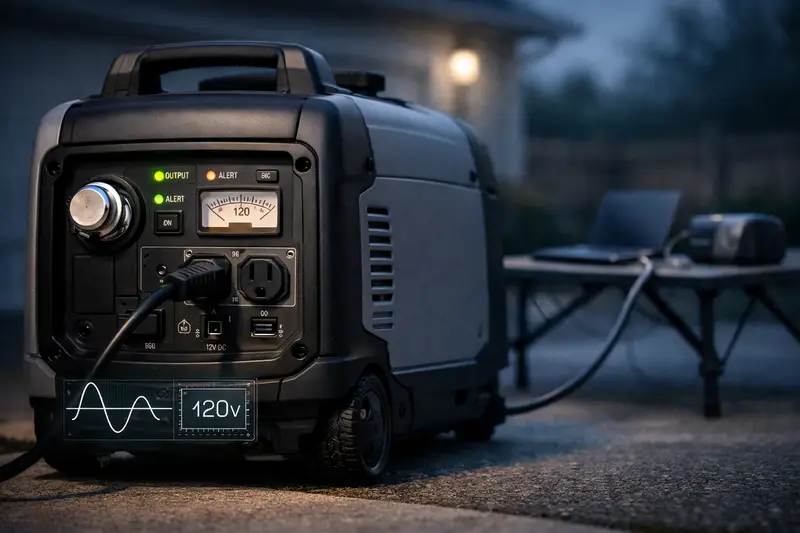
An inverter generator makes power in three steps instead of one: it generates raw AC power, converts it to DC, then inverts it back into clean, regulated AC. That extra conversion step is the whole reason inverter generators exist, and it’s why they cost more.
A conventional generator skips all that. Its engine spins a magnet inside a coil at a constant 3,600 RPM, producing AC power directly at 60Hz. That’s simple, cheap, and reliable, but the output quality is tied directly to how steady that engine spins. Load surges, minor engine vibration, even a dirty carburetor can all show up as fluctuations in your power.
Why the Extra Step Matters
The electronic conversion in an inverter generator lets the engine speed vary with the load instead of running flat-out all the time. Need 800 watts instead of 2,000? The engine throttles down. That’s the mechanical root of most of the differences you’ll read about below — fuel use, noise, and weight.
The Sine Wave Difference
Conventional generators produce a rougher wave form with more distortion baked in. Inverter generators produce a “clean” sine wave, nearly identical to what comes out of a wall outlet at your house. That distinction is measured by total harmonic distortion, or THD, and it’s not just a marketing term.
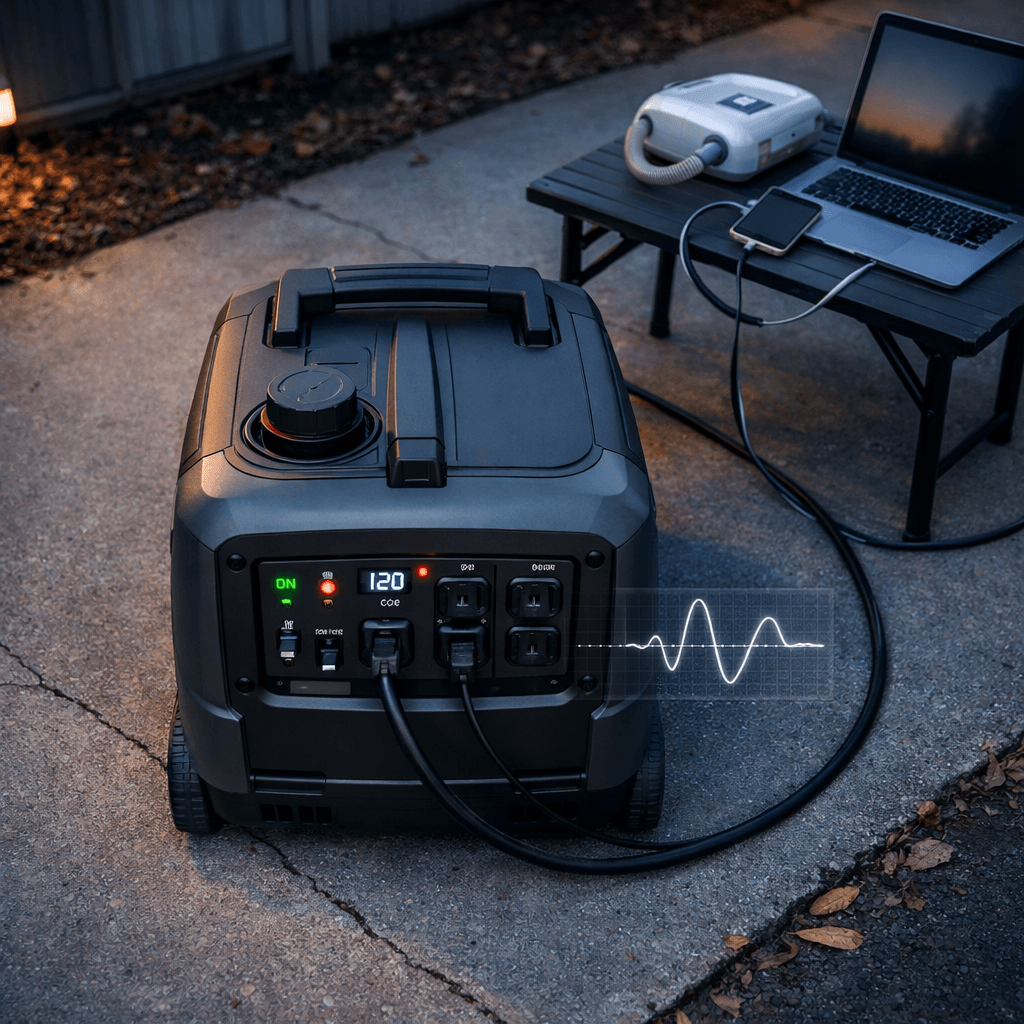
Most inverter generators run THD under 6%, sometimes under 3% on premium models. Conventional generators often sit at 15-25% THD or higher under load. For a circular saw, that number is irrelevant. For a laptop charger or a CPAP machine, it can be the difference between “works fine” and “fries the board.”
Generator or Inverter: What Changes for Power Quality
The direct answer: inverter generators produce stable, low-distortion power safe for sensitive electronics, while conventional generators produce rougher power that’s fine for tools and appliances with simple motors but risky for microprocessors. This is the single biggest reason to pick one over the other.
It’s a common mistake to assume all generators put out power that’s “good enough” for anything you plug in. That’s not true, and it’s not a minor caveat — it’s the core issue. A phone charger might survive on a conventional generator’s rough wave. A drone battery charger, a modern TV, or a router might not, especially over repeated exposure.
What Runs Fine on Rough Power
Power tools, simple resistive heaters, incandescent or basic LED work lights, and older appliances with simple motors generally don’t care about wave quality. A miter saw or a shop vac doesn’t have delicate circuitry to protect. This is why job sites have run on conventional generators for decades without issue.
What Needs Clean Power
Laptops, phones, smart TVs, modern refrigerators with electronic control boards, CPAP machines, and most home theater gear are built around sensitive circuit boards. Feed them dirty power long enough and you risk shortened lifespan or outright failure, not always immediately, sometimes after months of intermittent brownouts and spikes.
The practical rule I’d give any cabin builder: match the generator to the load, not the other way around. Don’t buy one expensive inverter unit and assume it should power your table saw and your laptop equally well — it can technically do both, but you’re often overpaying for capacity you don’t need on the tool side.
Fuel Efficiency and Runtime Compared
Inverter generators sip fuel because the engine throttles down when demand drops; conventional generators run at full RPM regardless of load, burning fuel whether you need 300 watts or 3,000. Over a weekend of cabin work, that gap adds up fast.
A small inverter generator running a few lights and a coffee maker overnight might burn through less than a gallon of gas in eight hours. A comparable-output conventional unit running at fixed speed the whole time could burn through double that, even with a light load, because the engine doesn’t know to slow down.
This matters most for overnight use, which is exactly the scenario off-grid cabin owners deal with constantly. Nobody wants to wake up at 2 a.m. to refuel a generator so the fridge doesn’t die. A quality inverter generator with a smaller tank can often outlast a conventional one with a bigger tank, purely because of how efficiently it burns fuel at partial load.
Conventional generators do have one fuel-related advantage: bigger tanks are common on bigger units, and at full continuous load — like running a whole job site — the efficiency gap narrows. If you’re maxing out the generator’s rated wattage most of the time anyway, the throttling advantage of an inverter matters less.
Noise Levels: Why Decibels Matter More at a Cabin Than a Job Site
Inverter generators typically run 50-58 decibels at a distance of 23 feet, roughly the volume of normal conversation. Conventional generators commonly run 64-72 decibels at the same distance, closer to a running lawn mower or vacuum cleaner. That gap is noticeable, especially at night.
On an active construction site, nobody’s fussing over an extra 15 decibels of engine noise. But at a cabin, especially one near other properties or in a quiet rural area, that noise difference decides whether you can run power after dark without every neighbor within earshot knowing about it.
Generator Type
Typical Noise (at 23 ft)
Typical Fuel Burn (light load)
Common THD
Small inverter (2,000-3,000W)
50-58 dB
Under 1 gal / 8 hrs
Under 6%
Mid conventional (5,000-7,000W)
64-72 dB
1.5-2.5 gal / 8 hrs
15-25%
Large conventional (10,000W+)
70-75 dB
3-4 gal / 8 hrs
15-25%
The lower noise floor of inverter generators comes directly from that variable-speed engine we talked about earlier. A throttled-down engine idling to cover a small load is simply quieter than one locked at full RPM all the time. It’s not soundproofing tricks — it’s physics.
If you’re doing rough framing during the day and running a lamp and a fridge overnight, you might genuinely want both types of units at different times, not one generator trying to cover the entire noise curve of your project.
Weight, Portability, and What You Give Up for Size
Inverter generators are lighter for their rated output because the components are more compact and efficient, but they usually top out at lower wattage than large conventional units. A common 3,000-watt inverter generator weighs somewhere around 60-90 pounds; a 7,500-watt conventional generator can weigh 150-200 pounds or more.
That’s a real tradeoff, and it’s one of the most misunderstood parts of the generator or inverter decision. People assume inverter automatically means “better” across every metric, including power output. It doesn’t. Inverter generators are often lower wattage than conventional units, not higher — you’re trading maximum output for portability and clean power, not getting both for free.
Portability for a Build Site
If you’re hauling a generator up a rough trail to a remote cabin lot, or moving it in and out of a truck bed daily, the lighter inverter unit wins easily. Many models come with folding handles and weigh little enough for one person to load without a dolly.
Wattage Capacity for Whole-Cabin Backup
If you need to run a well pump, a mini-split, and kitchen appliances simultaneously during an outage, you may be looking at 6,000-10,000 running watts, a range where conventional generators dominate the market and inverter options get expensive fast. A small 2,200-watt inverter unit simply won’t cover that load, no matter how clean its power is.
This is where the “higher price always means better fit” assumption falls apart. A $1,200 inverter generator might be a worse purchase than a $700 conventional one if your actual need is running a well pump and a chest freezer, not charging phones.
Parallel Capability: Combining Two Units Instead of Buying One Giant Generator
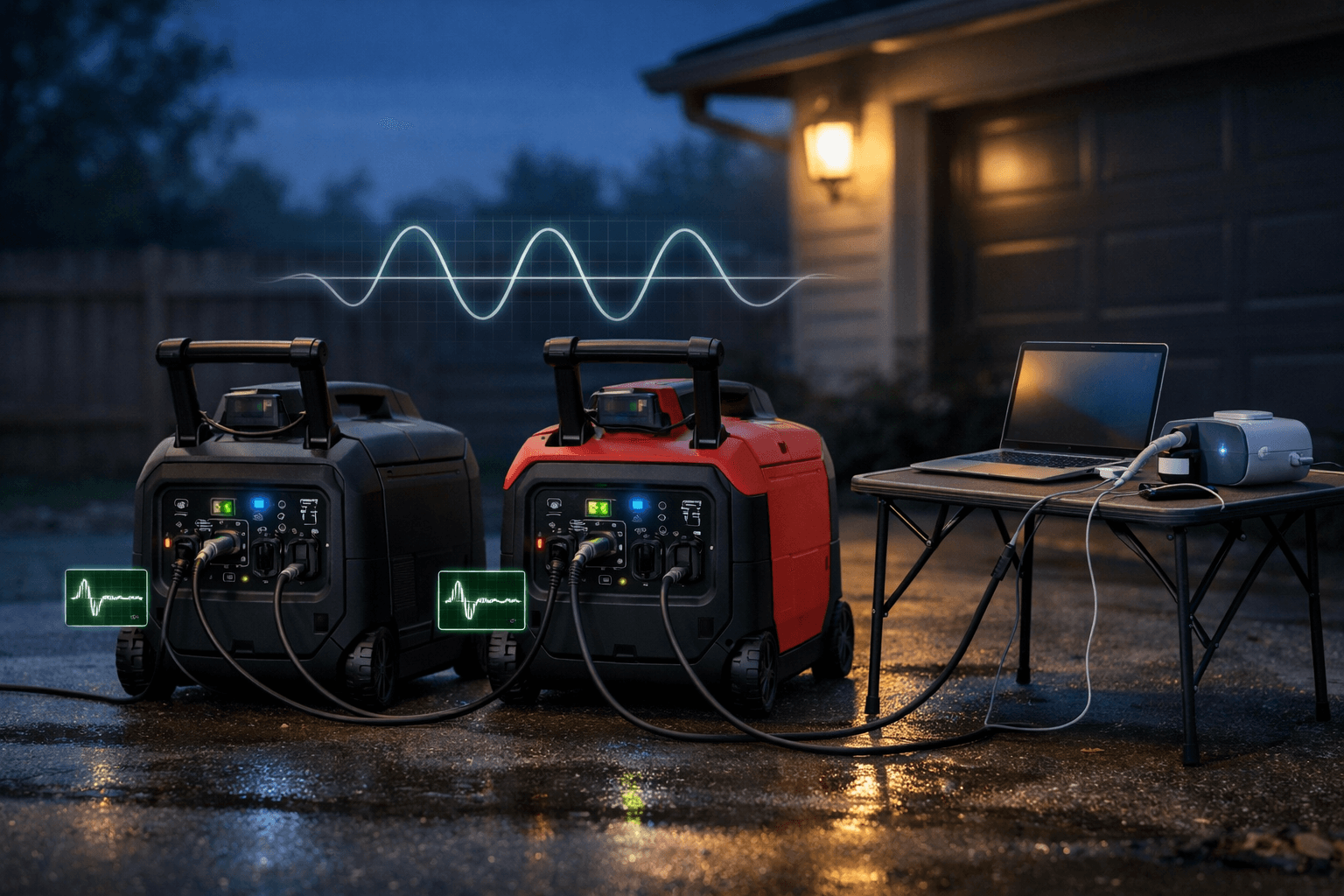
Many inverter generators support parallel operation, meaning you can connect two identical (or compatible) units with a special cable kit to combine their output into one shared load. This lets you run a smaller, quieter, cheaper unit day-to-day and add the second one only when you need more power.
This is one of the most overlooked features for cabin builders specifically. Instead of buying a single 6,000-watt inverter generator (expensive, heavy, often over $2,000), you could buy two 3,000-watt units and a parallel kit for a fraction of that combined cost, then only run both together when you’re actually pulling a heavy load.
Run one small inverter unit alone for daily light loads: lights, phone charging, a mini-fridge.
Add the second unit and connect the parallel kit when you need to run power tools or a larger appliance simultaneously.
Disconnect and store the second unit when the extra capacity isn’t needed, saving fuel and wear.
Use either unit independently as a backup if one needs maintenance.
Scale up gradually as your cabin’s power needs grow, rather than buying oversized capacity up front.
Conventional generators generally don’t offer parallel capability in consumer models — you buy the size you need up front, and that’s what you’re stuck with. If your power needs are going to grow as you finish the cabin (adding a well pump, then a mini-split, then a washer/dryer), the parallel-inverter strategy lets you scale without replacing equipment.
The catch: parallel kits only work between compatible models, often from the same manufacturer or the same power class, so you can’t always mix and match brands after the fact. Buy with that limitation in mind if you’re planning to expand later.
Building a Two-Generator Strategy for Cabin Construction
The real decision for most off-grid cabin builders isn’t “generator or inverter” as an either/or. It’s figuring out which loads on your site actually need clean power and which ones don’t, then sizing equipment for each category instead of buying one do-it-all unit.
Rough construction work, think circular saws, compressors, and framing nailers, doesn’t care about THD. A mid-size conventional generator in the 5,000-7,000 watt range handles that work fine, runs cheaper up front, and tolerates job site abuse better than a delicate inverter unit sitting in sawdust all day.
The Construction Phase Setup
During framing, roofing, and rough-in work, run a conventional generator. You need raw wattage to start motors under load (think miter saws or air compressors with high startup draw), and you’re not plugging in anything sensitive. A used or budget conventional generator in this phase takes abuse you wouldn’t want happening to a $1,500 inverter unit.
The Finishing and Living Phase Setup
Once you’re wiring in outlets, running a router for internet, charging tool batteries overnight, or just trying to watch something on a laptop after a long day of work, switch to the inverter generator. This is also the stage where noise matters more, since you’re likely staying overnight and want to actually sleep.
Plenty of cabin builders end up owning both types for exactly this reason, and it’s not wasteful redundancy — it’s matching the tool to the job the same way you wouldn’t frame a wall with a finish hammer. If you’re mapping out a full off-grid power setup for a cabin build, cabinlodger.com has more detail on sequencing that alongside solar and battery backup, which often ends up doing a lot of the light-duty overnight work that used to fall on a generator.
Budget-wise, a reasonable two-generator approach might run something like a $600-900 conventional unit for the rough build phase and a $900-1,400 inverter unit for finishing and overnight use, landing somewhere around $1,500-2,300 total. Compare that to a single high-capacity inverter generator covering everything, which can run $2,000-3,500 on its own and still not match the raw starting wattage of the conventional unit for heavy tools.
Cost Breakdown: What You’re Actually Paying For
Inverter generators cost more per watt of output than conventional generators, generally 30-80% more for comparable running wattage, because of the added electronic components and more efficient (and expensive) engine designs. That premium buys clean power, quiet operation, and better fuel economy, not more raw capacity.
A small 2,000-2,200 watt inverter generator commonly runs $400-700. A conventional generator at a similar 2,000-2,200 watt range might run $300-450, and jumping up to 5,000-6,500 watts in conventional format often lands around $600-1,000, still cheaper than a comparable-wattage inverter unit, if you can even find one at that size for a reasonable price.
Here’s a rough side-by-side to make the comparison concrete:
Feature
Inverter Generator
Conventional Generator
Typical price (2,000-2,500W)
$400-700
$300-450
Typical price (5,000-6,500W)
$1,500-2,200 (less common)
$600-1,000
Fuel use (light load)
Lower, throttles down
Higher, runs at fixed RPM
Startup wattage headroom
Lower relative to price
Higher relative to price
Where the money really goes is into that DC conversion and inversion circuitry, plus tighter manufacturing tolerances needed to keep THD low. Cheap inverter generators exist, but pushing that price down usually means cutting corners on runtime or build quality, not the sine wave cleanliness itself.
Don’t assume the priciest option on the shelf is automatically the right buy for your cabin. A $2,000 inverter generator sized for a small campsite setup won’t run a well pump and a mini-split at the same time, no matter how clean its power is or how much it cost. Match the spec sheet to your actual watt draw before you factor in price at all.
Frequently Asked Questions
Can a conventional generator damage my laptop or phone?
It’s possible, though not guaranteed on every use. Rough power with high THD can cause data corruption, unexpected shutdowns, or gradual wear on charging circuits, especially with repeated or extended use rather than a single quick charge.
Do I need an inverter generator for camping or RV use?
For most camping and RV setups, yes, it’s worth it. RVs often have sensitive electronics, air conditioners with variable-speed compressors, and limited storage space, all of which favor an inverter generator’s clean power, quiet operation, and lighter weight.
Is a 2,000-watt inverter generator enough to power a cabin?
Only for light loads: lights, phone charging, a small fridge, maybe a laptop. It won’t run a well pump, mini-split, and kitchen appliances together — for whole-cabin backup, look at 5,000+ watts or a parallel-capable pair of units.
Can I mix a conventional generator and an inverter generator on the same project?
Yes, and it’s often the smarter approach. Use the conventional unit for rough construction power tools and the inverter unit for finishing work and overnight electronics, rather than buying one oversized unit to cover both jobs.