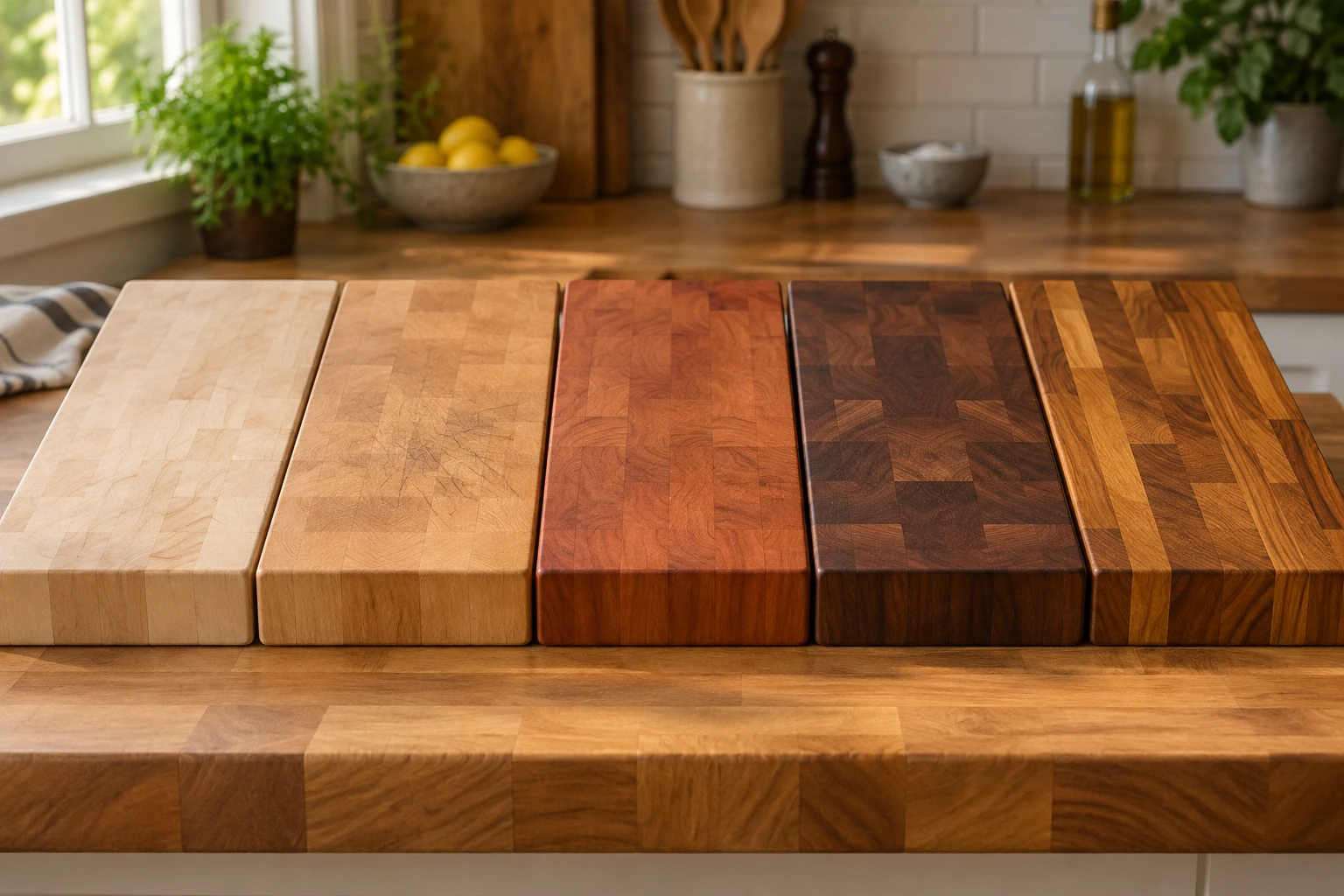

Hard maple is the best wood for a cutting board for most people. It’s tough, closed-grained, food-safe and not too hard on your knife edges. Walnut, cherry, beech and teak round out my top five, and each one wins at something different.
Hardness alone won’t pick your board for you, though. Grain, how the board is glued up, how much humidity it sees and how easily you can dry it all matter just as much. That’s especially true in a cabin, where water’s limited and the air swings from damp to dry through the year.
1. Hard Maple: Best All-Round Durability
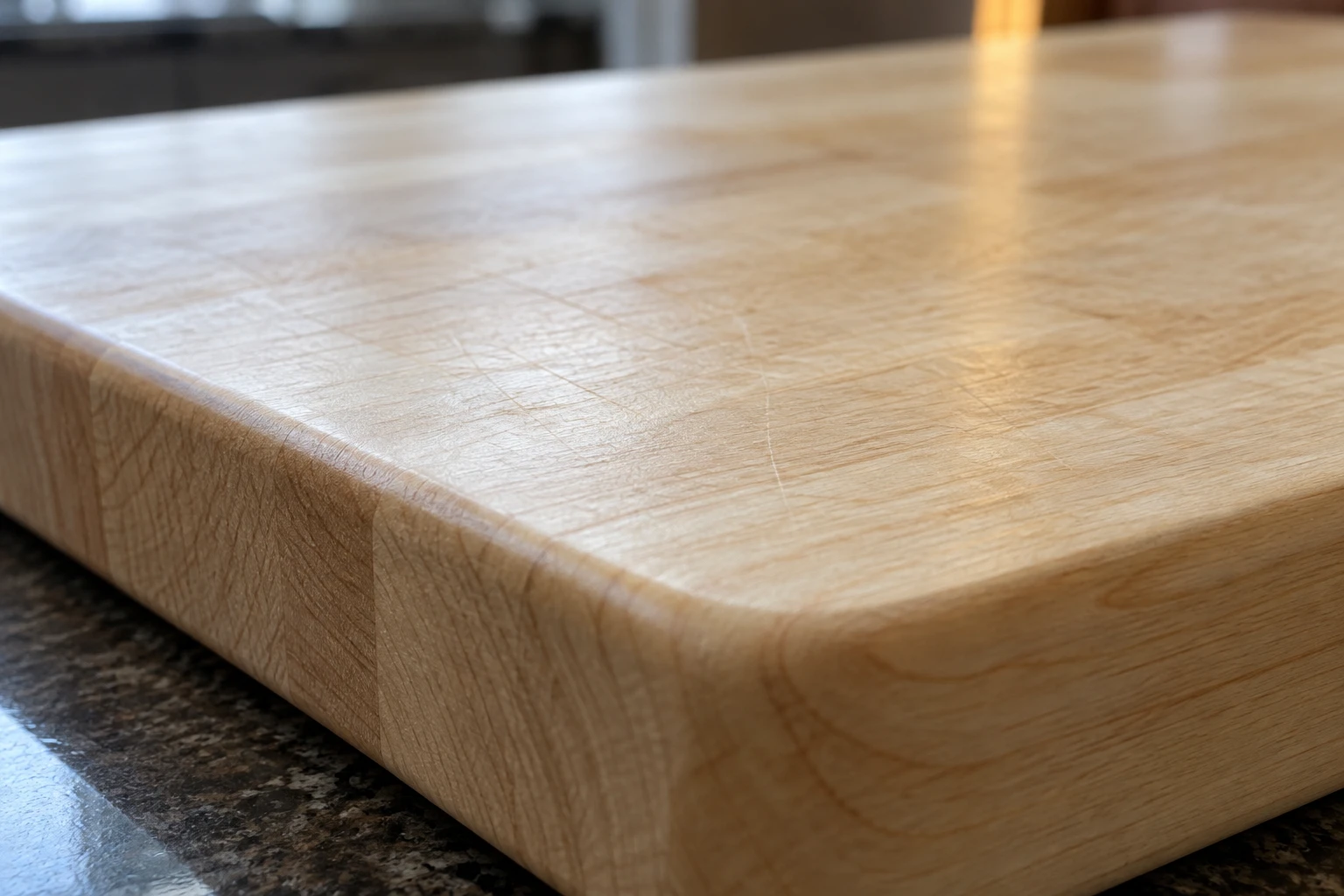
Hard maple (sugar maple) earns the top spot because it balances scratch resistance and knife-friendliness better than anything else that’s easy to buy in the US. It rates about 1,450 lbf on the Janka scale and has a tight, closed grain, so food and water don’t sink in easily.
Most top-rated commercial boards are maple. That includes end-grain butcher blocks that have shown little wear after a year of daily use. It’s a domestic hardwood, so you’ll find it at most lumberyards.
The downside is that maple’s pale color shows stains from beets and berries. If you’re building your own board, buy kiln-dried maple at 6-8% moisture content. Then let it sit in your cabin for a week or two before you glue it up.
2. Black Walnut: Best for Knife Edges and Serving
Walnut is the gentlest of the five on your knives. At about 1,010 lbf, it gives a softer, quieter cut than maple. Its dark chocolate color also hides stains, which is why so many prep-and-serve boards are walnut.
It’s a little more open-grained than maple, so oil it a bit more often. Expect deeper knife marks on an edge-grain walnut board. My advice is to go end grain with walnut, or use it as a contrast strip in a maple board.
Walnut costs more than maple. That’s a fair trade if the board stays on display.
3. Cherry: Best for a Lighter, Easy-to-Work Board
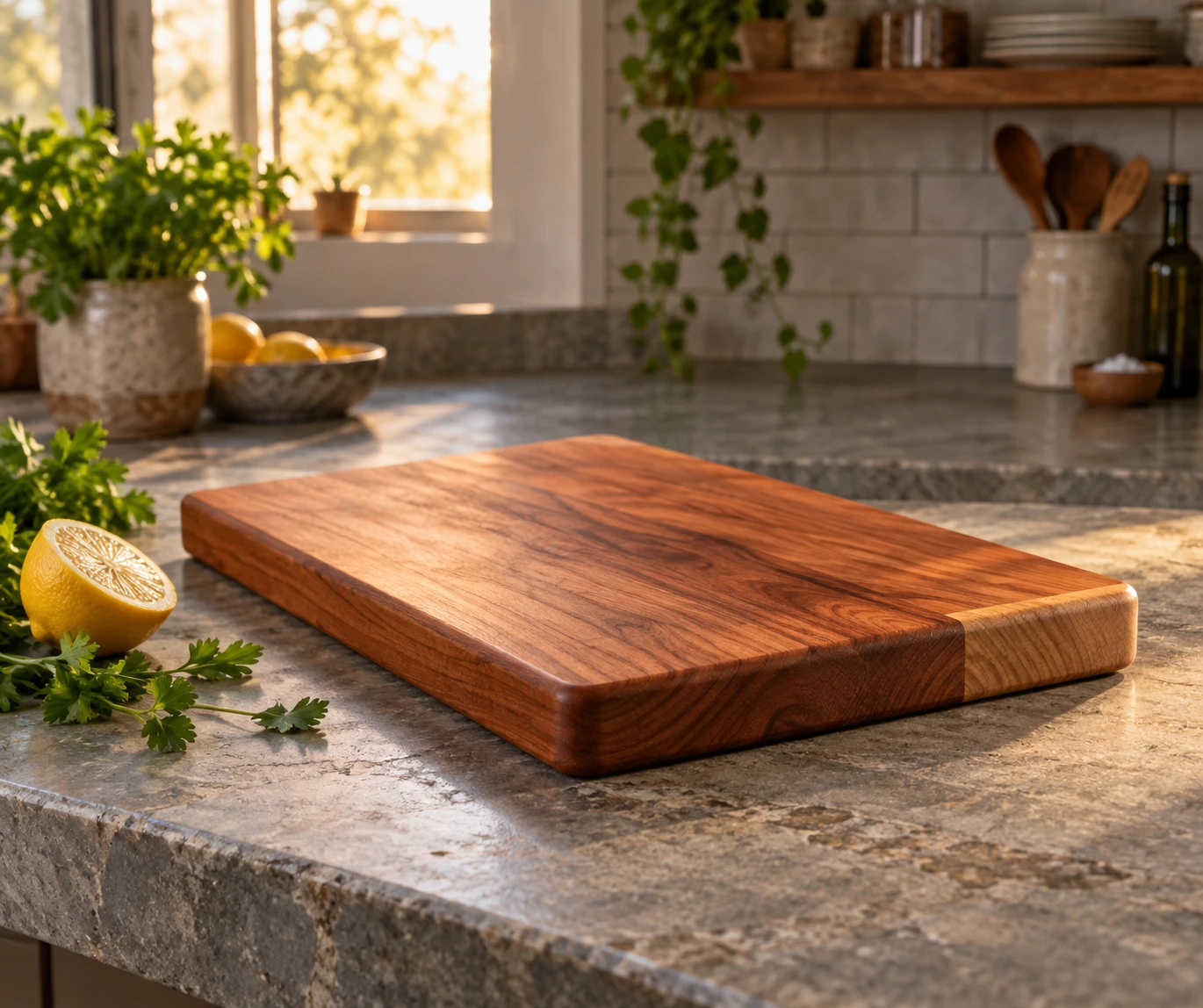
Cherry is about 950 lbf. It’s closed-grained and stable, and it machines and sands cleanly. That makes it a good choice if you’re building your first board with basic shop tools.
It starts pinkish-tan and darkens to a deep reddish brown within months of light exposure. Because it’s softer than maple, it’ll mark sooner. I’d pick it for a bread or cheese board, or a lighter-duty everyday board, rather than a heavy chopping block.
4. Beech: Best Budget Utility Board
Beech, at about 1,300 lbf, is tight-grained and food-safe. It’s long been a standard utility board in Europe. It gives you near-maple hardness at a lower price.
The catch is movement. Beech shrinks and swells more than maple with humidity changes. That makes it a little more prone to cracking and cupping, which counts in a cabin that goes from wet spring to woodstove-dry winter. Keep it oiled, and never leave it standing in water.
5. Teak: Best for Wet, Humid Conditions
Teak’s natural oils make it the most moisture-resistant wood on this list. That matters if your board lives near a wash basin or in a humid shoreline cabin, and it needs less oiling than the others.
The trade-off is your knives. Teak carries a lot of silica, a mineral that’s abrasive on steel, so it dulls edges faster than maple or walnut. Janka figures for “teak” boards also vary widely, from roughly 1,000 to over 3,000 lbf depending on the source and species sold under the name. Buy from a seller who names the species, and plan on honing your knife more often.
| Wood | Janka (lbf, approx.) | Grain | Knife wear | Moisture handling |
|---|---|---|---|---|
| Hard maple | 1,450 | Closed | Low | Good |
| Black walnut | 1,010 | Semi-open | Lowest | Good |
| Cherry | 950 | Closed | Low | Good |
| Beech | 1,300 | Closed | Low | Fair (moves more) |
| Teak | 1,000-3,500 | Oily, silica-rich | High | Excellent |
How to Choose and Care for a Board in a Cabin
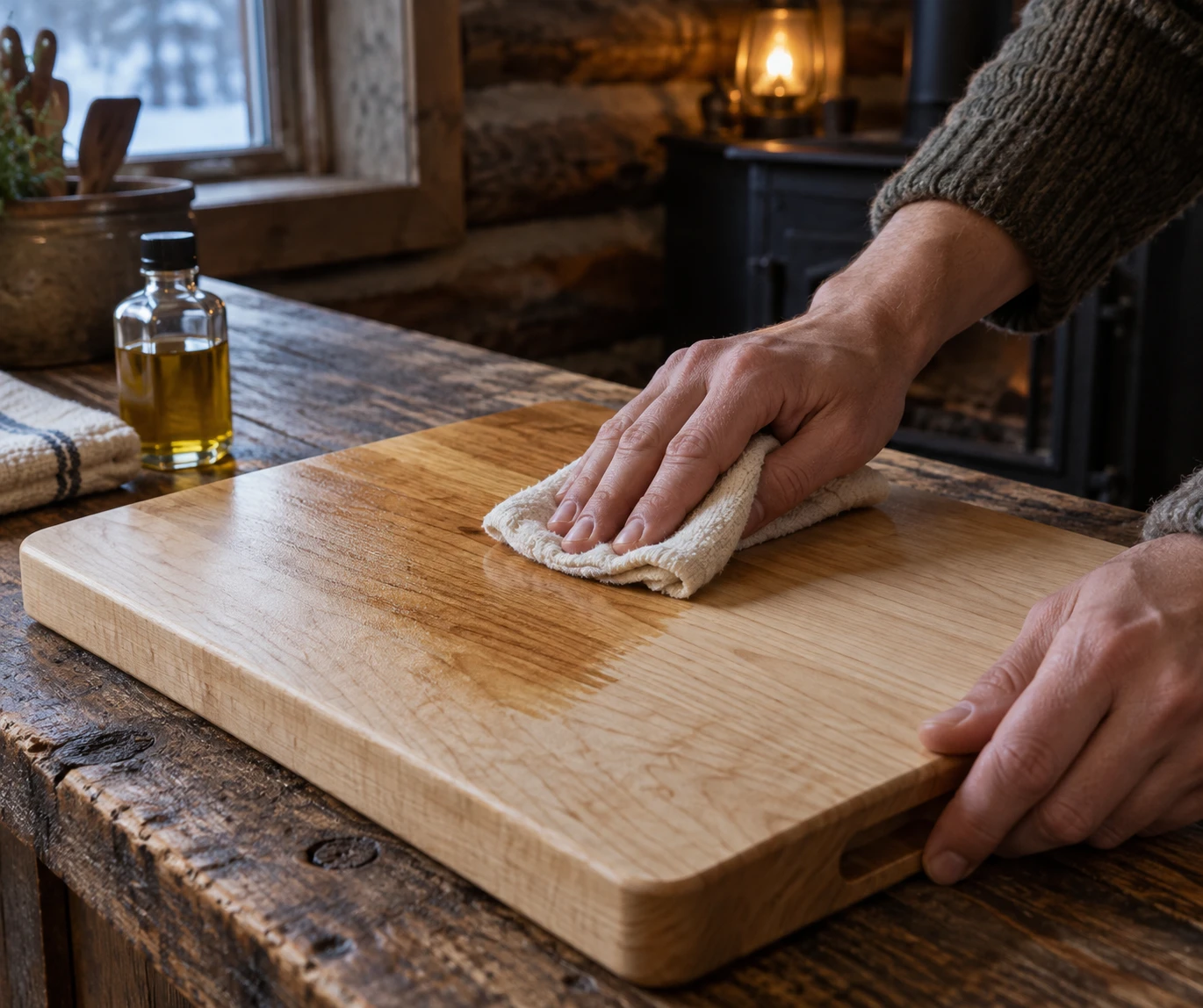
Species is only half the story. A well-built board in a decent wood will outlast a badly built one in the “best” wood.
End Grain vs. Edge Grain
End grain means the board’s surface shows the wood fibers’ ends, like a butcher block. Your knife slips between the fibers, so it dulls less and the marks close up. It costs more and needs more oil. Edge grain is cheaper and lighter, but it scars faster. For a heavy daily board, go end grain.
Wood, Glue and Finish to Avoid
Skip softwoods like pine, fir, spruce and cedar. Also skip any treated, painted or reclaimed lumber with an unknown history, and plywood or MDF. Shop scraps are fine only if you know the species and that they’ve never been treated. Bamboo is a grass, not a wood, and its high silica content makes it rough on knives. Glue up with a waterproof, food-contact-rated glue such as Titebond III. Finish with food-grade mineral oil or an oil-and-wax blend, never olive oil (it goes rancid) or varnish.
Cleaning and Drying with Limited Water
- Scrape off scraps, then wash with a little hot, soapy water.
- Rinse fast and wipe both faces dry.
- Stand the board on edge with air on both sides.
- Oil it monthly, or whenever it looks pale.
Wood is porous, so keep a separate board for raw meat to avoid cross-contamination. Drying both faces evenly is what prevents warping. If you’re planning to build your own, Cabin Lodger has more woodworking project guides from my own cabin build.
Frequently Asked Questions
Are wooden cutting boards antibacterial?
Not on their own. A well-kept, closed-grain board dries fast, which makes life hard for bacteria. Safe use still depends on washing it, drying it fully and using a separate board for raw meat. Replace any board with deep cracks.
What do professional chefs use for cutting boards?
Most chefs use maple end-grain blocks for knife work and color-coded plastic boards for raw proteins. Many health codes call for boards that can be sanitized easily, which is why plastic shows up so much in commercial kitchens.
Is end grain better than edge grain for durability?
Yes, for daily heavy chopping. End grain hides knife marks and is easier on your knife’s edge. It needs more oil and is more sensitive to glue-joint failure if it’s left wet. Edge grain makes sense for lighter use and smaller budgets.
References
- I Tested 23 Wooden Cutting Boards—8 Emerged (Nearly) Unscathed
- What’s the Best Wood for a Cutting Board?
[3]
[4] Best Cutting Boards for Slicing, Dicing, and Chopping (2026)
[5] Best Wood for Cutting Board: Our Pro Guide
[6] What is the best wood for a chopping board? – Betterwood
[7] A Cut Above: Finding the Perfect Wooden Cutting Board
[8] Janka Hardness Scale For Cutting Boards